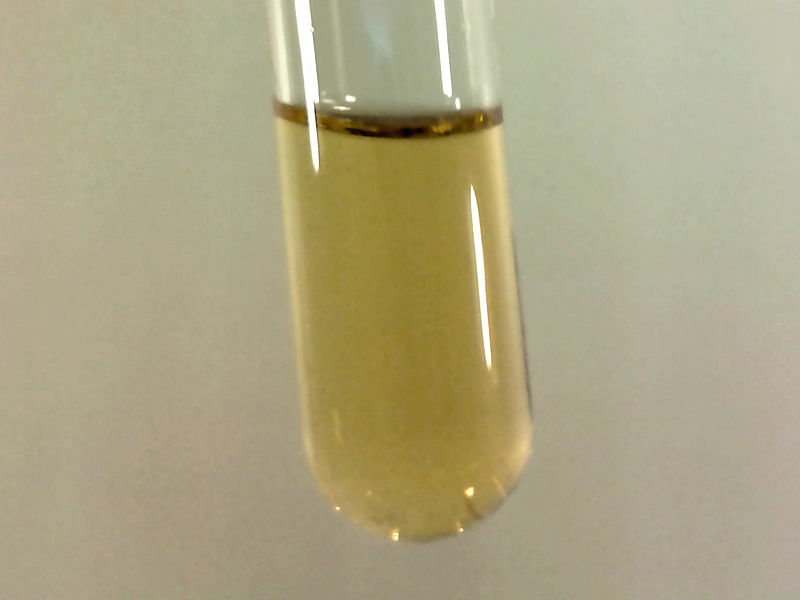
File:Fluoro_liquido_a_-196°C_1.jpg · Wikimedia Commons · See Wikimedia Commons
OverviewAI-generated
Fluorine is a chemical element with the symbol F and atomic number 9. Its mass is 18.998403162, and it has an electron configuration of 1s² 2s² 2p⁵, or [He] 2s² 2p⁵. The element exhibits an oxidation state of -1 and an electronegativity of 3.98. Its ionization energy is 15.7, and its ionic radius is 1.33.
Fluorine was discovered in 1810. It has a melting point of -363 and a boiling point of -307. The vapor pressure is 1. The substance is immediately dangerous to life or health at a level of 38.75. The time-weighted average exposure limit is 0.2. The NIOSH Pocket Guide ID is 0289.
Synthesized by Vinony from 32 facts across 4 sources: Wikidata, PubChem, PubMed, Vinony graph. Generated from structured data (not the Wikipedia text) and checked against those facts — may still contain errors.
Chemical data
- Formula
- F
- Molecular weight
- 18.99840316 g/mol
- IUPAC name
- fluorane
- SMILES
- [F]
- InChIKey
- YCKRFDGAMUMZLT-UHFFFAOYSA-N
- XLogP
- 0.6
- Polar surface area
- 0 Ų
- H-bond donors
- 0
- H-bond acceptors
- 0
- Formal charge
- 0
via PubChem
Research
64,795 papers- Fluorine biocatalysis.ReviewCurrent opinion in chemical biology · 2020Wu L, Maglangit F, Deng HDOI: 10.1016/j.cbpa.2020.01.004
- Drug Discovery Based on Fluorine-Containing Glycomimetics.ReviewMolecules (Basel, Switzerland) · 2023Wei X, Wang P, Liu F et al.DOI: 10.3390/molecules28186641
- Fluorine in psychedelic phenethylamines.ReviewDrug testing and analysis · 2012Trachsel DDOI: 10.1002/dta.413
- Fluorine-Directed Automated Mannoside Assembly.Angewandte Chemie (International ed. in English) · 2023Teschers CS, Gilmour RDOI: 10.1002/anie.202213304
- Fluorine and Fluorinated Motifs in the Design and Application of Bioisosteres for Drug Design.ReviewJournal of medicinal chemistry · 2018Meanwell NADOI: 10.1021/acs.jmedchem.7b01788
- The Role of Fluorine in Glycomimetic Drug Design.ReviewChemistry (Weinheim an der Bergstrasse, Germany) · 2021Hevey RDOI: 10.1002/chem.202003135
- Applications of Fluorine in Medicinal Chemistry.ReviewJournal of medicinal chemistry · 2015Gillis EP, Eastman KJ, Hill MD et al.DOI: 10.1021/acs.jmedchem.5b00258
- Modulating the Efficacy of Carbonic Anhydrase Inhibitors through Fluorine Substitution.ReviewAngewandte Chemie (International ed. in English) · 2021Berrino E, Michelet B, Martin-Mingot A et al.DOI: 10.1002/anie.202103211
via PubMed
Wikidata facts
- Instance of
- lithophile
- Subclass of
- halogens
- Part of
- halogens
- Named after
- hydrofluoric acid
- Followed by
- neon
- Mass
- 18.998403162
- Image
- Liquid fluorine tighter crop.jpg
Show 25 more facts
- immediately dangerous to life or health
- 38.75
- Commons gallery
- Fluorine
- melting point
- -363
- oxidation state
- -1
- element symbol
- F
- Commons category
- Fluorine
- topic's main category
- Category:Fluorine
- electronegativity
- 3.98
- atomic number
- 9
- NIOSH Pocket Guide ID
- 0289
- discoverer or inventor
- André-Marie Ampère
- boiling point
- -307
- vapor pressure
- 1
- ionization energy
- 15.7
- described by source
- Encyclopædia Britannica 11th edition
- time-weighted average exposure limit
- 0.2
- time of discovery or invention
- 1810-00-00
- location of discovery
- France
- Unicode character
- 氟
- different from
- fluorene
- electron configuration
- [He] 2s² 2p⁵
- chemical formula
- F
- ionic radius
- 0.08
- on focus list of Wikimedia project
- Wikipedia:Vital articles/Level/4
- maintained by WikiProject
- WikiProject Elements
via Wikidata · CC0
Article · Italiano
Il fluoro (AFI: /fluˈɔro/) è l'elemento chimico della tavola periodica degli elementi che ha numero atomico 9 e simbolo F. È il primo elemento del gruppo 17 del sistema periodico, facente parte del blocco p. Appartiene al gruppo degli alogeni ed è l'elemento più elettronegativo della tavola periodica; è l'unico elemento in grado di ossidare l'ossigeno. Il termine "fluoro" venne coniato da André-Marie Ampère e Sir Humphry Davy nel 1812 e deriva dai primi usi della fluorite come agente fondente (dalla parola latina fluere). I sali di fluoro si chiamano fluoruri. Il fluoro, a causa della sua elevata reattività, non si trova libero in natura, tranne che in piccole tracce all'interno di fluoriti sottoposte a irraggiamento beta e gamma. Si trova invece combinato con altri elementi e rappresenta circa lo 0,065% in massa della crosta terrestre. In natura, il fluoro si trova comunemente come ione fluoruro F−, in particolare nella fluorite e nella fluorapatite. Come tutti gli alogeni, si trova nel suo stato elementare come molecola biatomica, F2. Il fluoro elementare a temperatura ambiente è un gas di colore giallo pallido, poco più pesante dell'aria, tossico, estremamente aggressivo e di odore penetrante. Il fluoro ha un unico isotopo naturale, il 19F. Artificialmente sono stati sintetizzati altri isotopi radioattivi con numeri di massa compresi tra 17 e 22, con emivite che vanno dai 4 s per il 22F ai 110 minuti per il 18F. Più recentemente, in una pubblicazione del 31 luglio 2020, sono state descritte le proprietà dei nuclei di 29F, che, data l'inusuale abbondanza di neutroni al proprio interno, mostrano proprietà non comuni, in particolare sembra che questi nuclei atomici presentino un alone di materia con densità minore di quella del core centrale più compatto.
Abstract from DBpedia / Wikipedia · CC BY-SA
Gallery (33)
Available in 172 languages
- Español
- Français
- Deutsch
- 中文
- 日本語
- Русский
- Português
- Italiano
- العربية
- हिन्दी
- abstract
- Afrikaans
- Albanian
- Amharic
- Angika
- Aragonese
- Armenian
- Asturian
Show 153 more
- Awadhi
- Azerbaijani
- Bahasa Indonesia
- Balinese
- Bangla
- Bashkir
- Basque
- be_x_old
- Belarusian
- Bhojpuri
- Bikol
- blk
- Bosnian
- Breton
- Bulgarian
- Burmese
- Catalan
- cdo
- Cebuano
- Central Kurdish
- Cherokee
- Chuvash
- Cornish
- Corsican
- Croatian
- Czech
- Danish
- Egyptian Arabic
- Erzya
- Esperanto
- Estonian
- Extremaduran
- Faroese
- Fiji Hindi
- Filipino
- Finnish
- Friulian
- Galician
- Gan Chinese
- Ganda
- Georgian
- Greek
- Gujarati
- Haitian Creole
- Hakka Chinese
- Hawaiian
- Hebrew
- Hungarian
- hyw
- Icelandic
- Ido
- Inari Sami
- Interlingua
- Irish
- Javanese
- Kalmyk
- Kannada
- Kazakh
- kbp
- Komi
- Kurdish
- Kyrgyz
- Lao
- Latin
- Latvian
- Ligurian
- Limburgish
- Lingala
- Lithuanian
- Lojban
- Lombard
- Low German
- Luxembourgish
- Macedonian
- Malay
- Malayalam
- Manipuri
- Manx
- Māori
- Marathi
- Mongolian
- Moroccan Arabic
- Nederlands
- Nepali
- Newari
- Northern Frisian
- Norwegian
- Norwegian Nynorsk
- Novial
- Occitan
- Odia
- olo
- Oromo
- Ossetic
- Papiamento
- Pashto
- Piedmontese
- Polski
- Punjabi
- Quechua
- roa_rup
- Romanian
- Sanskrit
- Santali
- Saterland Frisian
- Scots
- Scottish Gaelic
- Serbian
- Serbian (Latin)
- Shona
- Sicilian
- Silesian
- simple
- Sindhi
- Sinhala
- Slovak
- Slovenian
- Somali
- Standard Moroccan Tamazight
- Sundanese
- Svenska
- Swahili
- Tajik
- Tamil
- Tatar
- Telugu
- Tibetan
- Tiếng Việt
- Toki Pona
- Tumbuka
- Türkçe
- Ukrainian
- Urdu
- Uyghur
- Uzbek
- Veps
- Volapük
- Walloon
- Waray
- Welsh
- Western Frisian
- Western Mari
- Western Panjabi
- Wu Chinese
- Yiddish
- Yoruba
- zh_classical
- zh_min_nan
- zh_yue
- Zulu
- فارسی
- ไทย
- 한국어
via Wikidata sitelinks · CC0