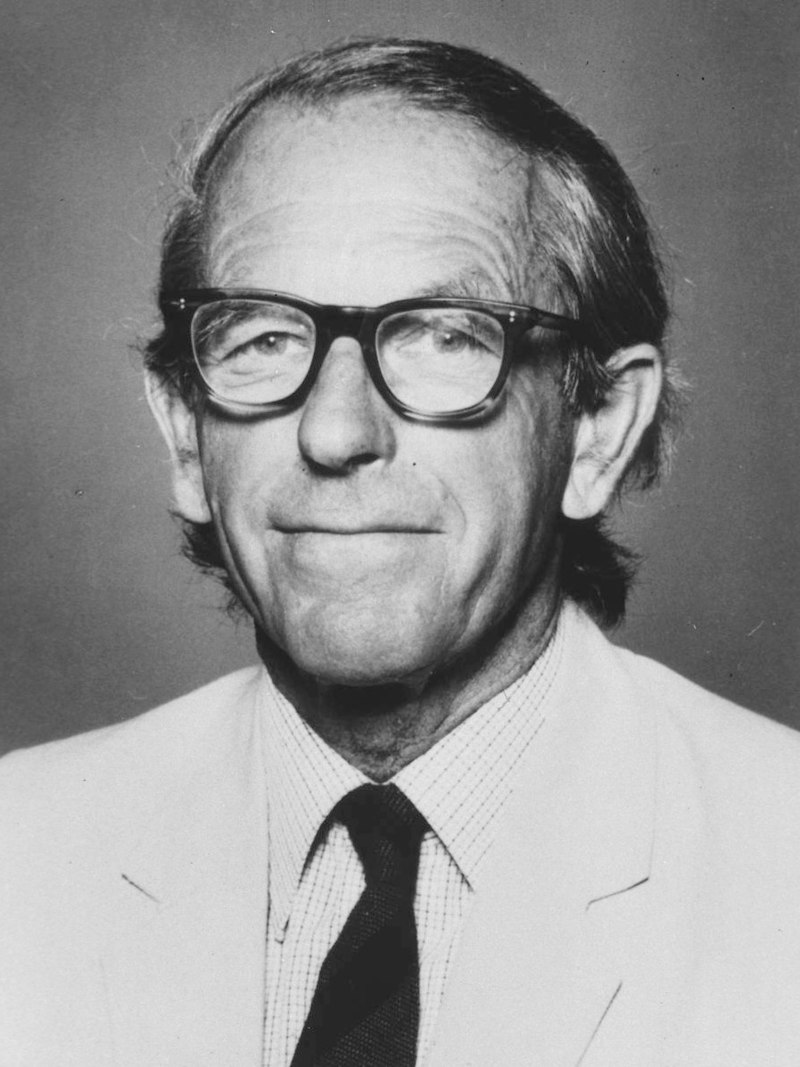
File:Frederick_Sanger2.jpg · Wikimedia Commons · See Wikimedia Commons
Frederick Sanger
Sign in to saveBritish biochemist (1918–2013)
OverviewAI-generated
Frederick Sanger was born on 13 August 1918 and died on 19 November 2013. He was the father of three children.
Sanger received the Nobel Prize twice. His work is recognized in several collections, including the Royal Society collection, the Nobel Laureates collection, the Nobel Chemistry collection, the American Academy Arts Sciences collection, and the Copley Medal collection.
Synthesized by Vinony from 10 facts across 3 sources: Wikidata, Nobel Prize, Vinony collections. Generated from structured data (not the Wikipedia text) and checked against those facts — may still contain errors.
Nobel Prizes (2)
- The Nobel Prize in Chemistry1958
“for his work on the structure of proteins, especially that of insulin”
- The Nobel Prize in Chemistry1980
“for their contributions concerning the determination of base sequences in nucleic acids”
Shared · 1/4 portion
Wikidata facts
- Instance of
- human
- Given name
- Frederick
- Family name
- Sanger
- Gender
- male
- Citizenship
- United Kingdom of Great Britain and Ireland
- Place of birth
- Rendcomb
- Place of death
- Cambridge
- Occupation
- conscientious objector
- Employer
- University of Cambridge
- Languages spoken
- English language
- Religion
- agnostic atheism
- Academic degree
- honorary doctorate
- Doctoral student
- Elizabeth Blackburn
- Field of work
- biochemistry
- Image
- Frederick Sanger2.jpg
- Number of children
- 3
Show 8 more facts
- Commons category
- Frederick Sanger
- date of birth
- 1918-08-13
- date of death
- 2013-11-19
- nominated for
- Nobel Prize in Physiology or Medicine
- student
- Elizabeth Blackburn
- name in native language
- Frederick Sanger
- on focus list of Wikimedia project
- Wikipedia:Vital articles/Level/4
- interested in
- biochemistry
Sources (8)
via Wikidata · CC0
~20 min read
Encyclopedic overview
Frederick Sanger (/ˈsæŋər/; 13 August 1918 – 19 November 2013) was a British biochemist who received the Nobel Prize in Chemistry twice.
He won the 1958 Chemistry Prize for determining the amino acid sequence of insulin and numerous other proteins, demonstrating in the process that each had a unique, definite structure; this was a foundational discovery for the central dogma of molecular biology.
Excerpted from Wikipedia’s “Frederick Sanger” article, available under the CC BY-SA 4.0 licence.
Gallery (4)
Available in 85 languages
- Español
- Français
- Deutsch
- 中文
- 日本語
- Русский
- Português
- Italiano
- العربية
- हिन्दी
- Afrikaans
- Armenian
- Asturian
- azb
- Azerbaijani
- Bahasa Indonesia
- Bangla
- Basque
Show 66 more
- Belarusian
- Bosnian
- Bulgarian
- Catalan
- Croatian
- Czech
- Danish
- Egyptian Arabic
- Esperanto
- Finnish
- Galician
- Georgian
- Greek
- Gujarati
- Hakka Chinese
- Hebrew
- Hungarian
- Ido
- Interlingua
- Irish
- Kyrgyz
- Latin
- Latvian
- Lithuanian
- Low German
- Luxembourgish
- Malagasy
- Malay
- Malayalam
- Mazanderani
- Mingrelian
- Nederlands
- Norwegian
- Occitan
- Polski
- Punjabi
- Quechua
- Romanian
- Rusyn
- Scottish Gaelic
- Serbian
- Serbian (Latin)
- simple
- Slovak
- Slovenian
- Svenska
- Swahili
- Tamil
- Tatar
- Telugu
- Tiếng Việt
- Türkçe
- Ukrainian
- Urdu
- Uzbek
- Volapük
- Waray
- Welsh
- Western Panjabi
- Wu Chinese
- Yoruba
- zh_min_nan
- zh_yue
- فارسی
- ไทย
- 한국어
via Wikidata sitelinks · CC0