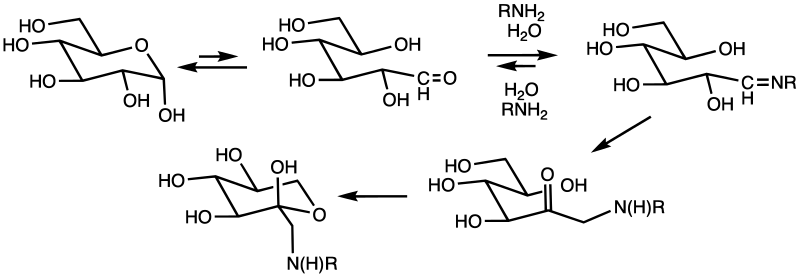
File:GlycationViaAmadoriRgmt.svg · Wikimedia Commons · See Wikimedia Commons
glycated haemoglobin
Sign in to saveAlso known as HGBA1C, HbA1c, A1C, Hb1c, A1c, haemoglobin A1c
form of haemoglobin chemically linked to a sugar
Key facts
- Medlineplus
- 003640
- Loinc
- 41995-2
via Wikipedia infobox
Research
62,072 papers- Glycated haemoglobin variability and risk of renal function decline in type 2 diabetes mellitus: An updated systematic review and meta-analysis.Diabetes, obesity & metabolism · 2024
- Glycated Haemoglobin Levels and Its Effect on Outcomes in Cardiac Surgery.Brazilian journal of cardiovascular surgery · 2022
- Glycaemic variability. What glycated haemoglobin hides.Revista clinica espanola · 2021
- Glycated haemoglobin analysis.Annals of clinical biochemistry · 1997
- Glycated haemoglobin in the year 2000.Journal of clinical pathology · 2000
via PubMed
Wikidata facts
- Subclass of
- medical test
- Has part
- hemoglobin
Show 1 more fact
- Commons category
- Glycated hemoglobin
Sources (2)
via Wikidata · CC0
~20 min read
Encyclopedic overview
Glycated hemoglobin, also called glycohemoglobin, is a form of hemoglobin (Hb) that is chemically linked to a sugar. Most monosaccharides, including glucose, galactose, and fructose, spontaneously (that is, non-enzymatically) bond with hemoglobin when they are present in the bloodstream. However, glucose is only 21% as likely to do so as galactose and 13% as likely to do so as fructose, which may explain why glucose is used as the primary metabolic fuel in humans.
The formation of excess sugar-hemoglobin linkages indicates the presence of excessive sugar in the bloodstream and is an indicator of diabetes or other hormone diseases in high concentration (HbA1c > 6.4%). A1c is of particular interest because it is easy to detect. The process by which sugars attach to hemoglobin is called glycation and the reference system is based on HbA1c, defined as beta-N-1-deoxy fructosyl hemoglobin as a component.
Excerpted from Wikipedia’s “glycated haemoglobin” article, available under the CC BY-SA 4.0 licence.