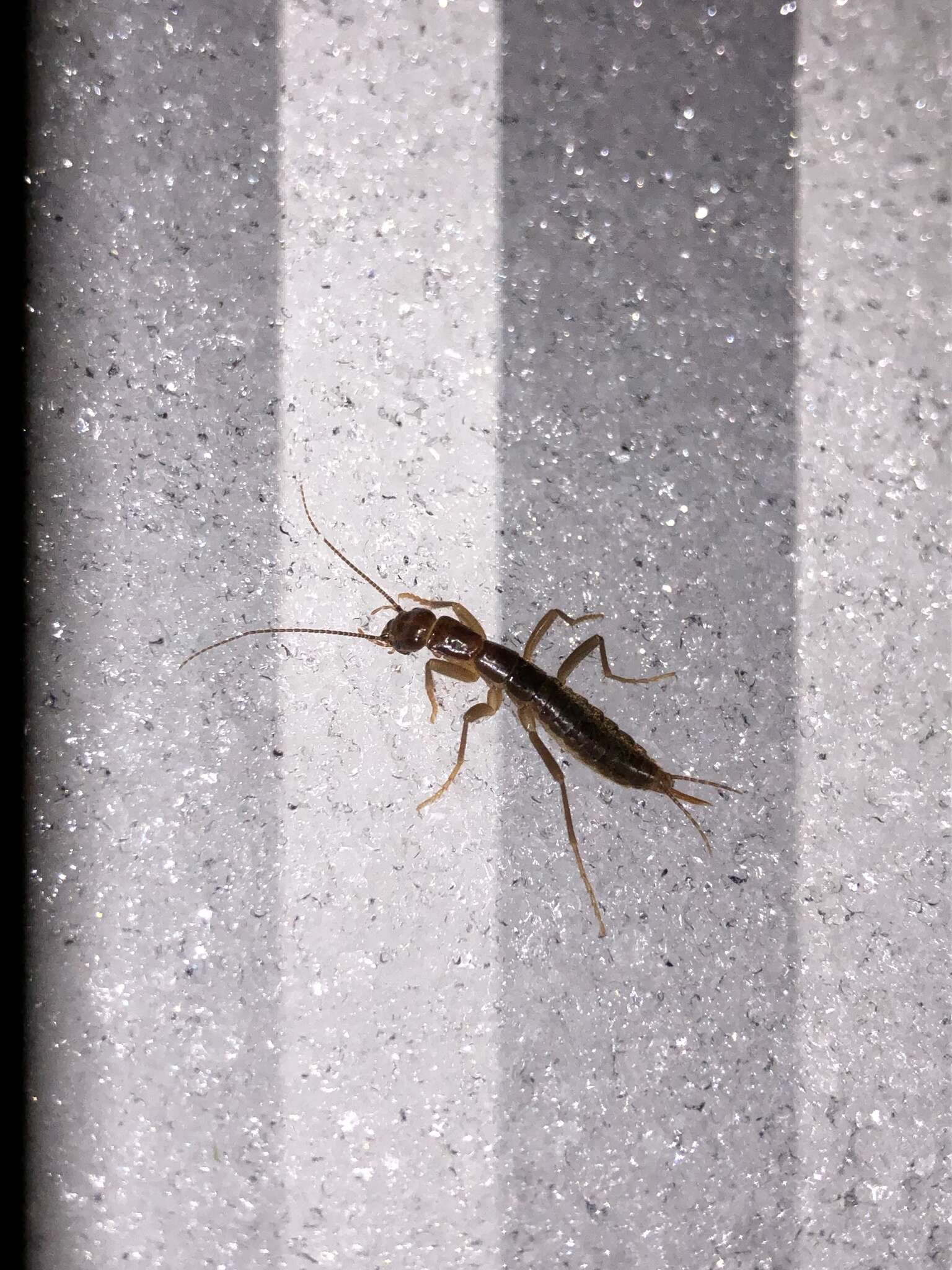
Encyclopedia of Life · EOL (see source)
Grylloblattidae
Sign in to saveGrylloblattidae, commonly known as the icebugs or ice crawlers, is a family of extremophile (psychrophile) and wingless insects that live in the cold on top of mountains and the edges of glaciers. They are the only living members of Grylloblattodea, which is generally considered an order. Alternatively, Grylloblattodea, along with Mantophasmatodea (rock crawlers), have been ranked as suborders of the order Notoptera. Grylloblattids are wingless insects mostly less than 3 cm long, with a head resembling that of a cockroach, with long antennae and having elongated cerci arising from the tip
Species
FAMILY
- KingdomAnimalia
- PhylumArthropoda
- ClassInsecta
- OrderGrylloblattodea
- FamilyGrylloblattidae
Les Grylloblattidae constituent l'unique famille du sous-ordre des Grylloblattodea, un groupe qui comprend des insectes extrêmophiles (psychrophiles), sans ailes, qui vivent dans le froid en haute altitude. Ils appartiennent, avec les Mantophasmatidae, à l'ordre des notoptères[1]. Sommaire 1 La découverte 2 Description et habitat 3 Classification 4 Références 5 Liens externes La découverte Croquis de Grylloblatta campodeiformis par Walker. Les grylloblattidés ont été une véritable surprise pour les scientifiques E. M Walker et T.B Kurata lors de leur découverte en 1914. Les premiers spécimens, deux femelles, ont été récoltés sur le mont Sulphur, à Banff, en Alberta. Elles avaient été retrouvées sous des pierres dans une pente, à plus de 2 000 mètres d'altitude. À en juger par leur taille et par l'apparence de leur abdomen, elles étaient probablement matures. Lors de la découverte, Walker et T.B Kurata cherchèrent d'autres spécimens mais en vain[2]. Ces insectes ont été très difficiles à classer car avec leurs caractéristiques générales, ils ne pouvaient être placés dans aucune des familles existantes. En dépit de l'absence d'ailes, l'examen des pièces buccales, des sclérites cervic
via GBIF
Museum specimens
- Specimen records
- 26
- With media
- 1
- Family
- Grylloblattidae
- Collections
- NMMNHS, LACM, EMEC, CASC, MSUC
- Recorded in
- United States, Canada
Wikidata facts
- Instance of
- taxon
- Image
- Galloisiana nipponensis 2.jpg
Show 4 more facts
- taxon name
- Grylloblattidae
- taxon rank
- family
- topic's main category
- Category:Grylloblattidae
- Commons category
- Grylloblattidae
Sources (1)
via Wikidata · CC0
~7 min read
Encyclopedic overview
7 sectionsContents
- Overview
- Habitat and distribution
- Diet
- Evolution
- Taxonomy
- References
- External links
Grylloblattidae, commonly known as the icebugs or ice crawlers, is a family of extremophile (psychrophile) and wingless insects that live in the cold on top of mountains and the edges of glaciers. They are the only living members of Grylloblattodea, which is generally considered an order. Alternatively, Grylloblattodea, along with Mantophasmatodea (rock crawlers), have been ranked as suborders of the order Notoptera. Grylloblattids are wingless insects mostly less than 3 cm long, with a head resembling that of a cockroach, with long antennae and having elongated cerci arising from the tip of their abdomen. They cannot tolerate warmth—most species will die at —and many species have small distribution ranges.
==Overview== Grylloblattids, ice crawlers or icebugs puzzled the scientists who discovered them in 1914, E.M. Walker and T.B. Kurata; the first species named was Grylloblatta campodeiformis, which means "cricket-cockroach shaped like a Campodea" (a kind of two-pronged bristletail). Most are nocturnal and appear to feed on detritus. They have long antennae (23–45 segments) and long cerci (5–8 segments), but no wings. Their eyes are either missing or reduced and they have no ocelli (simple eyes). Their closest living relatives are the recently discovered Mantophasmatodea. Most species are less than 3 cm long, the largest being Namkungia magnus.
Excerpted from Wikipedia’s “Grylloblattidae” article, available under the CC BY-SA 4.0 licence.