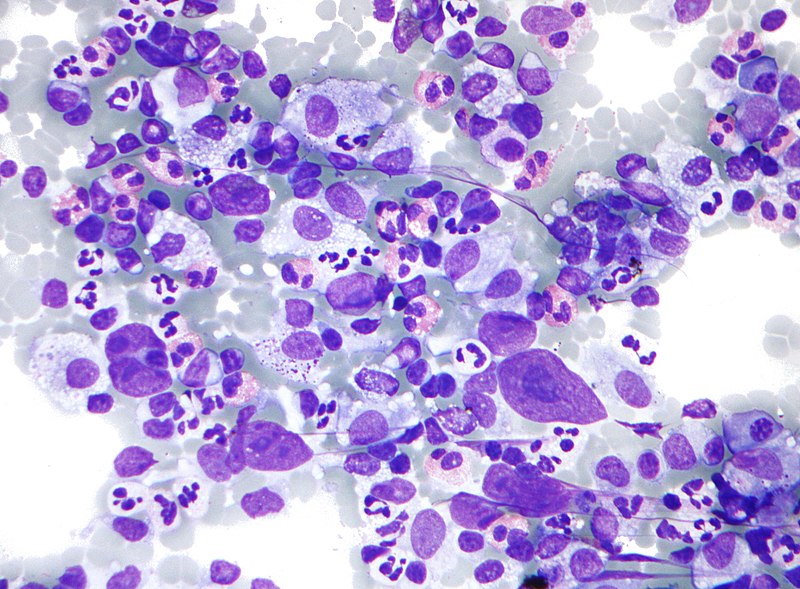
Hodgkin lymphoma
Also known as HL, Hodgkin disease, Hodgkin's sarcoma, Hodgkins lymphoma, stage I Subdiaphragmatic Hodgkin Lymphoma, stage II Subdiaphragmatic Hodgkin Lymphoma, Hodgkin's lymphoma; HL, Hodgkin's disease
lymphoma that is marked classically by the presence of Reed-Sternberg cells
AI overview
Hodgkin lymphoma is a type of cancer that affects the lymph nodes and lymphatic system, and doctors identify it by finding distinctive cells called Reed-Sternberg cells under a microscope. It matters because it's one of the most treatable forms of lymphoma, especially when caught early, making accurate diagnosis and prompt treatment important for patient outcomes.
AI-generated from the Wikipedia summary — may contain errors.
Research
102,335 papers- Diagnosis of Hodgkin lymphoma in the modern era.ReviewBritish journal of haematology · 2019Wang HW, Balakrishna JP, Pittaluga S et al.DOI: 10.1111/bjh.15614
- Classic Hodgkin lymphoma.ReviewHematological oncology · 2024Kahn J, Dabaja B, Wu S et al.DOI: 10.1002/hon.3239
- [Hodgkin lymphoma].Review[Rinsho ketsueki] The Japanese journal of clinical hematology · 2019Nishikori MDOI: 10.11406/rinketsu.60.447
- Advances in Hodgkin lymphoma research.ReviewTrends in molecular medicine · 2025Küppers R
Article
Hodgkin lymphoma (HL) is a cancer where multinucleated Reed–Sternberg cells (RS cells) are present in the lymph nodes. As it affects a subgroup of white blood cells called lymphocytes, it is a lymphoma. The condition was named after the English physician Thomas Hodgkin, who first described it in 1832. Symptoms may include fever, night sweats, and weight loss. Often, non-painful enlarged lymph nodes occur in the neck, under the arm, or in the groin. People affected may feel tired or be itchy.
The two major types of Hodgkin lymphoma are classical Hodgkin lymphoma and nodular lymphocyte-predominant Hodgkin lymphoma. About half of cases of Hodgkin lymphoma are due to Epstein–Barr virus (EBV) and these are generally the classic form. Other risk factors include a family history of the condition and having HIV/AIDS. Diagnosis is conducted by confirming the presence of cancer and identifying Reed–Sternberg cells in lymph node biopsies. The virus-positive cases are classified as a form of the Epstein–Barr virus-associated lymphoproliferative diseases.