Encyclopedia of Life · EOL (see source)
Kerodon
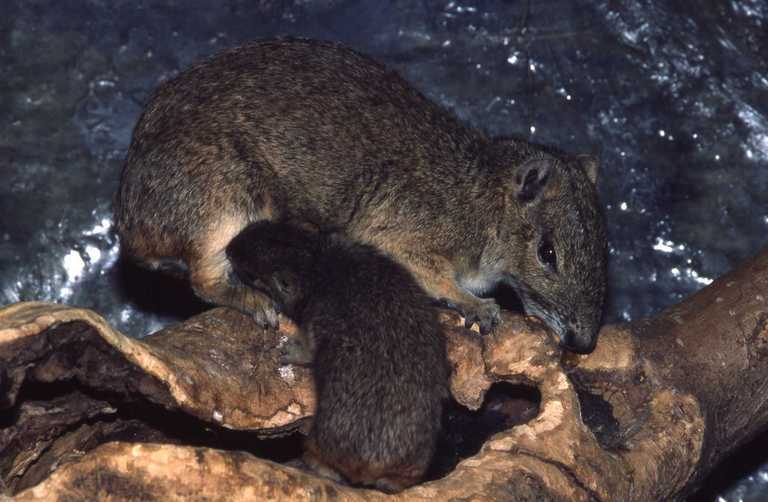
Sign in to saveThe genus Kerodon (vernacular name mocos; rock cavies) contains two species of South American cavies, the rock cavy and the acrobatic cavy. They are found in the semiarid regions of northeast Brazil known as the Caatinga. This area has a rocky terrain with large granite boulders that contain rifts and hollows where Kerodon species primarily live. They are related to capybaras and guinea pigs.
Species
GENUS
- KingdomAnimalia
- PhylumChordata
- ClassMammalia
- OrderRodentia
- FamilyCaviidae
岩豚鼠屬(学名:Kerodon)是水豚亞科下的一個屬,其下生物是生活在南美洲的齧齒動物,與水豚屬生物有親緣關係。[1] 它們主要生活在巖石嶙峋的峭壁上和洞穴中,也因此得名。[2] 目录 1 特徵 2 習性 3 分類 4 參考文獻 特徵 他們的體型相對水豚要小得多,外形與兔子肖似、腳掌厚實。成年的岩豚鼠體長20~40厘米(7.9~15.7英寸),重約1公斤(2.2英磅)。[3] 主要以樹葉、樹皮、種子和草為食。[4] 其懷孕期約76天,每年產胎1至3只,幼體在33天之內就會斷奶。133天後達到性成熟。[5] 習性 與近親水豚屬相同,岩豚鼠屬的生物高度社會化,[6] 族群中以雌性居多,雄性處於領導地位,且等級分明。通過不斷發出聲進行交流,因而這個群體顯得十分喧鬧。[7] 雄性會佔領一個或者數個岩地作為自己的領土,在傍晚時候開始活躍。[8] 分類 岩豚鼠屬曾被認為是水豚科(Hydrochoeridae)的生物,和豚鼠分在一起。後來的種系發生研究顯示其關係與水豚更為接近,因此又被劃分到了豚鼠科中。[6] Woods 和 Kilpatrick(2005)將其分在水豚亞科下,認為其在中新世中期從水豚中分化出來獨自進化。[9] 參考文獻 ^ Woods, C. A.; Kilpatrick, C. W. Infraorder Hystricognathi. (编) Wilson, D. E.; Reeder, D. M. Mammal Species of the World 3rd. Johns Hopkins University Press. 2005: 1538–1600. ISBN 978-0-8018-8221-0. OCLC 62265494. ^ White, Alex. Kerodon rupestris. Animal Diversity Web. [30 September 2013]. ^ Rock Cavy. Central Park Zoo. [30 September 2013]. ^ White, Alex. Kerodon rupestris. Animal Diversity Web. [30 September 2013]. ^ Cavies and Maras: Caviidae - Rock Cavy (kerodon Rupestris): Species Accounts. Net Industries. [30 September 2013]. ^ 6.0 6.1 Rowe, D. L. and R. L. Honeycutt. 2002. Phylogenetic relationships, ecological correlates, and molecular evolution within the Cavioid
via GBIF
Museum specimens
- Specimen records
- 13
- Family
- Caviidae
- Collections
- RBINS-SCIENTIFIC HERITAGE, UCLA, NHMUK
- Recorded in
- Argentina, Brazil, Bolivia
Wikidata facts
- Instance of
- taxon
- Parent taxon
- Hydrochoerinae
- Image
- Kerodon rupestris.jpg
Show 4 more facts
- Commons category
- Kerodon
- taxon name
- Kerodon
- taxon rank
- genus
- topic's main category
- Category:Kerodon
Sources (1)
via Wikidata · CC0
~2 min read
Encyclopedic overview
6 sectionsContents
- Characteristics
- Behavior
- Classification
- Species
- References
- Further reading
The genus Kerodon (vernacular name mocos; rock cavies) contains two species of South American cavies, the rock cavy and the acrobatic cavy. They are found in the semiarid regions of northeast Brazil known as the Caatinga. This area has a rocky terrain with large granite boulders that contain rifts and hollows where Kerodon species primarily live. They are related to capybaras and guinea pigs.
==Characteristics== They are hystricomorph rodents, medium-sized, with bodies, a face, and heavily padded feet. Their nails are blunt on all digits except a small grooming claw on the outermost digit of the foot. Fully grown adults weigh around 1000 g or 31–35 oz, and range in length from 200 to 400 mm or 7.5 to 16 in. They forage for mostly leaves, grasses, seeds, and tree bark. They breed year round, usually having one to three litters per year and one to three young per pregnancy. Gestation last around 76 days and the young are weaned from the mother within 33 days. They reach sexual maturity at 133 days.
Excerpted from Wikipedia’s “Kerodon” article, available under the CC BY-SA 4.0 licence.