Encyclopedia of Life · EOL (see source)
Hydrochoerinae
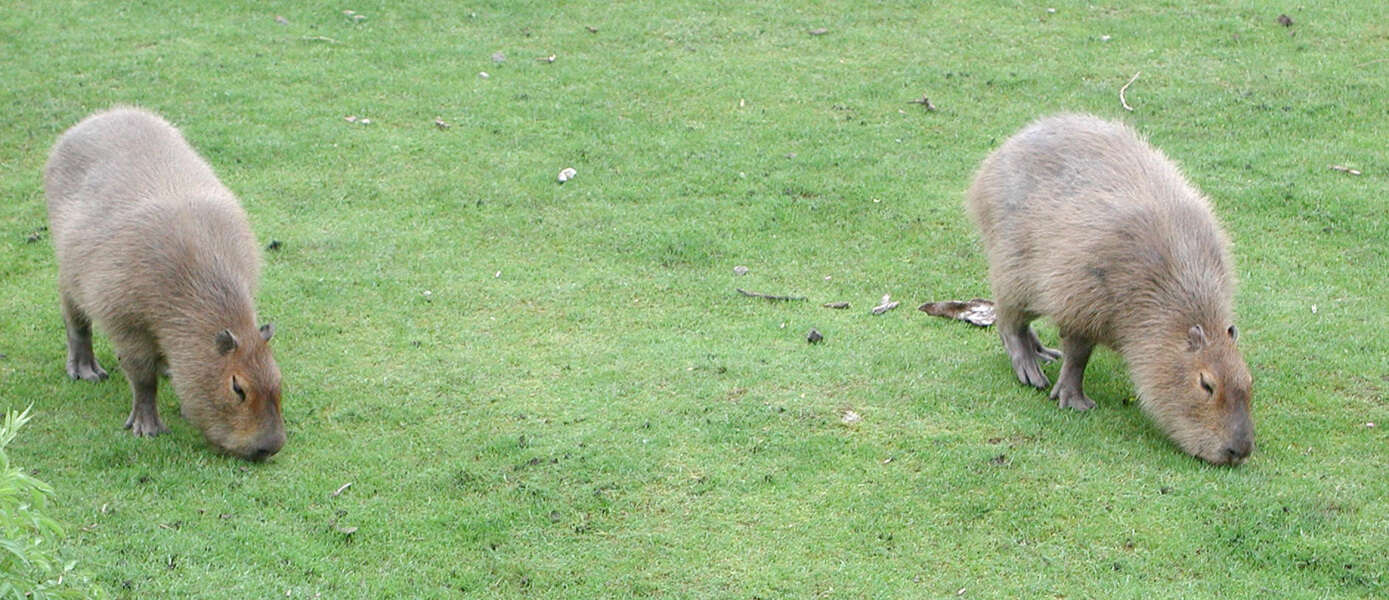
Sign in to saveHydrochoerinae (from Ancient Greek ὕδωρ (húdor), meaning "water", and χοίρος (khoíros), meaning "pig") is a subfamily of Caviidae, consisting of two living genera, Hydrochoerus, the capybaras, and Kerodon, the rock cavies. In addition, a number of extinct genera related to capybaras should also be placed in this subfamily. The taxonomy of Hydrochoerinae is confused because, until 2005, living capybaras and their extinct relatives were placed in their own family, Hydrochoeridae. Recent molecular phylogenetic studies recognize a close relationship between Hydrochoerus and Kerodon, supporting pla
Species
Les Hydrochoerinae sont une sous-famille de Rongeurs qui rassemble des Hystricognathes de la famille des Cavidés : les hydrochères (ou cabiaïs) et les cobayes des rochers. Cette sous-famille a été décrite pour la première fois en 1825 par le zoologiste britannique John Edward Gray (1800-1875). Sommaire 1 Systématique 1.1 Liste des genres 1.2 Liste des espèces 2 Notes et références 3 Liens externes Systématique Selon les auteurs, le genre Hydrochoerus est parfois classé dans une famille monotypique (Hydrochaeridae Gray, 1825) au lieu d'être inclus dans celle des Caviidae[2]. Liste des genres Selon ITIS (24 janv. 2013)[1] : genre Hydrochoerus Brisson, 1762 ou Hydrochoeris selon MSW[3] - les cabiaïs genre Kerodon F. Cuvier, 1825 - les cobayes des rochers Liste des espèces Selon Mammal Species of the World (version 3, 2005) (24 janv. 2013)[3] : genre Hydrochoeris Brisson, 1762 - les cabiaïs ou hydrochères Hydrochoeris hydrochaeris - le Capybara Hydrochoeris isthmius - le Cabiaï de Panama genre Kerodon F. Cuvier, 1825 - les cobayes des rochers Kerodon acrobata Kerodon rupestris - le Cobaye des rochers Notes et références ↑ a et b Integrated Taxonomic Information System (ITIS), www.itis.
via
Wikidata facts
Show 4 more facts
- taxon name
- Hydrochoerinae
- taxon rank
- subfamily
- Commons category
- Hydrochoerinae
- temporal range start
- Late Miocene
Sources (1)
via Wikidata · CC0
~1 min read
Encyclopedic overview
1 sectionsContents
- References
Hydrochoerinae (from Ancient Greek ὕδωρ (húdor), meaning "water", and χοίρος (khoíros), meaning "pig") is a subfamily of Caviidae, consisting of two living genera, Hydrochoerus, the capybaras, and Kerodon, the rock cavies. In addition, a number of extinct genera related to capybaras should also be placed in this subfamily. The taxonomy of Hydrochoerinae is confused because, until 2005, living capybaras and their extinct relatives were placed in their own family, Hydrochoeridae. Recent molecular phylogenetic studies recognize a close relationship between Hydrochoerus and Kerodon, supporting placement of both genera in a subfamily of Caviidae. Paleontological classifications have yet to incorporate this new taxonomy, and continue to use Hydrochoeridae for all capybaras, while using Hydrochoerinae for the living genus and its closest fossil relatives such as Neochoerus. The taxonomy of fossil hydrochoerines is also in a state of flux. In recent years, the diversity of fossil hydrochoerines has been substantially reduced. This is largely due to the recognition that capybara molar teeth show strong variation in shape over the life of an individual. In one instance, material once referred to four genera and seven species on the basis of differences in molar shape is now thought to represent differently aged individuals of a single species, Cardiatherium paranense.
==References==
Excerpted from Wikipedia’s “Hydrochoerinae” article, available under the CC BY-SA 4.0 licence.