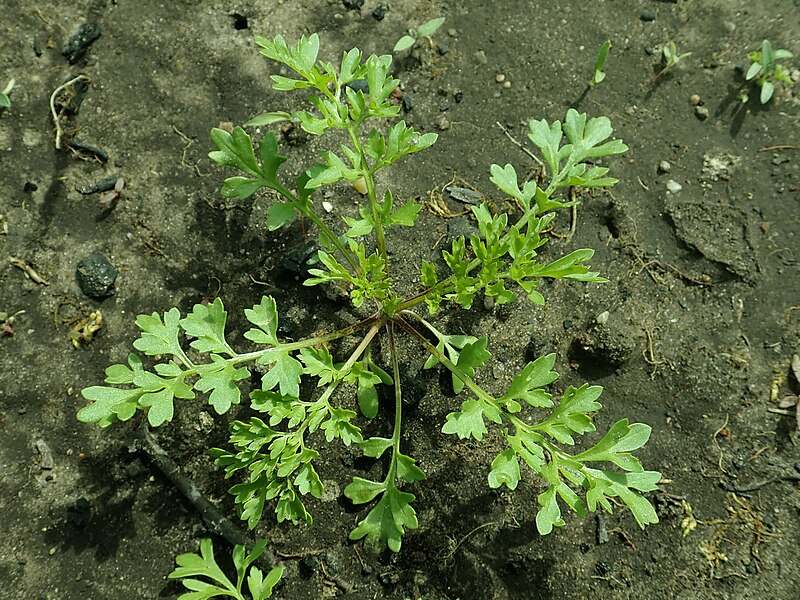
File:Lepidium_sativum_2019-05-04_2820.jpg · Wikimedia Commons · See Wikimedia Commons
OverviewAI-generated
*Lepidium sativum* is a species of plant in the family Brassicaceae, belonging to the genus *Lepidium*. It is classified within the order Brassicales, class Magnoliopsida, phylum Tracheophyta, and kingdom Plantae. The species is also referred to by common names such as gardencress pepperweed, Tuinkers, and pupurlys yr ardd. It produces fruit of the silicle type and is utilized as a medicinal plant.
Records indicate that *Lepidium sativum* has been documented in the Tibet Autonomous Region and the Zhoushan Archipelago. Additional occurrence data lists presence in Canada, the United States, and Mexico, with a description noting Chile Central. The taxon is distinct from *Cardamine*.
Synthesized by Vinony from 38 facts across 8 sources: Wikidata, GBIF, Encyclopedia of Life, PubMed, Gbif Occ, Plants of the World, iDigBio, Vinony graph. Generated from structured data (not the Wikipedia text) and checked against those facts — may still contain errors.
Species
Lepidium sativum
SPECIES
- KingdomPlantae
- PhylumTracheophyta
- ClassMagnoliopsida
- OrderBrassicales
- FamilyBrassicaceae
Chile Central
via GBIF · Kew POWO
Museum specimens
- Specimen records
- 1,351
- With media
- 1,060
- Family
- Brassicaceae
- Collections
- QUE, DAV, ANSP, RSA, CM, UNIVERSITY OF ALBERTA MUSEUMS
- Recorded in
- Canada, United States, Mexico
Research
940 papers- Anti-inflammatory and Immunomodulatory Properties of Lepidium sativum.ReviewBioMed research international · 2022Vazifeh S, Kananpour P, Khalilpour M et al.DOI: 10.1155/2022/3645038
- Lepidium sativum Linn.: a current addition to the family of mucilage and its applications.ReviewInternational journal of biological macromolecules · 2014Prajapati VD, Maheriya PM, Jani GK et al.DOI: 10.1016/j.ijbiomac.2014.01.008
- A Panoramic Review on Lepidium sativum L. Bioactives as Prospective Therapeutics.ReviewDrug research · 2021Ahmad A, Nabi R, Mishra A et al.DOI: 10.1055/a-1334-4101
- Nutraceutical Profiling, Bioactive Composition, and Biological Applications of Lepidium sativum L.ReviewOxidative medicine and cellular longevity · 2022Painuli S, Quispe C, Herrera-Bravo J et al.DOI: 10.1155/2022/2910411
- Research Update on the Therapeutic Potential of Garden Cress (Lepidium sativum Linn.) with Threatened Status.ReviewCurrent drug research reviews · 2024Gupta S, Gupta RDOI: 10.2174/0125899775273877231023102011
- Antimicrobial Properties of Lepidium sativum L. Facilitated Silver Nanoparticles.Pharmaceutics · 2021Haj Bloukh S, Edis Z, Abu Sara H et al.DOI: 10.3390/pharmaceutics13091352
- Lepidium sativum as candidate against excitotoxicity in retinal ganglion cells.Translational neuroscience · 2021Al-Dbass A, Amina M, Al Musayeib NM et al.DOI: 10.1515/tnsci-2020-0174
- Lepidium sativum Sprouts Grown under Elevated CO(2) Hyperaccumulate Glucosinolates and Antioxidants and Exhibit Enhanced Biological and Reduced Antinutritional Properties.Biomolecules · 2021Alotaibi MO, Khamis G, AbdElgawad H et al.DOI: 10.3390/biom11081174
via PubMed
Wikidata facts
- Instance of
- taxon
- Subclass of
- useful plant
- Parent taxon
- Lepidium
- Image
- Tereler.JPG
- Has use
- medicinal plant
Show 12 more facts
- taxon rank
- species
- taxon name
- Lepidium sativum
- Commons category
- Lepidium sativum
- Commons gallery
- Lepidium sativum
- described by source
- New International Encyclopedia
- taxon common name
- vrtna kreša
- has fruit type
- silicle
- short name
- L. sativum
- different from
- Cardamine
- taxon range
- Zhoushan Archipelago
- taxon author citation
- L.
Sources (7)
via Wikidata · CC0
~3 min read
Encyclopedic overview
Cress (Lepidium sativum), sometimes referred to as garden cress (or curly cress) to distinguish it from similar plants also referred to as cress (from Old English cresse), is a fast-growing, edible herb.
Garden cress is genetically related to watercress and mustard, sharing their peppery, tangy flavour and aroma. In some regions, garden cress is known as mustard and cress, garden pepper cress, pepperwort, pepper grass, or poor man's pepper.
Excerpted from Wikipedia’s “Lepidium sativum” article, available under the CC BY-SA 4.0 licence.
Gallery (7)
Available in 73 languages
- Español
- Français
- Deutsch
- 中文
- 日本語
- Русский
- Português
- Italiano
- العربية
- Achinese
- Afrikaans
- Amharic
- Armenian
- Asturian
- azb
- Azerbaijani
- Bahasa Indonesia
- Belarusian
Show 54 more
- Bosnian
- Bulgarian
- Catalan
- Cebuano
- Czech
- Danish
- Egyptian Arabic
- Esperanto
- Estonian
- Finnish
- Fula
- Georgian
- Greek
- Gujarati
- Hungarian
- Icelandic
- Irish
- Kabyle
- Kannada
- Kazakh
- Latvian
- lbe
- Lezghian
- Lithuanian
- Lower Sorbian
- Macedonian
- Malayalam
- Marathi
- Mazanderani
- Nederlands
- Nepali
- Northern Frisian
- Norwegian
- Norwegian Nynorsk
- Ossetic
- Polski
- Quechua
- Romanian
- Serbian (Latin)
- simple
- Slovak
- Svenska
- Tiếng Việt
- Türkçe
- Ukrainian
- Upper Sorbian
- Urdu
- Waray
- Welsh
- Wu Chinese
- Zaza
- فارسی
- ไทย
- 한국어
via Wikidata sitelinks · CC0