File:Amino_acid_zwitterions.svg · Wikimedia Commons · See Wikimedia Commons
tautomer
Sign in to saveAlso known as tautomers
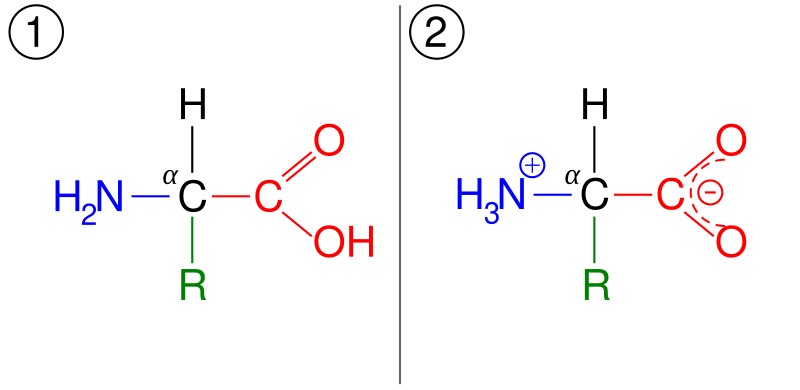
thumb|upright=1.3|alt=An amino acid, illustrated in two different ionization states. First, it has a neutral amine and neutral carboxylic acid. Second, it has a protonated ammonium cation and deprotonated carboxylate anion.| The tautomers of an amino acid: (1) neutral and (2) zwitterionic forms
Wikidata facts
- Subclass of
- structural isomer
Show 1 more fact
- Commons category
- Tautomerism
via Wikidata · CC0
~7 min read
Encyclopedic overview
8 sectionsContents
- Examples
- Prototropy
- Valence tautomerism
- Inorganic materials
- Consequences for chemical databases
- See also
- References
- External links
thumb|upright=1.3|alt=An amino acid, illustrated in two different ionization states. First, it has a neutral amine and neutral carboxylic acid. Second, it has a protonated ammonium cation and deprotonated carboxylate anion.| The tautomers of an amino acid: (1) neutral and (2) zwitterionic forms
In chemistry, tautomers () are a subset of structural isomers (constitutional isomers) of chemical compounds that readily interconvert. The chemical reaction interconverting the two is called tautomerization. This conversion commonly results from the relocation of a hydrogen atom within the compound. The phenomenon of tautomerization is called tautomerism, also called desmotropism. Tautomerism is for example relevant to the behavior of amino acids and nucleic acids, two of the fundamental building blocks of life.
Excerpted from Wikipedia’s “tautomer” article, available under the CC BY-SA 4.0 licence.