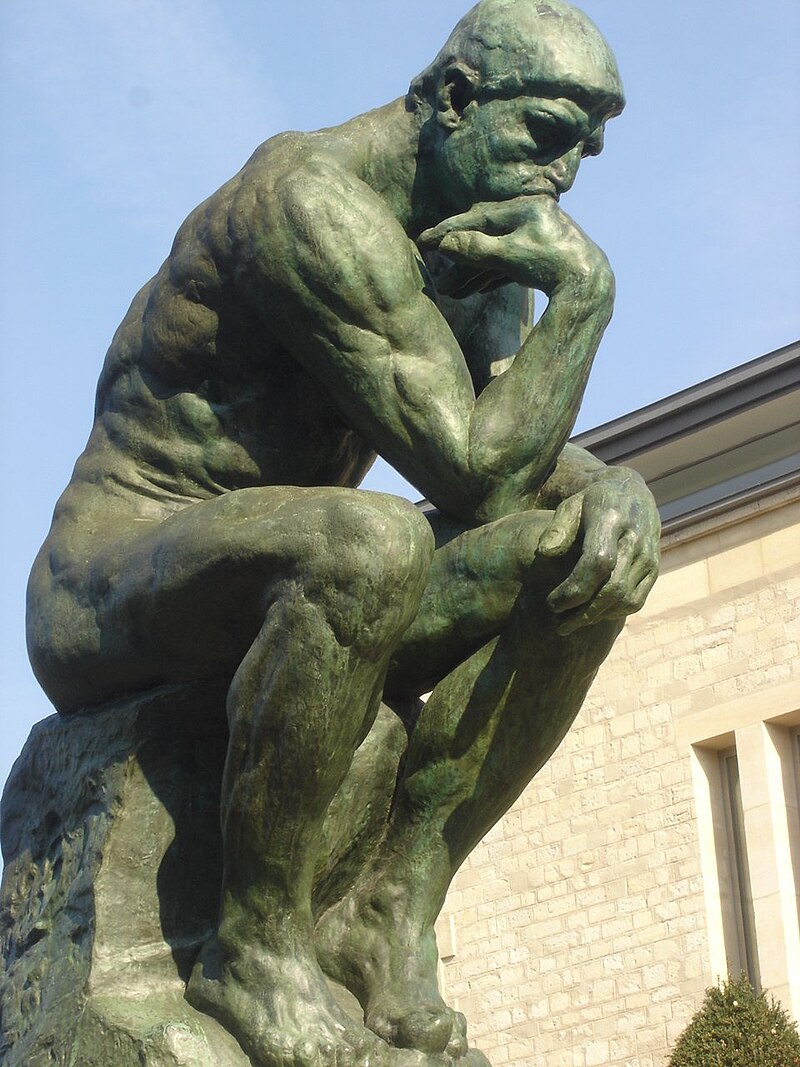
File:Jardin_du_Musee_Rodin_Paris_Le_Penseur_20050402_(02).jpg · Wikimedia Commons · See Wikimedia Commons
Also known as thinking skill
哲学および生理学的・心理学的概念
Thought refers to mental activities like reasoning, problem-solving, and remembering that happen in your mind without requiring direct sensory input from your surroundings. It matters because these cognitive processes allow us to judge situations, form ideas, imagine possibilities, and deliberately work through problems—capabilities that are fundamental to how we understand and navigate the world.
AI-generated from the Wikipedia summary — may contain errors.
In the Vinony graph
Vinony's link graph records 657 inbound references to 思考, and connects out to Sigmund Freud, René Descartes and logic.
It sits within the topics Commons link is locally defined, Concepts in epistemology and Concepts in metaphilosophy.
Vinony links it to 145 Wikipedia language editions.
Research
724,922 papers- Brain mechanisms underlying the inhibitory control of thought.ReviewNature reviews. Neuroscience · 2025Anderson MC, Crespo-Garcia M, Subbulakshmi SDOI: 10.1038/s41583-025-00929-y
- Thought-Feeling Accuracy in Person Perception and Metaperception: An Integrative Perspective.ReviewAnnual review of psychology · 2025Vorauer JD, Hodges SD, Hall JADOI: 10.1146/annurev-psych-011624-024416
- Thought suppression and psychopathology.ReviewBehaviour research and therapy · 1999Purdon CDOI: 10.1016/s0005-7967(98)00200-9
- The neural ingredients for a language of thought are available.ReviewTrends in cognitive sciences · 2023Kazanina N, Poeppel DDOI: 10.1016/j.tics.2023.07.012
- Clinically relevant aspects of thought across psychological disorders.ReviewCognitive processing · 2025Hammerdahl E, Vazquez N, Alperin BRDOI: 10.1007/s10339-025-01271-y
- On the relationship between unprompted thought and affective well-being: A systematic review and meta-analysis.Psychological bulletin · 2024Kam JWY, Wong AY, Thiemann RF et al.DOI: 10.1037/bul0000428
- Thought contagion? Conspiracy beliefs boost paranoid thoughts.Applied psychology. Health and well-being · 2024Molenda Z, Marchlewska M, Karakula A et al.DOI: 10.1111/aphw.12577
- Language and thought are not the same thing: evidence from neuroimaging and neurological patients.ReviewAnnals of the New York Academy of Sciences · 2016Fedorenko E, Varley RDOI: 10.1111/nyas.13046
via PubMed
Wikidata facts
- Subclass of
- cognitive process
- Has part
- proprioception
- Image
- Herkulaneischer Meister 002.jpg
- Said to be same as
- thought
Show 4 more facts
- Commons category
- Thinking
- topic's main category
- Category:Thought
- on focus list of Wikimedia project
- Wikipedia:Vital articles/Level/4
- studied by
- cognitive science
Sources (5)
via Wikidata · CC0
Article · 日本語
思考(しこう、(英: thinking)は、考えや思いを巡らせる行動であり、結論を導き出すなど何かしら一定の状態に達しようとする過程において、筋道や方法など模索する精神の活動である。広義には人間が持つ知的作用を総称する言葉、狭義では概念・判断・推理を行うことを指す。知的直感を含める場合もあるが、感性や意欲とは区別される。哲学的には思惟(しい、しゆい)と同義だが、大森荘蔵は『知の構築とその呪縛』(p152)にて思考と思惟の差について言及し、思惟とは思考を含みつつ感情なども包括した心の働きと定義している。 論理学分野で研究されてきた思考の定義は定まっておらず、多様な側面を持つ。心理学分野の研究では、思考とは何らかの思想や問題対処法を立ち上げる心の過程や操作を示し、その対象は問題解決、方略、推理、理解、表象(心像、観念、概念など)知識といった現象を取り扱う。 漢字「思考」の「思」は、「田」が頭蓋骨の意味が転じた「頭脳の活動」、「心」が「精神の活動」を指す。「考」は知恵の意味「老」に終わりなく進む「て」が付属したものである。漢字全体では、頭や心で活動し、知恵を巡らせることを意味する。 思考とは何かという疑問は、人類の歴史の中で繰り返し問いかけられてきた。ただし思考だけを独立させて取り扱うのではなく、知能や生命、さらに社会など総体的に人間が生きる側面のひとつとみなし、複雑系を構成する要素として組織的に扱う必要がある。イマヌエル・カントは、近代的な個人の思考とはひとりでは成り立たせることは不可能であり、必ず他者と共同され、公開し、主観を共有する状態からしか生まれないと述べた。そうでないものを「未成年状態」と定め、それを脱却するために啓蒙が必要と説いた。したがって、言論の自由とは意思を発表する権利という点に止まらず、思考の権利でもあると考えた。
Abstract from DBpedia / Wikipedia · CC BY-SA
Gallery (6)
Available in 145 languages
- Español
- Français
- Deutsch
- 中文
- 日本語
- Русский
- Português
- Italiano
- العربية
- हिन्दी
- abstract
- Afrikaans
- Albanian
- Albanian
- Aragonese
- Armenian
- Assamese
- Asturian
Show 126 more
- Avaric
- azb
- Azerbaijani
- Bahasa Indonesia
- Bangla
- Bashkir
- Basque
- bat_smg
- Bavarian
- be_x_old
- Belarusian
- Bikol
- Bosnian
- btm
- Bulgarian
- Burmese
- Catalan
- Central Kurdish
- Chechen
- Cornish
- Crimean Tatar
- Croatian
- Czech
- Danish
- Egyptian Arabic
- Esperanto
- Estonian
- Extremaduran
- Fiji Hindi
- Fijian
- Filipino
- Finnish
- Fula
- Galician
- Gan Chinese
- gcr
- Georgian
- Goan Konkani
- Greek
- Guarani
- Haitian Creole
- Hausa
- Hebrew
- Hungarian
- hyw
- Iban
- Icelandic
- Iloko
- Interlingua
- Jamaican Creole English
- Kabyle
- Kannada
- Kara-Kalpak
- Kazakh
- Khmer
- Kurdish
- Kyrgyz
- Lao
- Latin
- Latvian
- Lithuanian
- Lojban
- Lombard
- Low German
- Macedonian
- Madurese
- Malagasy
- Malay
- Malayalam
- Marathi
- Mingrelian
- Mirandese
- Moroccan Arabic
- Nederlands
- Newari
- Northern Frisian
- Norwegian
- Norwegian Nynorsk
- Occitan
- Pashto
- Piedmontese
- Polski
- Punjabi
- Quechua
- Romanian
- Rusyn
- Samoan
- Scots
- Serbian
- Serbian (Latin)
- Shona
- Sicilian
- simple
- Sindhi
- Slovak
- Slovenian
- Svenska
- Swahili
- Tajik
- Tamil
- Tatar
- Telugu
- Tiếng Việt
- Toki Pona
- Tsonga
- Türkçe
- Ukrainian
- Urdu
- Uzbek
- Venetian
- Waray
- Welsh
- Western Frisian
- Western Panjabi
- Wu Chinese
- Yakut
- Yiddish
- Zaza
- zh_classical
- zh_min_nan
- zh_yue
- Zhuang
- Zulu
- فارسی
- ไทย
- 한국어
via Wikidata sitelinks · CC0