Category
page 1Israeli cuisine
.%20Leiden%20University%20Library%2C%20Collection%20A.%20P.%20H.%20Hotz.jpg)
kabab
Kebab ( , ), kebap, kabob (alternative North American spelling), kebob, or kabab (Hindi and Kashmiri spelling) is a variety of roasted meat dishes that originated in the Middle East.

pilaf
Pilaf (), pilav, pilau or plov () is a rice dish, or in some regions, a wheat dish, whose recipe usually involves cooking in stock or broth, adding spices, and other ingredients such as vegetables and meat, and employing some technique for achieving cooked grains that do not adhere.

falafel

couscous
Couscous () is a traditional North African dish of small steamed granules of rolled semolina that is often served with a stew spooned on top. Pearl millet, sorghum, bulgur, and other cereals are sometimes cooked in a similar way in other regions, and the resulting dishes are also sometimes called couscous.

shawarma
Shawarma (; ) is a Middle Eastern dish that originated during the Ottoman Empire, consisting of meat that is cut into thin slices, stacked in an inverted cone, and roasted on a slow-turning vertical spit. Traditionally made with lamb or mutton, it may also be made with chicken, turkey meat, beef, falafel or veal. The surface of the rotisserie meat is routinely shaved off once it cooks and is ready to be served. Shawarma is a popular street food throughout the Arab world, Israel and the Greater Middle East.

semolina
Semolina is a coarse flour traditionally made from durum wheat. Its high protein and gluten content make it especially suitable for pasta.

tandoor
upright=1.2|thumb|Modern ceramic wood-fired tandoors
cheesecake
Cheesecake is a dessert made with a soft fresh cheese (typically cottage cheese, cream cheese, quark or ricotta), eggs, and sugar. It may have a crust or base made from crushed cookies (or digestive biscuits), graham crackers, pastry, or sometimes sponge cake. Cheesecake is known for its rich, creamy flavor and smooth texture. It may be baked or unbaked and is usually served chilled.

tehina
Tahini (; , or, in Iraq, ) is a Middle Eastern condiment (a seed butter) made from ground sesame seeds. The most common variety comes from hulled seeds, but unhulled ones can also be used; the latter variety is slightly bitter, but more nutritious. The seeds are more commonly roasted than raw. Tahini can be served by itself (as a dip), made into a salad dressing, or used as a major ingredient in hummus, baba ghanoush, or halva.

strudel
Strudel ( , ) is a type of layered pastry with a filling that is usually sweet, but savoury fillings are also common. It became popular in the 18th century throughout the Austrian Empire. Strudel is part of Austrian cuisine and German cuisine but is also common in other Central European cuisines. In Italy it is recognized as a (PAT) of South Tyrol.

pickled cucumber
cucumber preserved in vinegar

shakshuka
thumb|Individual portion of shakshouka
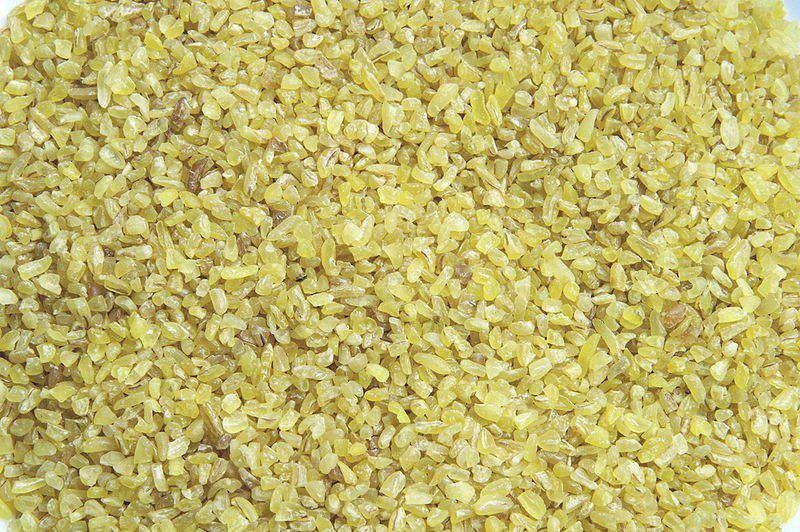
bulgur
thumb|Coarse bulgur

potato pancake
fried pancakes of grated or ground potato

cabbage roll
dish of cabbage leaves with a filling

tajine
thumb|A Portuguese-made tagine pot
A tagine or tajine, also tajin or tagin () is a Maghrebi dish, and the earthenware pot in which it is cooked. It is also called or .
.jpg)
Tabbouleh
Tabbouleh (), also transcribed tabouleh, tabbouli, tabouli, or taboulah, is a Levantine salad of finely chopped parsley, soaked bulgur, tomatoes, mint, and onion, seasoned with olive oil, lemon juice, salt and sweet pepper. Some variations add lettuce, or use semolina instead of bulgur.

matzah
thumb|250x250px|Matzah plate with an inscription of the blessing over the matzah
right|thumb|250x250px|Handmade matzah shmura
thumb|250x250px|Matzah shmura worked with machine for Passover
Matzah, matzo, or maẓẓah (; , : matzot or Ashk. matzos) is an unleavened flatbread that is part of Jewish cuisine and forms an integral element of the Passover festival, during which chametz (leavening agent and five grains deemed by halakha to be self-leavening) is forbidden.
baba ghanoush
Levantine appetizer consisting of finely chopped roasted eggplant, olive oil, lemon juice, various seasonings, and tahini
apple strudel
apple-filled pastry

kibbeh
Kibbeh (, also kubba and other spellings; ; ) is a popular dish in the Arab world and the Levant in particular, made of spiced lean ground meat and bulgur wheat. Kibbeh is considered to be a national dish of Lebanon and Syria.
sour cream
dairy product produced by fermenting a regular cream with certain kinds of lactic acid bacteria
cottage cheese
cheese made from skim milk, lactic bacteria and rennet

salep
Salep, also spelled sahlep, salepi or sahlab, is a flour made from the tubers of the orchid genus Orchis (including species Orchis mascula and Orchis militaris). These tubers contain a nutritious, starchy polysaccharide called glucomannan. Salep flour is consumed in beverages and desserts, especially in the cuisines of the former Byzantines and Ottoman, notably in the Levant where it is a traditional winter beverage. An increase in consumption is causing local extinctions of orchids in parts of Greece, Turkey, and Iran.

schnitzel
Schnitzel () is a thin slice of meat. The meat is usually thinned by pounding with a meat tenderizer. Most commonly, the meat is breaded before frying. Breaded schnitzel is popular in many countries and is made using veal, pork, chicken, mutton, beef, or turkey. Schnitzel originated as Wiener schnitzel and is very similar to other breaded meat dishes.
Israeli cuisine
culinary traditions of Israel
ful medames
Syrian salad of fava beans, chopped tomatoes, onion, parsley, lemon juice, olive oil, pepper and salt)

torshi
thumb|Turşu in Turkey
Torshi, tursu or turshi () are the pickled vegetables of many Middle Eastern, Caucasian, Slavic and Balkan cuisines.

Maqluba
Maqluba (also attested by a variety of other spellings in English; ) is a traditional Levantine dish, a variety of Pilaf that is popular across Palestine, Jordan, Syria, Lebanon, Israel, and Iraq. It consists of meat, rice, and fried vegetables placed in a pot which is flipped upside down when served, hence the name.

za'atar
'''Za'atar' ( ; , ) is a versatile herb blend and family of wild herbs native to the Levant, central to Middle Eastern cuisine and culture. The term refers both to aromatic plants of the Origanum and Thymbra genera (including Origanum syriacum, known as Bible hyssop) and to the prepared spice mixture of dried herbs (traditionally Origanum syriacum''), toasted sesame seeds, sumac, and salt. With roots stretching back to ancient Egypt and classical antiquity, za'atar has been used for millennia as a seasoning, folk remedy, and cultural symbol.
.jpg)
cholent
Cholent or Schalet () is a traditional slow-simmering Sabbath stew in Jewish cuisine that was developed by Ashkenazi Jews first in France and later Germany, and is first mentioned in the 12th century. It is closely related to the French cassoulet and is believed to have been derived from hamin, a similar Sabbath stew that emerged in Spain among Sephardic Jews and made its way to France by way of Provence.
shish kebab
skewered meat dish

Tarama
Taramasalata or taramosalata (; from 'fish roe' < + Greek: 'salad' < ) is a meze made from tarama, the salted and cured roe (colloquially referred to as caviar) of the cod, carp, or grey mullet (bottarga) mixed with olive oil, lemon juice, and a starchy base of bread or potatoes, or sometimes almonds. Variants may include garlic, spring onions, or peppers, or vinegar instead of lemon juice. While not traditionally Greek, smoked rather than cured cod's roe is more widely available in some places, and often used. Bottarga is usually much more expensive than cod roe.
mujadara
Mujaddara ( mujaddarah, with alternative spellings in English majadra, mejadra, moujadara, mudardara, and megadarra) is a dish consisting of cooked lentils together with groats, generally rice, and garnished with sautéed onions. It is especially popular in the Levant.
roast goose
dish

Kugel
Kugel ( , pronounced or ) is a baked casserole, most commonly made from egg noodles (lokshen) or shredded potato. It is a traditional Ashkenazi Jewish dish, often served on Sabbath and Jewish holidays. American Jews also serve it for Thanksgiving dinner. In Hungary it is known as "vargabéles" and served as a sweet dish.
skhug
Zhug (from Yemenite Arabic or IPA: [zħuːq] through ), also known as sahawiq (Yemeni Arabic: , IPA: [saħaːwiq]), is a hot sauce originating in Yemeni cuisine. In other countries of the Arabian Peninsula it is also called mabooj (), and bisbaas.
orgeat syrup
syrup made from almonds, sugar and rose water

baharat
thumb|right|100px|A small jar of homemade Gulf-style baharat

charoset
thumb|250px|Ashkenazi-style haroset made from apples, walnuts, red wine and cinnamon
freekeh
Freekeh (sometimes spelled frikeh) or farik ( / ALA-LC: farīkah; pronounced free-kah /ˈfɹiːkə/) is a cereal food made from green durum wheat (Triticum turgidum var. durum) that is roasted and rubbed to create its flavour. It is an ancient dish derived from Levantine and North African cuisines, remaining popular in many countries of the eastern Mediterranean Basin, where durum wheat originated.

sfiha
Sfiha, esfiha, esfirra, sfija, sfihah, sfeeha or fatay () is a Levantine dish consisting of flatbread cooked with a minced meat topping, often a mix of sheep and veal, and flavored with onions, tomatoes, pine nuts, and spices. It is traditionally found in the countries of the Levant, and is closely related to manakish and lahmacun. Sfiha is particularly associated with Baalbek, a city located in the Beqaa Valley of Lebanon.
shish taouk
dish of Levantine cuisine, skewers of marinated chicken pieces

Sabich
Sabich or sabih ( ; Judeo-Iraqi Arabic: ) is a sandwich of pita or laffa bread stuffed with fried eggplants, hard-boiled eggs, chopped salad, parsley, amba and tahini sauce. It is a staple of Jewish-Iraqi cuisine and was created by Iraqi Jews in Israel in the 1960s.
date honey
syrup extracted from dates

Ka'ak
'''Ka'ak' ( , also transliterated ), is a baked good of varying types produced throughout the Arab world and the Near East. The bread, in Middle Eastern countries, is similar to a dry and hardened biscuit and mostly ring-shaped. A similar pastry called "kue kaak''" is also popular in Indonesia.

kreplach
Kreplach (from ) are small dumplings in Ashkenazi Jewish cuisine filled with ground meat, mashed potatoes or another filling, usually boiled and served in chicken soup, though they may also be served fried. They are similar to other types of dumpling, such as Polish pierogi, Polish and Ukrainian uszka, Russian pelmeni, Italian ravioli or tortellini, German Maultaschen, and Chinese jiaozi and wonton. The dough is traditionally made of flour, water and eggs, kneaded and rolled out into thin sheets. Some modern-day cooks use frozen dough sheets or wonton wrappers. Ready-made kreplach are also sol
Ptitim
toasted pasta in tiny balls

Borani
thumb|Turkish borani with spinach
Seven Species
seven agricultural products listed in the Bible as special products of the Land of Israel
mangal
Middle Eastern barbecue
matzah ball
flour-based ball in Jewish cuisine
Liver and onions
Prepared dish

smen
Smen (from also called sman, semn, semneh, or sminn) is a salted, fermented butter native to North African cuisine (Algeria, Morocco and Tunisia), as well as a traditional Yemeni dish. In countries like Jordan and Lebanon, samneh is a type of butter similar to clarified butter, while north African smen is a type of fermented butter similar to ghee.
Bamba
peanut snack
kibbeh nayeh
Levantine dish made of raw meat
matzah brei
sauteed matzo omelette
stuffed squash
dish common in the former Ottoman Empire
Matbucha
Matbucha (, maṭbūkhah; ) is a North African condiment or cooked salad consisting of cooked tomatoes and roasted bell peppers seasoned with garlic and chili pepper, and slow-cooked for a number of hours. It is traditionally served in North Africa with a traditional Moroccan bread and as a condiment typically served as part of an appetizer, often as part of a salad course.
Gondi dumpling
Persian Jewish dish