Category
page 1Portuguese cuisine

samosa
A samosa () () is a fried Indian pastry with a savoury filling that mostly consists of vegetables like spiced potatoes, onions, and peas, but can include cheese such as paneer, meat or even fish. Its name originates from the Middle Persian word sambosag () (meaning 'triangular pastry'). It is made in different shapes, including triangular, cone, or crescent, depending on the region. Samosas are often accompanied by chutney, and have origins in medieval times or earlier. Sweet versions containing traditional Indian flavours or even chocolate are also made. Samosas are popular snacks in South As

gazpacho
Gazpacho () or gaspacho (), also called Andalusian gazpacho (from Spanish gazpacho andaluz), is a cold soup and drink made of raw, blended vegetables. It originated in the southern regions of the Iberian Peninsula and spread into other areas. Gazpacho is widely eaten in Spain and Portugal, particularly in summer, since it is refreshing and cool.
%20(page%2078-79).png)
marmalade
Marmalade is a sweet, tangy fruit preserve made from the juice and peel of citrus fruits boiled with sugar and water. The well-known version is made from bitter orange, but other citrus fruits such as lemons and limes can also be used. The bitter orange is mostly used in marmalade because of its high pectin content, which gives a thick consistency to its marmalade. In addition, the balance of acid and pectin is needed for consistency. Fruits with low pectin have it added to make the marmalade.

paprika
Paprika is a spice made from dried and ground red peppers, Capsicum annuum. It can have varying levels of heat, but the peppers used for hot paprika tend to be milder and have thinner flesh than those used to produce chili powder. The milder, sweet paprika is mostly composed of the fruit of the pepper with most of the seeds removed; whereas some seeds and stalks are retained in the peppers used for hotter paprika.
.jpg)
churro
A churro (, ) is a type of fried dough from Spanish and Portuguese cuisine, made with choux pastry dough piped into hot oil with a piping bag and large closed star tip or similar shape. They are also found in Latin American cuisine, Philippine cuisine and in other areas that have received immigration from Spanish- and Portuguese-speaking countries, especially in France and the Southwestern United States.
%20caseras.JPG)
empanada
An empanada is a type of baked or fried turnover consisting of pastry and filling, common in Spain, Portugal, other Southern European countries, North African countries, West African countries (where they are known as meatpies in Nigeria), South Asian countries, Latin American countries, and the Philippines. The name comes from the Spanish (to bread, i.e., to coat with bread), and translates as 'breaded', that is, wrapped or coated in bread. They are made by folding dough over a filling, which may consist of meat, cheese, tomato, corn, or other ingredients, and then cooking the resulting turno
pastel de nata
Portuguese egg tart pastry dusted with cinnamon
Portuguese cuisine
culinary traditions of Portugal
Berliner
German jelly doughnut
snail as food
flesh from snails

merienda
thumb|Typical merienda fare
thumb|Typical vespertine merienda in the Andalusia|South of Spain
thumb|Traditional serving of merienda in Café El Gato Negro, [[Buenos Aires: medialunas (croissants), café en jarrito (a double espresso coffee) and a little glass of sparkling water]]
thumb|A typical meryenda in the Philippines, [[tsokolate with suman rice cakes and ripe carabao mangoes]]
Merienda is a light meal in southern Europe, particularly Spain (merenda in Galician, berenar in Catalan), Portugal (lanche, merenda) and Italy (merenda), whence the word spread to Serbo-Croatian in, according to di
piri piri
cultivar of Capsicum frutescens
.jpg)
sofrito
' (), (), soffritto (), (), () or ' () typically consists of aromatic ingredients cut into small pieces and sautéed or braised in cooking oil for a long period of time over a low heat, then used as a foundation for a variety of dishes. It is a basic preparation in Mediterranean and Latin American cooking.
.jpg)
Francesinha
Francesinha ( meaning little French girl or little French woman) is a Portuguese sandwich, originally from Porto, made with layers of toasted bread and assorted hot meats such as roast, steak, wet-cured ham, linguiça, or chipolata over which sliced cheese is melted by the ladling of a near-boiling tomato-and-beer sauce called molho de francesinha. It is typically served with French fries.
dried and salted cod
cod which has been preserved by drying after salting

escabeche
__NOTOC__
thumb|Escabeche of tilapia, from the [[Philippines]]

churrasco
Churrasco (, ) is the Portuguese and Spanish name for grilled beef prominent in South American and Iberian cuisines, and in particular in Brazil, Bolivia, Paraguay, Uruguay, and Argentina. The term is also used in other Spanish- and Portuguese-speaking countries for a variety of different meat products.

charcuterie
thumb|upright=1.35|Charcuterie hanging in a French shop
Charcuterie (, , also , ; ; from , and ) is a branch of French cuisine devoted to prepared meat products, such as bacon, ham, sausage, terrines, galantines, ballotines, pâtés, and confit, primarily from pork.

rissole
A rissole (from Latin , meaning reddish, via French , meaning "to redden") is "a ball or flattened cake of chopped meat, fish or vegetables mixed with herbs or spices, then coated in breadcrumbs and fried."
iberico ham
Bellota ham
.jpg)
Migas
Migas (, ) ("crumbs" in English) is a dish traditionally made from stale bread and other ingredients in Spanish and Portuguese cuisines. Originally introduced by shepherds, migas are very popular across the Iberian Peninsula, and are the typical breakfast of hunters at monterías in some regions of Spain.

Malasada
Malassada is a Portuguese fried pastry from the Azores. It is a type of doughnut, made of flattened rounds of yeasted dough, coated with sugar and cinnamon or accompanied with molasses.
peixinhos da horta
Portuguese fried vegetable-based dish
sardine as food
flesh from sardines
Broa
Broa ( or ) is a type of maize or rye bread traditionally made in Portugal and Galicia. It exists in somewhat different versions in Portuguese speaking countries like Angola, Brazil, Cape Verde, Mozambique. The Portuguese broas are either made from a mixture of cornmeal, rye, barley, wheat flour and yeast, baking soda or baking powder, or simply from rye and yeast. Before maize was brought from the Americas in the fifteenth century, broa was mostly made from rye. In Brazil, broa is more closely related to cornbread, likely a Native American influence, traditionally seasoned with fennel.
Folar
Folar or folar de Páscoa is a traditional Portuguese bread served at Easter. The recipe varies from region to region and it may be sweet or savory.
pig's ear
cooked ear of pig for human food consumption
roasted chestnuts
popular autumn and winter street food
Malagueta pepper
variety of plant
quail meat
flesh from quail
Queijo de Azeitão
Portuguese cheese

cabidela
thumb|right|Chicken cabidela
Cabidela () or arroz de cabidela (cabidela rice) is a Portuguese dish made with poultry, usually a rooster (male chicken). It is typical of the northern Minho region. The particularity of the dish is that the hen's blood is added almost at the end, mixed with vinegar (to prevent clotting) while the rice is boiling, much like "jugged" or "civet" dishes. The blood is captured when the animal is slaughtered and imparts a brown color to the dish. Occasionally, white rice can be served with the dish, although this is not common. Cooking with blood is an antique custom c
.jpg)
Açorda
Açorda is a traditional Portuguese dish composed of cubed or sliced stale bread with garlic, cilantro, and poached eggs. It is a type of bread soup, although some variants have a consistency closer to that of a porridge.
Queijo do Pico
trademark

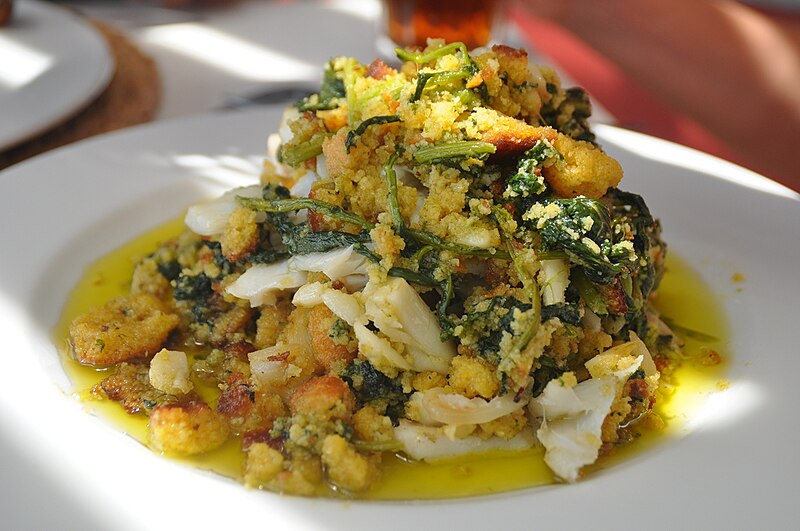
bacalhau
thumb|Salted and dried cod, produced in Norway
''' () is the Portuguese word for cod and—in a culinary context—dried and salted cod. Fresh (unsalted) cod is referred to as ' (fresh cod).

cataplana
thumb|right|200px|Open cataplana
thumb|right|200px|Closed cataplana
thumb|right|200px|Clams in a cataplana
A cataplana is an item of cookware used to prepare Portuguese seafood dishes, popular in the country's Algarve region. The cataplana is also the name of a typical dish of Algarve region as well as a Portuguese item of cookware used to make the dish and a method of cooking using it. The cooking vessel can be used for cooking a wide variety of ingredients, but prawns, clams and pork cataplanas are the most popular menus of the cataplana dish.

linguiça
thumb|right|190px|Linguiça for sale in Espírito Santo, Brazil
Linguiça () is a Portuguese sausage made from pork and seasoned with onion, garlic, paprika and other spices. It can be used fresh in cooked preparations or undergo a curing and preservation process through smoking.

Bolo do caco
Typical bread from Madeira, Portugal

bocadillo
The ' () or ' (in Cheli), in Spain, is a sandwich made with Spanish bread, usually a baguette or similar type of bread, cut lengthwise. Traditionally seen as a humble food, its low cost has allowed it to evolve over time into a representative piece of cuisine. In Spain, they are often eaten in cafes and tapas bars.
cod tongue
Variety cut from the lower jaw of codfish

Fartura
thumb|Traditional farturas
thumb
A fartura is a fried dough made of flour, yeast, baking soda, salt, sugar, cinnamon, and water, that is fried in oil, in the form of a roll and traditionally sold at fairs in Portugal. It is preferable to consume them when they are hot so that the crunchy surface does not harden.
Tripas à moda do Porto
traditional Portuguese dish
bifana
Bifana () is a classic Portuguese sandwich eaten all across the country.
Xerém
thumb|upright=1.1|Algarvian xarém, a dish from Portugal
Baba de camelo
Portuguese dessert
arroz de marisco
Portuguese seafood rice dish
espetada
Espetada (also known as espetinho, especially in Brazil) is the Portuguese term used for the technique of cooking food on skewers, and for the dishes prepared that way. Espetada is a traditional dish in Portuguese cuisine.
list of Portugal food and drink products with protected status
Wikimedia list article
Portuguese sweet bread
Lightly sweetened bread, often eaten on holidays
Bacalhau à Zé do Pipo
Bacalhau casserole
Atlantic diet
Type of diet involving the avoidance of processed foods
bolo de arroz
rice muffin from Portugal
hog maw
stomach of a pig as food
bife a cavalo
traditional dish in Portugal and Brazil, consisting of a grilled, sometimes deep fried steak, with fried eggs on top
pastel de feijão
Portuguese bean tart
Molotof
Portuguese dessert
Cebolada
Cebolada is a Portuguese onion stew, onion sauce or paste that is prepared with onion as a primary ingredient. Versions prepared as a paste may be slow-cooked.
Conventual sweets
Portuguese sweets
Empadão
thumb|right|300px|Empadão
Empadão is a traditional Portuguese dish, also popular in Brazil. It is made in an oven and can contain red meat, chicken, tuna, codfish and seafood between layers of mashed potato, dry dough, rice, bread or inside of wheat flour pasta, although the ground meat-mashed potatoes version is the more traditionally used, similar to the English shepherd's pie.
dobrada
Portuguese meat dish