Category
page 1Spanish cuisine

Olea europaea
The olive (botanical name Olea europaea, "European olive") is a species of subtropical evergreen tree in the family Oleaceae. Originating in Asia Minor, it is abundant throughout the Mediterranean Basin, with wild subspecies in Africa and western Asia; modern cultivars are traced primarily to the Near East, Aegean Sea, and Strait of Gibraltar. The olive is the type species for its genus, Olea, and lends its name to the Oleaceae plant family, which includes lilac, jasmine, forsythia, and ash. The olive fruit is classed botanically as a drupe, similar in structure and function to the cherry or p

mayonnaise
Mayonnaise (), colloquially referred to as "mayo" (), is a thick, creamy sauce with a rich and tangy taste that is commonly used on sandwiches, hamburgers, bound salads, and French fries. It also forms the base for various other sauces, such as tartar sauce, fry sauce, remoulade, salsa golf, ranch dressing, and rouille.

fries
deep-fried potatoes

saffron
alt=Saffron|thumb|Saffron crocus, Crocus sativus, with its vivid crimson stigmas and styles

paella
Paella ( , ; ; ) is a rice dish originally from the Valencian Community. Paella is regarded as one of the community's identifying symbols. It is one of the best-known dishes in Spanish cuisine.

Olivier salad
salad dish

paprika
Paprika is a spice made from dried and ground red peppers, Capsicum annuum. It can have varying levels of heat, but the peppers used for hot paprika tend to be milder and have thinner flesh than those used to produce chili powder. The milder, sweet paprika is mostly composed of the fruit of the pepper with most of the seeds removed; whereas some seeds and stalks are retained in the peppers used for hotter paprika.

aioli
Aioli, allioli, or aïoli () is a cold sauce consisting of an emulsion of garlic and olive oil; it is found in the cuisines of the northwest Mediterranean.

shakshuka
thumb|Individual portion of shakshouka
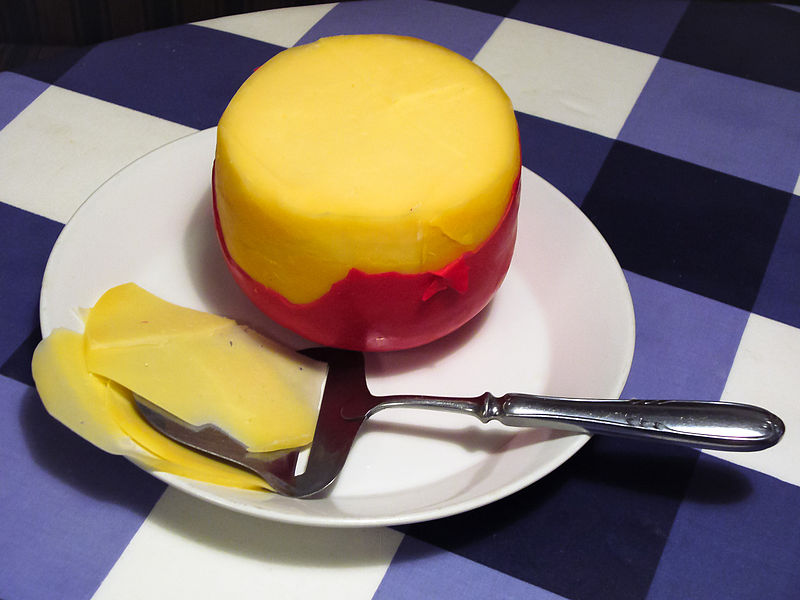
Edam
Dutch cheese

Spanish cuisine
culinary traditions of Spain
%20caseras.JPG)
empanada
An empanada is a type of baked or fried turnover consisting of pastry and filling, common in Spain, Portugal, other Southern European countries, North African countries, West African countries (where they are known as meatpies in Nigeria), South Asian countries, Latin American countries, and the Philippines. The name comes from the Spanish (to bread, i.e., to coat with bread), and translates as 'breaded', that is, wrapped or coated in bread. They are made by folding dough over a filling, which may consist of meat, cheese, tomato, corn, or other ingredients, and then cooking the resulting turno

Mirinda
Mirinda ( ) is a brand of soft drink that was created in Spain in 1959 and has been distributed globally by PepsiCo since 1970. Its name comes from the Esperanto translation of "admirable" or "amazing". Mirinda is available in multiple formulations of flavour, carbonation and sweetener depending on the taste of individual markets. It is made in many different fruit varieties, but the orange flavour represents the majority of Mirinda sales worldwide following a major repositioning of the brand towards that flavour in the early 1990s.

tapas
thumb|right | Tapas bar and restaurant at Plaza Mayor, Madrid|Plaza Mayor, Madrid

Common ling
species of fish
snail as food
flesh from snails
.jpg)
Blancmange
Blancmange (, from , ) is a sweet dessert popular throughout Europe commonly made with milk or cream, and sugar, thickened with rice flour, gelatin or corn starch, and often flavoured with almonds.

merienda
thumb|Typical merienda fare
thumb|Typical vespertine merienda in the Andalusia|South of Spain
thumb|Traditional serving of merienda in Café El Gato Negro, [[Buenos Aires: medialunas (croissants), café en jarrito (a double espresso coffee) and a little glass of sparkling water]]
thumb|A typical meryenda in the Philippines, [[tsokolate with suman rice cakes and ripe carabao mangoes]]
Merienda is a light meal in southern Europe, particularly Spain (merenda in Galician, berenar in Catalan), Portugal (lanche, merenda) and Italy (merenda), whence the word spread to Serbo-Croatian in, according to di
scorched rice
crunchy, slightly browned cooked rice

Botargo
Bottarga is salted, cured fish roe pouch, typically of the grey mullet or the bluefin tuna (). The best-known version is produced around the Mediterranean; similar foods are the Japanese and Taiwanese , which is softer, and Korean , from mullet or freshwater drum. It has many names and is prepared in various ways. Due to its scarcity and involved preparation it is expensive and regarded as a delicacy.
roast chicken
Whole chicken or large pieces of meat cooked by boiling or fried
.jpg)
sofrito
' (), (), soffritto (), (), () or ' () typically consists of aromatic ingredients cut into small pieces and sautéed or braised in cooking oil for a long period of time over a low heat, then used as a foundation for a variety of dishes. It is a basic preparation in Mediterranean and Latin American cooking.
green sauce
family of cold, uncooked sauces based on herbs, including the Spanish and Italian salsa verde, the French sauce verte, the German Grüne Soße or Frankfurter Grie Soß, and the Argentinian chimichurri
Patatas bravas
potato dish native to Spain
suckling pig
piglet fed on its mother's milk

orujo
thumb|right|A bottle of orujo (Cantabrian brand Sierra del Oso)
Orujo is a pomace brandy (a liquor obtained from the distillation of marc, the solid remains left after pressing of the grape) from northern Spain. It is a transparent spirit with an alcohol content over 50% (100°US ; 87.6ºBritain and Commonwealth proof). Its name comes from the expression "aguardiente de orujo" (pomace spirit).

escabeche
__NOTOC__
thumb|Escabeche of tilapia, from the [[Philippines]]
Basque cuisine
local cuisine of the Basque region

Adobo
thumb|right|—smoked, ripe jalapeño peppers in
thumb|right|Peruvian chicken made from dried (yellow lantern chili, Capsicum chinense)
' or ' (Spanish: marinade, sauce, or seasoning) is the immersion of food in a stock (or sauce) composed variously of paprika, oregano, salt, garlic, and vinegar to preserve and enhance its flavor. The Portuguese variant is known as . The practice, native to Iberia (Spanish and Portuguese cuisine), was widely adopted in Latin America, as well as Spanish and Portuguese colonies in Africa and Asia.
Catalan cuisine
Mediterranean style of cuisine from Catalonia

buñuelo
A buñuelo (, alternatively called boñuelo, bimuelo, birmuelo, bermuelo, bumuelo, burmuelo, or bonuelo, is a fried dough fritter found in Spain, Latin America, and other regions with a historical connection to Spaniards or Sephardic Jews, including Southwest Europe, the Balkans, Anatolia, where the sweet form is called lokma and the rest pişi, and parts of Asia and North Africa. Buñuelos are traditionally prepared at Christmas, Easter, and Hanukkah. They will usually have a filling or a topping. In Mexican cuisine, it is often served with a syrup made with piloncillo.

pincho
A pincho (; literally "thorn" or "spike"), pintxo () or pinchu () is a small snack, typically eaten in bars or taverns. They are traditional in northern Spain and especially popular in the Basque country, Navarre, La Rioja, Cantabria, and Asturias. Pinchos are usually eaten in the company of friends or relatives; thus, they have a strong socializing component, and, in the Basque country and Navarre, they are usually regarded as a cornerstone of local culture and society. They are related to tapas, the main difference being that pinchos are usually 'spiked' with a skewer or toothpick, often to

wafer cookie
thumbnail|right|Oblea from Karlovy Vary spa, Czech Republic
Oblea is a wafer dessert from several countries in Latin America, and has variants across Europe. It consists of two thin wafers sandwiching a sweet filling. While obleas are typically filled with arequipe, they may also contain jam, cheese, fruits, whipped cream, or a combination of multiple fillings. They are sometimes served with marmalade, condensed milk, chocolate, raspberry sauce, cheese, coconut or other toppings.
iberico ham
Bellota ham
squid as food
squid used as food, commonly eaten in the Mediterranean, in East Asia, and elsewhere
.jpg)
Migas
Migas (, ) ("crumbs" in English) is a dish traditionally made from stale bread and other ingredients in Spanish and Portuguese cuisines. Originally introduced by shepherds, migas are very popular across the Iberian Peninsula, and are the typical breakfast of hunters at monterías in some regions of Spain.

jamón
Jamón (; : jamones) is a type of dry-cured ham produced in Spain. It is one of the most globally recognised food items of Spanish cuisine. It is also regularly a component of tapas.
calamari sandwich
sandwich with a filling of fried squid rings, popular in Madrid, Spain
arroz con pollo
traditional dish of Spain and Latin America
Liver and onions
Prepared dish
Salpicon
Salpicon (, meaning "hodgepodge" or "medley"; ) is a dish of one or more ingredients diced or minced and bound with a sauce or liquid. There are different versions found in Spanish and the broader Latin American cuisine and Filipino cuisine. A salpicon is sometimes used as stuffing.
pork chop
type of meat cut

natillas
() is a term in Spanish for a variety of custards and similar sweet desserts in the Spanish-speaking world. In Spain, this term refers to a custard dish made with milk and eggs, similar to other European creams as . In Colombia, the delicacy does not include eggs, and is called .
stuffed eggplant
eggplant dish
Menudo
Mexican soup
nun's puffs
dessert pastry
pig's ear
cooked ear of pig for human food consumption
Galician cuisine
typical dishes and ingredients
candied almonds
sweet almond snack food
lemon chicken
chicken dish
quail meat
flesh from quail

biscuit roll
Barquillo is a crispy rolled wafer pastry originating in Spain. It is made from the basic cookie ingredients of flour, sugar, egg whites and butter rolled out thinly and then shaped into a hollow cylinder or a cone. It was traditionally sold by roadside vendors known as barquilleros who carried a characteristic red roulette tin (the ruleta de barquillero). It was introduced to Latin America and the Philippines during colonial times. In Spain and former Spanish colonies, barquillos are commonly regarded as a type of Christmas cookie. It is also popular during various fiestas. It spread to neigh
Ibores cheese
Spanish cheese
Denominación de Origen

pincho moruno
Pinchitos or pinchos morunos is a Moorish-derived food in Spanish cuisine, similar to kebab. The name pinchitos is used in the southern Spanish autonomous communities of Andalusia and Extremadura. They consist of small cubes of meat threaded onto a skewer () which are traditionally cooked over charcoal braziers.

bocadillo
The ' () or ' (in Cheli), in Spain, is a sandwich made with Spanish bread, usually a baguette or similar type of bread, cut lengthwise. Traditionally seen as a humble food, its low cost has allowed it to evolve over time into a representative piece of cuisine. In Spain, they are often eaten in cafes and tapas bars.
Aragonese cuisine
regional culinary traditions of Spain

Castilian-Manchego cuisine
cuisine of the Castilla–La Mancha region of Spain
Manjar blanco
term used in Spanish-speaking area of the world in reference to milk-based delicacies
fried cheese
cheese dish fried in oil