Category
page 1Ukrainian cuisine

borscht
Borscht () is a sour soup, made with meat stock, vegetables and seasonings, common in Eastern Europe, Central Europe and Northern Asia. In English, the word borscht, borrowed via Yiddish, is most often associated with the variant of the soup originating in Ukraine, made with red beetroots as one of the main ingredients, which give the dish its distinctive red color. The same name, however, is also used for a wide selection of sour-tasting soups without beetroots, such as sorrel-based green borscht, rye-based white borscht, and cabbage borscht.
.jpg)
Rumex acetosa
Sorrel (Rumex acetosa) is a perennial herbaceous plant in the family Polygonaceae. It is also called common sorrel, garden sorrel, spinach dock and narrow-leaved dock ("dock" often used for the genus).

goulash
Goulash (, ) is a meal made of meat and vegetables seasoned with paprika and other spices. Originating in Hungary, goulash is a common meal predominantly eaten in Central Europe but also in other parts of Europe. It is one of the national dishes of Hungary and a symbol of the country.

blood sausage
sausage filled with blood that are cooked or dried and mixed with a filler until they are thick enough to congeal when cooled

semolina
Semolina is a coarse flour traditionally made from durum wheat. Its high protein and gluten content make it especially suitable for pasta.

shashlik
Shashlik, or shashlyck ( shashlyk ), is a dish of skewered and grilled cubes of meat, similar to or synonymous with shish kebab. It is known traditionally by various other names in the Caucasus, Eastern Europe and Central Asia, and from the 19th century became popular as shashlik across much of the Russian Empire and nowadays in former Soviet Union republics.

börek
Börek (also burek or byrek) is a family of pastries or pies made in the Middle East and Southeast Europe. The pastry is made of a thin flaky dough such as filo with a variety of fillings, such as meat, cheese, spinach, or potatoes. A börek may be prepared in a large pan and cut into portions after baking, or as individual pastries. They are usually baked but some varieties can be fried. Börek is sometimes sprinkled with sesame or nigella seeds, and it can be served hot or cold.
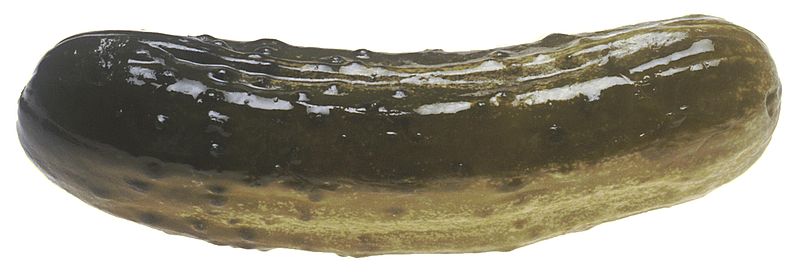
pickled cucumber
cucumber preserved in vinegar

bigos
Bigos (), '''hunter's stew''', is a Polish dish of chopped meat of various kinds stewed with sauerkraut, shredded fresh cabbage and spices. It is served hot and can be enriched with additional vegetables and wine. Originally from Poland, the dish also became traditional in the areas of the vast Polish–Lithuanian Commonwealth.

Ukrainian cuisine
culinary traditions of Ukraine

potato pancake
fried pancakes of grated or ground potato

cabbage roll
dish of cabbage leaves with a filling

aspic
thumb|upright|Aspic with chicken and eggs
Aspic () or meat jelly is a savoury gelatin made with a meat stock or broth, set in a mold to encase other ingredients. These often include pieces of meat, seafood, vegetable, or eggs. Aspic is also sometimes referred to as aspic gelée or aspic jelly. In its simplest form, aspic is essentially a gelatinous version of conventional soup.

pierogi
Pierogi ( ; , ) are filled dumplings made by wrapping unleavened dough around a filling and cooking in boiling water. They are occasionally flavored with a savory or sweet garnish. Typical fillings include potato and twaróg cheese, sauerkraut, ground meat, mushrooms, fruits, or berries. Savory pierogi are often served with a topping of sour cream, fried onions, or both.

steak tartare
meat dish made from finely chopped raw beef or horse meat

blini
Blini (also blinis or bliny; ; blin; ) are Russian pancakes, often made with a yeast-raised batter of buckwheat and/or wheat flour and milk. They may be served with smetana, cottage cheese, caviar and other garnishes, or simply smeared with butter. They are a traditional dish in Russian cuisine.

chicken Kiev
Ukrainian stuffed fried chicken dish
varenyky
Varenyky (, : ) are traditional Ukrainian dumplings made from unleavened dough and filled with sweet or savoury ingredients. They are regarded as one of the most emblematic dishes of Ukrainian cuisine and are closely related to other East European dumplings such as Polish pierogi. A key distinction made between the Ukrainian varenyky and the Polish pierogi is that the former has thinner, softer dough and traditionally simpler filling, most often only consisting of potato.

kissel
Kissel or kisel is a simple dish with the consistency of a thick gel, and made of sweet fruit, berry, grains (oatmeal, rye, wheat), peas, or from milk. It is commonly thickened with potato starch or corn starch and may be served either as a drinkable dessert or as a thicker, jelly-like dish. It belongs to the group of cold-solidified desserts, although it can be served warm.

Kutia
Kutia or kutya is a ceremonial grain dish with sweet gravy traditionally served predominantly in Belarusian and Ukrainian cuisine, but also in parts of Lithuania, Poland, and Russia. It is consumed by both Eastern Orthodox Christians and Catholics, though whether it is served on Christmas–Feast of Jordan holiday season or as part of a funeral feast can vary between regions. The word with a descriptor is also used to describe the eves of Christmas, New Year, and Feast of Jordan days.
open sandwich
single slice of bread with food items on top
Chiburekki
Chebureki ( Cheburek) are deep-fried turnovers with a filling of ground or minced meat and onions. A popular street dish, they are made with a single round piece of dough folded over the filling in a crescent shape. They have become widespread in the former Soviet-aligned countries of Eastern Europe in the 20th century.

halušky
right|thumb|Haluškár strainer
pampushka
Pampushka ( , pl. ; diminutive of pampukh or pampukha) is a small savory or sweet yeast-raised bun or doughnut typical for Ukrainian cuisine.
Crimean Tatar cuisine
culinary traditions of Crimean Tatars
paska
Eastern European pastry traditionally baked for Easter

oladyi
Oladyi or oladi ( pl., diminutive: оладушки, oladushki, sg. оладья, oladya ; , oladky) are small thick pancakes or fritters common in Russian and Ukrainian cuisines. The batter for oladyi is made from wheat or (nowadays more rarely) buckwheat flour, eggs, milk, salt, and sugar with yeast or baking soda. The batter may also contain kefir, soured milk or yoghurt. Oladyi may also include various additions, such as apple or raisins.
Vinegret
Vinegret (), or Russian vinaigrette, is a salad in Russian cuisine which is also popular in other post-Soviet states. The dish includes diced cooked vegetables (red beets, potatoes, carrots), chopped onions, as well as sauerkraut and/or brined pickles. Other ingredients, such as green peas or beans, are sometimes also added. The naming comes from vinaigrette, which is used as a dressing. However, in spite of the name, vinegar is often omitted in modern cooking, and sunflower or other vegetable oil is just used. Some cooks add the brine from the pickled cucumbers or sauerkraut.

kasha
In English, kasha () is a porridge usually made from buckwheat, a pseudocereal. In the Slavic languages, kasha means porridge. In some varieties of Central and Eastern European cuisine, kasha can apply to any kind of cooked grain. It can be baked but most often is boiled, either in water or milk, but the word can also refer to the grain before preparation, which corresponds to the definition of 'groats'.
pirog
Pirog (; , , ; ; ; , ; , ; ; Estonian: pirukas ): is a baked case of dough with either sweet or savory filling. The dish is common in Finnish and Eastern European cuisines.
deviled egg
egg-based dish
pig slaughter
work of slaughtering domestic pigs to obtain pig meat (pork)

uszka
() or vushka ( ; ; ) are small dumplings (a very small and twisted version of pierogi) usually filled with flavourful wild forest mushrooms and/or minced meat. They are usually served with borscht, though they can be eaten simply with melted butter and herbs (usually chives) sprinkled over. When vegetarian (filled only with mushrooms or onion) they are a part of traditional Christmas Eve dishes in Poland, Belarus, and Ukraine, and are either added to the soup or eaten as a side dish.
thumb|right|200px|Uszka in traditional Polish borscht|barszcz
kogel mogel
egg-based homemade dessert
dressed herring
Russian layered salad

bublik
Bublik (also booblik or bublyk; , plural: ; ) is a traditional Eastern European bread roll. It is a ring of yeast-leavened wheat dough that has been boiled in water for a short time before baking.

korovai
thumb|Wedding korovai in Kyiv, 2020
thumb|A korovai and a kolach (bread)| kolach served alongside [[kvass and kefir in a Polish household]]
pickled herring
traditional way of preserving herring

koliva
Koliva, also spelled, depending on the language, kollyva, kollyba, kolyvo, or colivă, is a dish based on boiled wheat that is used liturgically in the Eastern Orthodox Church for commemorations of the dead.

knish
A knish or knysh ( or , ) is a traditional food of Eastern European origin, characteristic of Ukrainian and Ashkenazi Jewish cuisine. It typically consists of a filling covered with dough that is baked or sometimes deep-fried.
lazanki
Lazanki (, , , singular łazanka or łazanek, , Ukrainian: лазанки) is a Polish, Russian, Lithuanian and Belarusian type of pasta.
mimosa salad
Eastern European layered cold composed salad of cheese, eggs, canned fish, onion, and mayonnaise
baked milk
beverage derived from milk
Banusz
Banush or banosh (; ; ) is a Ukrainian dish prepared from cornmeal with added smetana (sour cream), topped with pork rind, mushrooms, and bryndza. The dish is considered to be a part of Ukrainian cuisine, in particularly Hutsul. It is commonly served in Ukrainian restaurants as well as available in Ukrainian supermarkets, but it is especially popular in the Carpathian region in West Ukraine and Romania.
Yavoriv pie
pie with potatoes and buckwheat

chrain
thumb|White
thumb|Red
'''''' (; ; or ; ; ; ; ; ; ; meaning 'horseradish' in all these languages) is a spicy paste made of grated horseradish. It is a common condiment for meat and fish dishes in Eastern and Central European cuisines (Slovene, northern Croatian, Belarusian, Czech, Slovak, German (especially Bavarian), Polish, Romanian, Latvian, Lithuanian, Russian, Ukrainian and Ashkenazi Jewish cuisine). comes from Yiddish , which is in turn a loanword from Slavic languages.

Nemiroff
Nemiroff is a Ukrainian vodka brand. It is one of the world's largest producers of alcohol, with its products sold in more than 81 countries. The company is one of the top three world leaders in supplying vodka to duty-free shops.
.svg)
Sarburma
Sarburma, also known simply as ' among Crimean Tatars and as pierekaczewnik' among Lipka Tatars, is a traditional meat pie in Crimean Tatar cuisine. In Crimean Tatar language means "to wrap" and "to curl". Its name among Lipka Tatars comes from the Russian verb "to roll up." Nowadays, it is a widespread snack in Crimea, neighbouring regions of Ukraine (), and in Turkey (). In Poland it is a distinctive cuisine of the Lipka Tatars, and is registered under the name pierekaczewnik in the European Union and United Kingdom as a Traditional Speciality Guaranteed. The main ingredients are traditional

zapekanka
thumb|240px|Potato zapekanka
In East Slavic cuisine, zapekanka () is a cheesecake whose base constitutes a pureed ingredient and a binding component.
Kuliŝ
Kulish (, , ) is a surname of Ukrainian origin. In the Ukrainian language kulish () means "millet porridge". The Russian variant of this dish, kulesh () should be differentiated from kulesha () (maize-flour porridge).
Hutsul bryndza
Cheese from the Hutsul region of Ukraine
Twelve-dish Christmas Eve supper
Traditional meal in some European cultures
Kherson Watermelon
symbol of Kherson and its liberation from Russian occupiers
Cossack cuisine
cuisine of the Cossack people of Russia and Ukraine
liver cake
Russian delicacy made of chicken liver
zozulia
sweet millet dish with poppy seeds from Ukraine
cuisine of Odesa
local cuisine of Odesa, Ukraine
Chocolate salo
Ukrainian dish
Biola
soft Drinks and Juice brand in Ukraine
pierogi leniwe
Polish dumplings