File:Clade-grade_II.svg · Wikimedia Commons · See Wikimedia Commons
clade
Sign in to saveAlso known as monophyletic group, monophyletic taxon, evolutionary clade
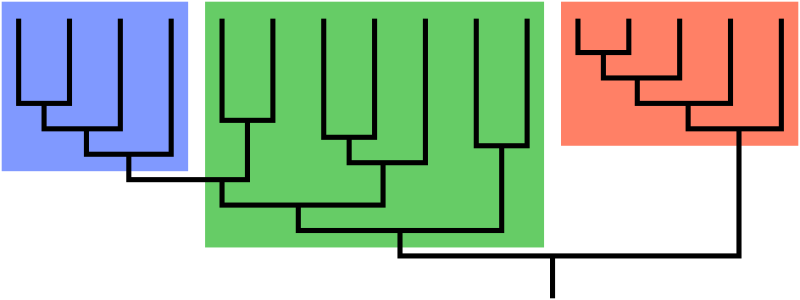
thumb|400px| Cladogram (a branching tree diagram) illustrating the relationships of organisms within groups of taxa known as clades. The vertical line (stem) at the base (bottom) represents the [[last common ancestor. The blue and red subgroups are clades, each defined by a common ancestor stem at the base of its respective subgroup (branch). The green subgroup alone, however, is not a clade; it is a paraphyletic group relative to the blue subgroup because it excludes the blue branch, which shares the same common ancestor. Together, the green and blue subgroups form a clade.]]
A clade is a group of organisms that includes a common ancestor and all of its descendants, shown as branches on a tree diagram. Scientists use clades to understand evolutionary relationships because they reveal which species are most closely related by shared ancestry.
AI-generated from the Wikipedia summary — may contain errors.
In the Vinony graph
Vinony's link graph records 5,713 inbound references to clade, and connects out to monophyly, eukaryote and extinction.
It sits within the topics 1950s neologisms, Evolutionary biology terminology and Philosophy of biology.
Vinony links it to 72 Wikipedia language editions.
Wikidata facts
- Instance of
- taxonomic rank
- Subclass of
- taxon
- Part of
- cladistics
- Image
- Cladogram Crocodilia NL.PNG
Show 3 more facts
- topic has template
- Template:Clade
- manifestation of
- monophyly
- has characteristic
- monophyly
Sources (2)
via Wikidata · CC0
~9 min read
Encyclopedic overview
12 sectionsContents
- Naming and etymology
- History of nomenclature and taxonomy
- Definition
- Clades and phylogenetic trees
- Terminology
- Age
- Viruses
- See also
- Notes
- References
- Bibliography
- External links
thumb|400px| Cladogram (a branching tree diagram) illustrating the relationships of organisms within groups of taxa known as clades. The vertical line (stem) at the base (bottom) represents the [[last common ancestor. The blue and red subgroups are clades, each defined by a common ancestor stem at the base of its respective subgroup (branch). The green subgroup alone, however, is not a clade; it is a paraphyletic group relative to the blue subgroup because it excludes the blue branch, which shares the same common ancestor. Together, the green and blue subgroups form a clade.]]
In biology, a clade () (), also known as a monophyletic group or natural group, is a group of organisms that is composed of a common ancestor and all of its descendants. Clades are the fundamental unit of cladistics, a modern approach to taxonomy adopted by most biological fields.
Excerpted from Wikipedia’s “clade” article, available under the CC BY-SA 4.0 licence.
Gallery (15)
Available in 72 languages
- Español
- Français
- Deutsch
- 中文
- 日本語
- Русский
- Português
- Italiano
- العربية
- हिन्दी
- Afrikaans
- Aragonese
- Armenian
- Asturian
- Azerbaijani
- Bahasa Indonesia
- Basque
- Belarusian
Show 53 more
- Bosnian
- Bulgarian
- Catalan
- Chuvash
- Czech
- Esperanto
- Estonian
- Finnish
- Galician
- Georgian
- Greek
- Hebrew
- Hungarian
- Icelandic
- Iloko
- Interlingua
- Irish
- Javanese
- Kabyle
- Kashmiri
- Latin
- Latvian
- Limburgish
- Low German
- Macedonian
- Malay
- Malayalam
- Maltese
- Manx
- Marathi
- Moroccan Arabic
- Nederlands
- Norwegian
- Polski
- Romanian
- Serbian
- Serbian (Latin)
- Sindhi
- Slovak
- Slovenian
- Svenska
- Tamil
- Tiếng Việt
- Türkçe
- Ukrainian
- Venetian
- West Flemish
- Western Frisian
- Wu Chinese
- zh_yue
- فارسی
- ไทย
- 한국어
via Wikidata sitelinks · CC0