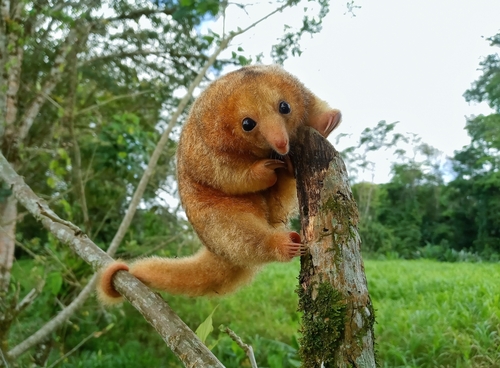
(c) Anthony Ramírez Murillo, some rights reserved (CC BY-NC), uploaded by Anthony Ramírez Murillo · cc-by-nc
Silky anteater
Sign in to saveAlso known as Cyclopes Badajatus Camachus, Cyclopes didactylus, Pygmy anteater
species of mammal
OverviewAI-generated
The Silky anteater, scientifically named *Cyclopes didactylus*, is a species within the genus *Cyclopes*. It is also referred to by the common names Pygmy anteater, Inti Pelejo, Serafín, and Serafín del Platanar. This organism belongs to the class Mammalia and is identified by the short name C. didactylus.
The taxon range for this species is listed as Belém. According to the IUCN Red List, its conservation status was assessed as Least Concern in 2014. The species has been recorded in 308 observations on iNaturalist.
Synthesized by Vinony from 17 facts across 4 sources: Wikidata, iNaturalist, IUCN Red List, Vinony graph. Generated from structured data (not the Wikipedia text) and checked against those facts — may still contain errors.
Species
Least ConcernNorthern Silky Anteater
species
二名法 Cyclopes didactylus(Linnaeus, 1758) 侏食蟻獸(學名:Cyclopes didactylus),貧齒總目披毛目侏食蟻獸科的單科種,分佈于中美洲和南美洲從墨西哥最南端到巴西、巴拉圭的廣大地區。 侏食蟻獸是4種食蟻獸中體型最小的一種,體長只有36-45釐米,體重小於400克。體毛軟密,呈金褐色,口鼻部較短,尾能捲曲,前爪上有兩個大爪。 食物以蚂蚁或腐烂的水果等。 最近基因硏究顯示其實侏食蟻獸至少分為七種,而非以往的一種[2]。 亞種 約有6種亞種: Cyclopes didactylus catellus Thomas, 1928 Cyclopes didactylus dorsalis Gray, 1865 Cyclopes didactylus eva Thomas, 1902 Cyclopes didactylus ida Thomas, 1900 Cyclopes didactylus melini Lönnberg, 1928 Cyclopes didactylus mexicanus Hollister, 1914 參考 ^ Cyclopes didactylus. IUCN Red List of Threatened Species 2008. International Union for Conservation of Nature. 2008. ^ Miranda, Flávia R.; Casali, Daniel M.; Perini, Fernando A.; Machado, Fabio A.; Santos, Fabrício R. Taxonomic review of the genus Cyclopes Gray, 1821 (Xenarthra: Pilosa), with the revalidation and description of new species. Zoological Journal of the Linnean Society. 2017. doi:10.1093/zoolinnean/zlx079. 查 论 编 按亞目分類的披毛目現存物種 界 動物界 · 門 脊索動物門 · 綱 哺乳綱 · 亞綱 真獸亞綱 · 總目 異關節總目 樹懶亞目 Folivora (樹懶) 樹懶科 Bradypodidae 樹懶屬 Bradypus 侏三趾樹懶(B. pygmaeus) · 鬃毛三趾樹懶(B. torquatus) · 白喉三趾樹懶(B. tridactylus) · 褐喉三趾樹懶(B. variegatus) 二趾樹懶科 Megalonychidae 二趾樹懶屬 Choloepus 二趾樹懶(C. didactylus) · 霍氏樹懶(C. hoffmanni)
via IUCN
Wikidata facts
Show 7 more facts
- taxon rank
- species
- IUCN conservation status
- Least Concern
- Commons category
- Cyclopes didactylus
- taxon name
- Cyclopes didactylus
- taxon common name
- mrówkojad karłowaty
- short name
- C. didactylus
- taxon range
- Belém
Sources (5)
via Wikidata · CC0
~7 min read
Encyclopedic overview
The silky anteater, also known as the pygmy anteater, has traditionally been considered a single species of anteater, Cyclopes didactylus, in the genus Cyclopes, the only living genus in the family Cyclopedidae. Found in southern Mexico, and Central and South America, it is the smallest of all known anteaters. It has nocturnal habits and appears to be completely arboreal; its hind feet are highly modified for climbing.
A taxonomic review in 2017, including both molecular and morphological evidence, found that Cyclopes may actually comprise at least seven species. The only known extinct cyclopedid species is Palaeomyrmidon incomtus, from the Late Miocene (c. 7 to 9 million years ago) of modern-day Argentina.
Excerpted from Wikipedia’s “Silky anteater” article, available under the CC BY-SA 4.0 licence.