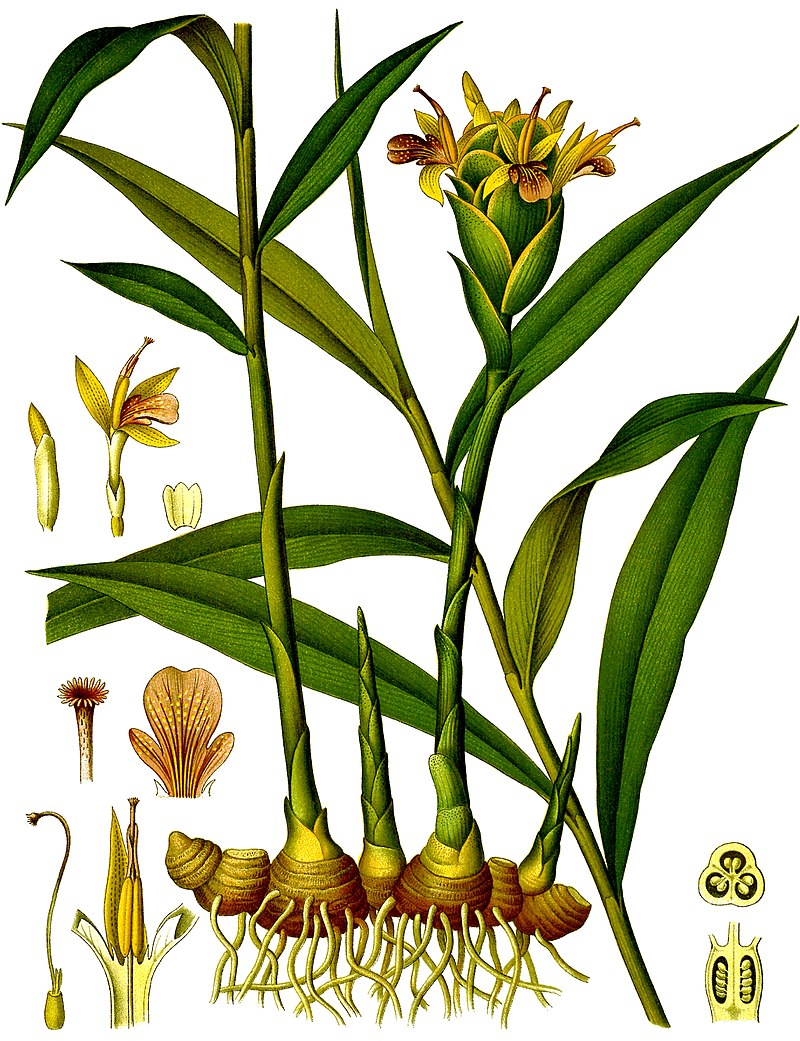
File:Koeh-146-no_text.jpg · Wikimedia Commons · See Wikimedia Commons
زنجبیل
Sign in to saveAlso known as Zingiber officinale, ginger root
Ginger (Zingiber officinale) is a flowering plant whose rhizome, ginger root or ginger, is widely used as a spice and a folk medicine. It is an herbaceous perennial that grows annual pseudostems (false stems made of the rolled bases of leaves) about one meter tall, bearing narrow leaf blades. The inflorescences bear flowers having pale yellow petals with purple edges, and arise directly from the rhizome on separate shoots.
OverviewAI-generated
Zingiber officinale, commonly known as ginger, is a species within the genus Zingiber. It serves as the source of the spice, vegetable, and medicinal plant also called ginger. The taxon is classified under the family Zingiberaceae and is described by Roscoe. Its fruit type is a capsule.
The species has a range including China, Fujian, Guangdong, Maranhão, Assam, China South-Central, and the East Himalaya. It is considered a useful plant and has uses as a spice, vegetable, and medicinal plant. The IUCN conservation status is Data Deficient, as recorded in 2020. Ginger may cause allergic reactions when applied.
The taxon is referenced by 2,319 other encyclopedia articles. There are 7,285 PubMed records for ginger. Common names include garden ginger, 薑, and Cooking Ginger. The water footprint is 1657.
Synthesized by Vinony from 31 facts across 5 sources: Wikidata, PubMed, IUCN Red List, Plants of the World, Vinony graph. Generated from structured data (not the Wikipedia text) and checked against those facts — may still contain errors.
Species
Data DeficientZingiber officinale, the root ginger of commerce, is cultivated in the Hazara region m Haripur and Tret. Also cultivated in the Sind and Punjab Plains. It is always propagated by rhizomes. The rhizomes are dug up while the plant is in the vegetative state and thus it rarely flowers.
via IUCN · Kew POWO
Key facts
- Nutritional value.name
- Ginger root (raw)
- Nutritional value.image
- Ginger cross section.jpg
- Nutritional value.caption
- Cross-section of ginger root
- Nutritional value.kJ
- 333
- Nutritional value.water
- 79 g
- Nutritional value.protein
- 1.82 g
- Nutritional value.fat
- 0.75 g
- Nutritional value.carbs
- 17.77 g
- Nutritional value.fiber
- 2 g
- Nutritional value.sugars
- 1.7 g
- Nutritional value.calcium_mg
- 16
- Nutritional value.iron_mg
- 0.6
- Nutritional value.magnesium_mg
- 43
- Nutritional value.phosphorus_mg
- 34
- Nutritional value.potassium_mg
- 415
- Nutritional value.sodium_mg
- 13
- Nutritional value.zinc_mg
- 0.34
- Nutritional value.manganese_mg
- 0.229
via Wikipedia infobox
Research
7,285 papers- Zingiber officinale var. rubrum: Red Ginger's Medicinal Uses.ReviewMolecules (Basel, Switzerland) · 2022Zhang S, Kou X, Zhao H et al.DOI: 10.3390/molecules27030775
- Gingerols and shogaols: Important nutraceutical principles from ginger.ReviewPhytochemistry · 2015Semwal RB, Semwal DK, Combrinck S et al.DOI: 10.1016/j.phytochem.2015.07.012
- Ginger and its constituents in asthma: a mini-review.ReviewThe Journal of asthma : official journal of the Association for the Care of Asthma · 2024Ahmed Abdelmawgood I, Sayed AM, Mohamed OA et al.DOI: 10.1080/02770903.2024.2361779
- Ginger for treating nausea and vomiting: an overview of systematic reviews and meta-analyses.ReviewInternational journal of food sciences and nutrition · 2024Li Z, Wu J, Song J et al.DOI: 10.1080/09637486.2023.2284647
- Ginger (Zingiber officinale Rosc.) and its bioactive components are potential resources for health beneficial agents.Phytotherapy research : PTR · 2021Zhang M, Zhao R, Wang D et al.DOI: 10.1002/ptr.6858
- Ginger and Testosterone.ReviewBiomolecules · 2018Banihani SADOI: 10.3390/biom8040119
- Some phytochemical, pharmacological and toxicological properties of ginger (Zingiber officinale Roscoe): a review of recent research.ReviewFood and chemical toxicology : an international journal published for the British Industrial Biological Research Association · 2008Ali BH, Blunden G, Tanira MO et al.DOI: 10.1016/j.fct.2007.09.085
- Effects of a ginger extract on knee pain in patients with osteoarthritis.Arthritis and rheumatism · 2001Altman RD, Marcussen KCDOI: 10.1002/1529-0131(200111)44:11<2531::aid-art433>3.0.co;2-j
via PubMed
Wikidata facts
Show 15 more facts
- taxon rank
- species
- taxon name
- Zingiber officinale
- Commons category
- Zingiber officinale
- topic's main category
- Category:Ginger
- Commons gallery
- Zingiber officinale
- taxon common name
- வேர்க்கம்பு
- has fruit type
- capsule
- IUCN conservation status
- Data Deficient
- taxon range
- Gabon
- on focus list of Wikimedia project
- Wikipedia:Vital articles/Level/4
- water footprint
- 1657
- short name
- Z. officinale
- taxon author citation
- Roscoe
- external data available at URL
- www.gbif.org/dataset/31dc1507-a6e1-4233-a8df-c7a78596a7e4
Sources (14)
via Wikidata · CC0
Gallery (30)
Available in 161 languages
- Español
- Français
- Deutsch
- 中文
- 日本語
- Русский
- Português
- Italiano
- العربية
- हिन्दी
- Achinese
- Afrikaans
- Akan
- Albanian
- Amharic
- ami
- Aragonese
- Aramaic
Show 142 more
- Armenian
- Assamese
- Asturian
- Azerbaijani
- Bahasa Indonesia
- Balinese
- Bangla
- Banjar
- Basque
- bat_smg
- Betawi
- Bikol
- Bislama
- Bosnian
- Breton
- Bulgarian
- Burmese
- Catalan
- cdo
- Cebuano
- Central Dusun
- Central Kurdish
- Croatian
- Czech
- dag
- Danish
- Egyptian Arabic
- Esperanto
- Estonian
- Filipino
- Finnish
- fiu_vro
- Fon
- Fula
- Galician
- Ganda
- Georgian
- Goan Konkani
- Gorontalo
- Greek
- Gujarati
- Haitian Creole
- Hakka Chinese
- Hausa
- Hebrew
- Hungarian
- hyw
- Iban
- Icelandic
- Ido
- Igbo
- Irish
- Javanese
- Kannada
- Kashmiri
- Kazakh
- kge
- Khmer
- Kikuyu
- Komi
- Komi-Permyak
- Kurdish
- Latin
- Latvian
- Lezghian
- Limburgish
- Lingala
- Lithuanian
- Macedonian
- Madurese
- Maithili
- Malagasy
- Malay
- Malayalam
- Manipuri
- Marathi
- Minangkabau
- mnw
- nds_nl
- Nederlands
- Nepali
- Nias
- Northern Frisian
- Norwegian
- Norwegian Nynorsk
- nrm
- Occitan
- Odia
- Old English
- Ossetic
- Pampanga
- Pashto
- Polski
- Punjabi
- pwn
- Quechua
- Romanian
- Sanskrit
- Santali
- Scots
- Scottish Gaelic
- Serbian
- Serbian (Latin)
- Shan
- Sicilian
- simple
- Sindhi
- Sinhala
- Slovak
- Slovenian
- Sundanese
- Svenska
- Swahili
- szy
- Tahitian
- Tajik
- Tamil
- Telugu
- Tibetan
- Tiếng Việt
- Tulu
- Türkçe
- Tyap
- Ukrainian
- Upper Sorbian
- Urdu
- Uyghur
- Uzbek
- Waray
- Welsh
- West Flemish
- Western Panjabi
- Wu Chinese
- Yiddish
- Yoruba
- zh_classical
- zh_min_nan
- zh_yue
- Zhuang
- فارسی
- ไทย
- 한국어
via Wikidata sitelinks · CC0