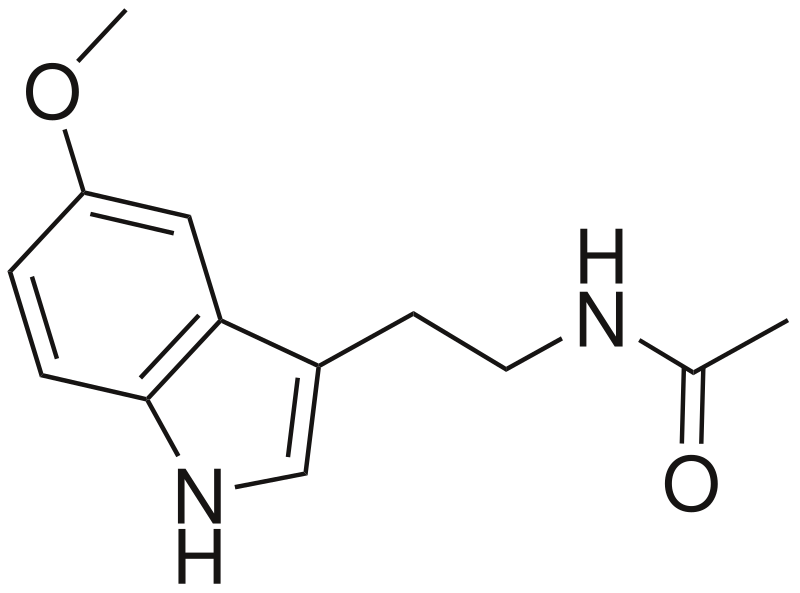
File:Melatonin.svg · Wikimedia Commons · See Wikimedia Commons
メラトニン
Sign in to saveAlso known as MLT, N-[2-(5-methoxyindol-3-yl)ethyl]acetamide, 5-methoxy-N-acetyltryptamine, Melovine, {N-[2-(5-methoxy-1H-indol-3-yl)ethyl]-} Acetamide, N-(2-(5-Methoxyindol-3-yl)ethyl)-Acetamide, N-Acetyl-5-methoxy-tryptamine, N-[2-(5-Methoxyindol-3-yl)ethyl]-Acetamide
動物、植物、微生物に存在する内因性ホルモン
OverviewAI-generated
Melatonin is a chemical compound with the formula C₁₃H₁₆N₂O₂. Its IUPAC name is N-[2-(5-methoxy-1H-indol-3-yl)ethyl]acetamide. The substance has a mass of 232.121 and a weight of 232.28. It carries a charge of 0 and features two hydrogen bond donors and two hydrogen bond acceptors. The calculated xlogp value is 0.8, while the topological polar surface area (TPSA) is 54.1.
The defined daily dose for melatonin is 2.0. The compound is associated with a PubMed query count of 37218. It is referenced by 1,555 other encyclopedia articles.
Synthesized by Vinony from 20 facts across 4 sources: Wikidata, PubChem, PubMed, Vinony graph. Generated from structured data (not the Wikipedia text) and checked against those facts — may still contain errors.
Chemical data
- Formula
- C13H16N2O2
- Molecular weight
- 232.28 g/mol
- IUPAC name
- N-[2-(5-methoxy-1H-indol-3-yl)ethyl]acetamide
- SMILES
- CC(=O)NCCC1=CNC2=C1C=C(C=C2)OC
- InChIKey
- DRLFMBDRBRZALE-UHFFFAOYSA-N
- XLogP
- 0.8
- Polar surface area
- 54.1 Ų
- H-bond donors
- 2
- H-bond acceptors
- 2
- Formal charge
- 0
via PubChem
Drug data · ChEMBL
- Max clinical phase
- Approved
- Molecule type
- Small molecule
- First approval
- 2007
- Admin. routes
- oral
- Indications
- sunburn, substance withdrawal syndrome, aortic aneurysm, metabolic syndrome
via ChEMBL · EBI
Research
37,218 papersvia PubMed
Wikidata facts
- Subclass of
- hormone
- Has part
- carbon
- Mass
- 232.121
- Has use
- medication
Show 11 more facts
- medical condition treated
- jet lag
- Commons category
- Melatonin
- found in taxon
- Trigonella foenum-graecum
- chemical formula
- C₁₃H₁₆N₂O₂
- topic's main category
- Category:Melatonin
- canonical SMILES
- CC(=O)NCCC1=CNC2=C1C=C(C=C2)OC
- isomeric SMILES
- C/C(=N\CCC1=CNC2=C1C=C(C=C2)OC)/O
- defined daily dose
- 2.0
- subject has role
- primary metabolite
- different from
- melanin
Sources (11)
via Wikidata · CC0
Article · 日本語
メラトニン(英: Melatonin)は、動物、植物、微生物に存在する内因性ホルモンであり、また化学的にN-アセチル-5-メトキシトリプタミン (N-acetyl-5-methoxytryptamine) として知られる。日本では、これまで公に小児に対して使用できる睡眠薬がなかったが、2020年に商品名メラトベルで処方箋医薬品として「小児期の神経発達症に伴う入眠困難の改善」の適応で初めて承認された。動物では、メラトニンの血中濃度は1日の周期で変化しており、それぞれの生物学的な機能における概日リズムによる同調を行っている。メラトニンによる多くの生物学的な効果は、の活性を通して生成され、他にも広範囲にわたる強力な抗酸化物質としての役割によって、特に核DNAやミトコンドリアDNAを保護する。 メラトニンはアメリカ食品医薬品局(FDA)によってサプリメントに分類されており、医薬品ではない。メラトニンの徐放製剤は、2007年に欧州医薬品庁によって55歳以上の人々に対して処方箋医薬品としてCircadinが承認されたが、小さな効果しか示していない。メラトニン徐放製剤が症状を呈するオーストラリアでは2009年に承認された。ヒトが長期間にわたり外部から補給することによる完全な影響はまだ判明していない。また、2018年に欧州医薬品庁によって小児用メラトニン徐放製剤Slenytoが「小児及び青年期の自閉スペクトラム症及びスミス・マギネス症候群を伴う不眠症」の適応で承認された。
Abstract from DBpedia / Wikipedia · CC BY-SA
Gallery (15)
Available in 72 languages
- Español
- Français
- Deutsch
- 中文
- 日本語
- Русский
- Português
- Italiano
- العربية
- हिन्दी
- Armenian
- azb
- Azerbaijani
- Bahasa Indonesia
- Basque
- be_x_old
- Belarusian
- Bosnian
Show 53 more
- Bulgarian
- Burmese
- Catalan
- Central Kurdish
- Croatian
- Czech
- Danish
- Divehi
- Esperanto
- Estonian
- Extremaduran
- Finnish
- Galician
- Georgian
- Greek
- Gujarati
- Hebrew
- Hungarian
- Icelandic
- Irish
- Latin
- Latvian
- Lithuanian
- Macedonian
- Malay
- Malayalam
- Mongolian
- Nederlands
- Norwegian
- Norwegian Nynorsk
- Occitan
- Odia
- Polski
- Romanian
- Serbian
- Serbian (Latin)
- simple
- Slovak
- Slovenian
- Svenska
- Tajik
- Tamil
- Telugu
- Tiếng Việt
- Türkçe
- Ukrainian
- Urdu
- Uzbek
- Welsh
- Wu Chinese
- فارسی
- ไทย
- 한국어
via Wikidata sitelinks · CC0