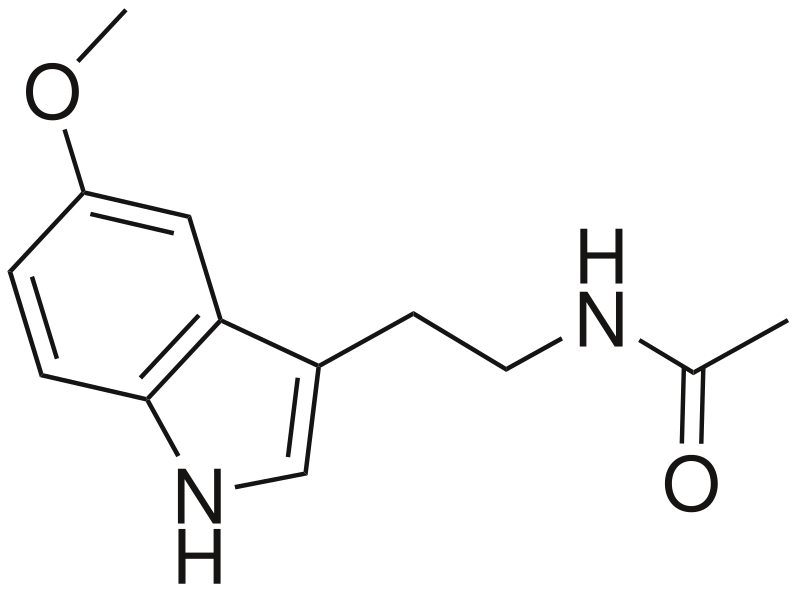
File:Melatonin.svg · Wikimedia Commons · See Wikimedia Commons
melatonine
Sign in to saveAlso known as MLT, N-[2-(5-methoxyindol-3-yl)ethyl]acetamide, 5-methoxy-N-acetyltryptamine, Melovine, {N-[2-(5-methoxy-1H-indol-3-yl)ethyl]-} Acetamide, N-(2-(5-Methoxyindol-3-yl)ethyl)-Acetamide, N-Acetyl-5-methoxy-tryptamine, N-[2-(5-Methoxyindol-3-yl)ethyl]-Acetamide
hormoon
OverviewAI-generated
Melatonin is a chemical compound with the formula C₁₃H₁₆N₂O₂. Its IUPAC name is N-[2-(5-methoxy-1H-indol-3-yl)ethyl]acetamide. The substance has a mass of 232.121 and a weight of 232.28. It carries a charge of 0 and features two hydrogen bond donors and two hydrogen bond acceptors. The calculated xlogp value is 0.8, while the topological polar surface area (TPSA) is 54.1.
The defined daily dose for melatonin is 2.0. The compound is associated with a PubMed query count of 37218. It is referenced by 1,555 other encyclopedia articles.
Synthesized by Vinony from 20 facts across 4 sources: Wikidata, PubChem, PubMed, Vinony graph. Generated from structured data (not the Wikipedia text) and checked against those facts — may still contain errors.
Chemical data
- Formula
- C13H16N2O2
- Molecular weight
- 232.28 g/mol
- IUPAC name
- N-[2-(5-methoxy-1H-indol-3-yl)ethyl]acetamide
- SMILES
- CC(=O)NCCC1=CNC2=C1C=C(C=C2)OC
- InChIKey
- DRLFMBDRBRZALE-UHFFFAOYSA-N
- XLogP
- 0.8
- Polar surface area
- 54.1 Ų
- H-bond donors
- 2
- H-bond acceptors
- 2
- Formal charge
- 0
via PubChem
Drug data · ChEMBL
- Max clinical phase
- Approved
- Molecule type
- Small molecule
- First approval
- 2007
- Admin. routes
- oral
- Indications
- sunburn, substance withdrawal syndrome, aortic aneurysm, metabolic syndrome
via ChEMBL · EBI
Research
37,218 papersvia PubMed
Wikidata facts
- Subclass of
- hormone
- Has part
- carbon
- Mass
- 232.121
- Has use
- medication
Show 11 more facts
- medical condition treated
- jet lag
- Commons category
- Melatonin
- found in taxon
- Trigonella foenum-graecum
- chemical formula
- C₁₃H₁₆N₂O₂
- topic's main category
- Category:Melatonin
- canonical SMILES
- CC(=O)NCCC1=CNC2=C1C=C(C=C2)OC
- isomeric SMILES
- C/C(=N\CCC1=CNC2=C1C=C(C=C2)OC)/O
- defined daily dose
- 2.0
- subject has role
- primary metabolite
- different from
- melanin
Sources (11)
via Wikidata · CC0
Article · Nederlands
Melatonine is een hormoon dat bij mensen in de pijnappelklier (epifyse) geproduceerd wordt uit serotonine en in een met de tijd van de dag variërende hoeveelheid aan het bloed en het hersenvocht wordt afgegeven. Het is bij veel diersoorten van invloed op het slaap-waakritme en het voortplantingsritme. Bij mensen is de natuurlijke productie van melatonine door de pijnappelklier direct gekoppeld aan de blootstelling aan licht van bepaalde receptoren in het netvlies van de ogen. Bij de aanwezigheid van blauwachtig licht (uit zonlicht of uit kunstlicht en beeldschermen) wordt de productie van melatonine geremd. Neemt de blootstelling aan licht af, dan komt de natuurlijke productie van melatonine weer op gang. Voor het lichaam is dit het signaal om de dag-activiteiten te verminderen en zich voor te bereiden op de nacht. Melatonine wordt als voedingssupplement en geneesmiddel ingezet bij de behandeling van slapeloosheid, zoals van jetlag of ploegendienst. Het wordt meestal via de mond ingenomen. Het wetenschappelijk bewijs voor de werking van metalonine bij dergelijke slaapproblemen is echter niet sterk. Uit een grootschalig onderzoek in 2017 bleek dat melatonine-inname geen grote invloed heeft op de totale slaaptijd of slaapkwaliteit. Desondanks kan gebruik van melatonine de symptomen van enkele slaapstoornissen verlichten.
Abstract from DBpedia / Wikipedia · CC BY-SA
Gallery (15)
Available in 72 languages
- Español
- Français
- Deutsch
- 中文
- 日本語
- Русский
- Português
- Italiano
- العربية
- हिन्दी
- Armenian
- azb
- Azerbaijani
- Bahasa Indonesia
- Basque
- be_x_old
- Belarusian
- Bosnian
Show 53 more
- Bulgarian
- Burmese
- Catalan
- Central Kurdish
- Croatian
- Czech
- Danish
- Divehi
- Esperanto
- Estonian
- Extremaduran
- Finnish
- Galician
- Georgian
- Greek
- Gujarati
- Hebrew
- Hungarian
- Icelandic
- Irish
- Latin
- Latvian
- Lithuanian
- Macedonian
- Malay
- Malayalam
- Mongolian
- Nederlands
- Norwegian
- Norwegian Nynorsk
- Occitan
- Odia
- Polski
- Romanian
- Serbian
- Serbian (Latin)
- simple
- Slovak
- Slovenian
- Svenska
- Tajik
- Tamil
- Telugu
- Tiếng Việt
- Türkçe
- Ukrainian
- Urdu
- Uzbek
- Welsh
- Wu Chinese
- فارسی
- ไทย
- 한국어
via Wikidata sitelinks · CC0