File:Weiselzellen_68a.jpg · Wikimedia Commons · See Wikimedia Commons
royal jelly
Sign in to saveAlso known as mateří kašička
secretion from the glands in the hypopharynx of nurse bees
Royal jelly is a nutrient-rich secretion produced by young worker bees from glands in their heads, which they use to feed developing bee larvae. It's particularly significant because queen bees are fed royal jelly exclusively throughout their development, which scientists believe plays a key role in determining whether a larva develops into a queen or a regular worker bee.
AI-generated from the Wikipedia summary — may contain errors.
Research
1,560 papers- Royal Jelly: Biological Action and Health Benefits.ReviewInternational journal of molecular sciences · 2024Oršolić N, Jazvinšćak Jembrek MDOI: 10.3390/ijms25116023
- Honey, Propolis, and Royal Jelly: A Comprehensive Review of Their Biological Actions and Health Benefits.ReviewOxidative medicine and cellular longevity · 2017Pasupuleti VR, Sammugam L, Ramesh N et al.DOI: 10.1155/2017/1259510
- Royal jelly and its hormonal effects in breast cancer: a literature review.Daru : journal of Faculty of Pharmacy, Tehran University of Medical Sciences · 2024Aavani F, Rahimi R, Goleij P et al.DOI: 10.1007/s40199-024-00513-2
- Royal Jelly-A Traditional and Natural Remedy for Postmenopausal Symptoms and Aging-Related Pathologies.ReviewMolecules (Basel, Switzerland) · 2020Bălan A, Moga MA, Dima L et al.DOI: 10.3390/molecules25143291
- Neuroregulatory effect of royal jelly.ReviewThe Journal of nutritional biochemistry · 2025Zhu F, Yang R, He B et al.DOI: 10.1016/j.jnutbio.2025.110028
- Royal Jelly: An ancient remedy with remarkable antibacterial properties.ReviewMicrobiological research · 2016Fratini F, Cilia G, Mancini S et al.DOI: 10.1016/j.micres.2016.06.007
- Royal Jelly and Its Components Promote Healthy Aging and Longevity: From Animal Models to Humans.ReviewInternational journal of molecular sciences · 2019Kunugi H, Mohammed Ali ADOI: 10.3390/ijms20194662
- Effect of royal jelly to deal with stress oxidative in preconception women: A literature review.ReviewGaceta sanitaria · 2021Rizki AMF, Usman AN, Raya I et al.DOI: 10.1016/j.gaceta.2021.10.036
via PubMed
Wikidata facts
- Instance of
- mixture
- Subclass of
- food
- Has part
- alpha,alpha-trehalose
- Image
- Weiselzellen 79a.jpg
- Has use
- medication
Show 3 more facts
- Commons category
- Royal jelly
- produced by
- Apis mellifera
- natural product of taxon
- Apis mellifera
via Wikidata · CC0
~6 min read
Encyclopedic overview
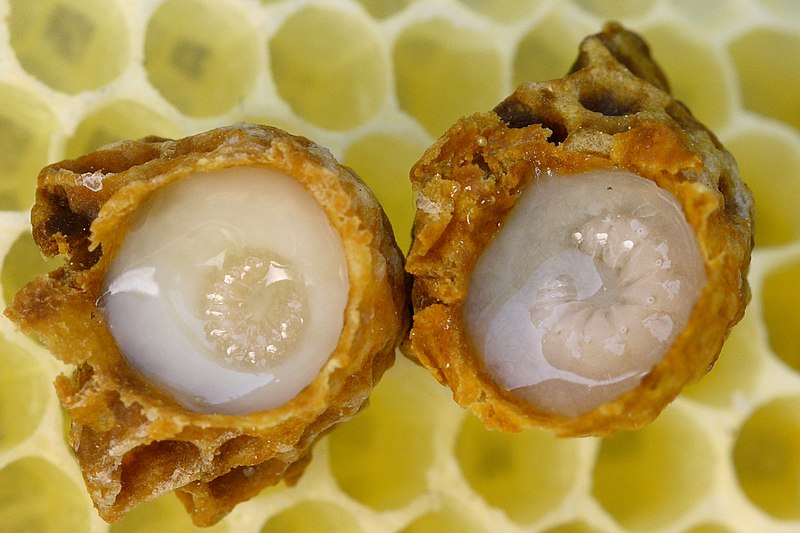
Developing queen larvae surrounded by royal jelly Royal jelly is a honey bee secretion that is used in the nutrition of larvae and adult queens. It is secreted from the glands in the hypopharynx of nurse bees, and fed to all larvae in the colony, regardless of sex or caste.
Queen larva in a cell on a frame with bees During the process of creating new queens, the workers construct special queen cells. The larvae in these cells are fed with copious amounts of royal jelly. This type of feeding in part triggers the development of queen morphology, including the fully developed ovaries needed to lay eggs. Note however that some newer research shows it is not solely the presence of royal jelly that develops the queen but rather the absence of certain other nutrients fed to worker bees.
Excerpted from Wikipedia’s “royal jelly” article, available under the CC BY-SA 4.0 licence.