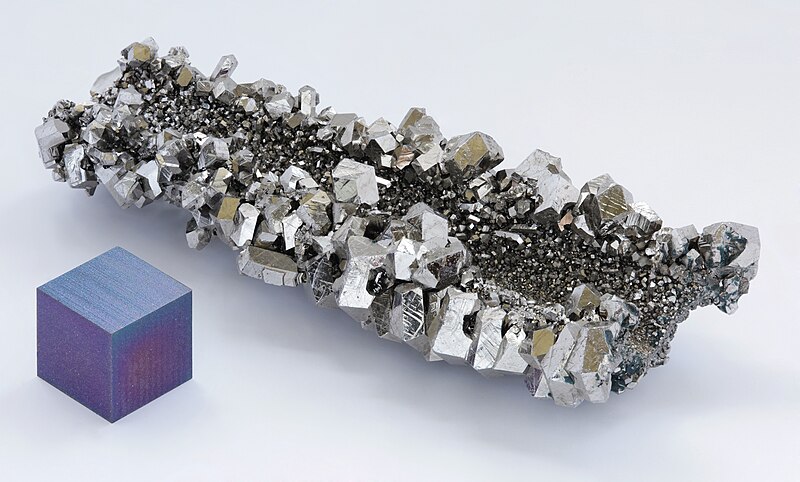
File:Niobium_crystals_and_1cm3_cube.jpg · Wikimedia Commons · See Wikimedia Commons
niobium
Sign in to saveAlso known as Nb, element 41, 41Nb, columbium, Cb, Columbite
Niobium is a chemical element; it has symbol Nb (formerly columbium, Cb) and atomic number 41. It is a light grey, crystalline transition metal. Pure niobium has a Mohs hardness rating similar to pure titanium, and it has similar ductility to iron. Niobium oxidizes in Earth's atmosphere very slowly, hence its application in jewelry as a hypoallergenic alternative to nickel. Niobium is found in the minerals pyrochlore and columbite, as well as other minerals. Its name comes from Greek mythology: Niobe, daughter of Tantalus, the namesake of tantalum. The name reflects the great similarity betwee
OverviewAI-generated
Niobium is a chemical element with the symbol Nb and atomic number 41. It was discovered in 1801. The element is also referred to by the symbol Cb. Its standard chemical formula is Nb, and it is represented by the Unicode character 鈮.
The atomic mass of niobium is 92.90637. It has an electronegativity of 2 and an ionic radius of 0.79. The primary oxidation state is 5. Its electron configuration is [Kr] 4d⁴ 5s¹. In its elemental form, it has a charge of 0 and no hydrogen bond donors or acceptors.
Research interest in the element is reflected in medical literature, with 4,203 PubMed articles referencing niobium. It is also cited by 1,340 other encyclopedia articles.
Synthesized by Vinony from 25 facts across 4 sources: Wikidata, PubChem, PubMed, Vinony graph. Generated from structured data (not the Wikipedia text) and checked against those facts — may still contain errors.
Chemical data
- Formula
- Nb
- Molecular weight
- 92.90637 g/mol
- IUPAC name
- niobium
- SMILES
- [Nb]
- InChIKey
- GUCVJGMIXFAOAE-UHFFFAOYSA-N
- Polar surface area
- 0 Ų
- H-bond donors
- 0
- H-bond acceptors
- 0
- Formal charge
- 0
via PubChem
Research
4,203 papers- Niobium: The Focus on Catalytic Application in the Conversion of Biomass and Biomass Derivatives.ReviewMolecules (Basel, Switzerland) · 2023Oliveira L, Pereira M, Pacheli Heitman A et al.DOI: 10.3390/molecules28041527
- Electrochemical biosensors based on niobium-containing oxides: A review.ReviewAnalytica chimica acta · 2025Gotardi J, Dos Santos Júnior AG, Gnoatto SCB et al.DOI: 10.1016/j.aca.2025.344239
- Bio-functional niobium-based metallic biomaterials: Exploring their physicomechanical properties, biological significance, and implant applications.ReviewActa biomaterialia · 2025Liu Z, Zhao MC, Yin D et al.DOI: 10.1016/j.actbio.2024.12.036
- Niobium-Containing Phosphate Glasses Prepared by the Liquid-Phase Method.International journal of molecular sciences · 2024Takahashi M, Shiraki S, Lee S et al.DOI: 10.3390/ijms26010161
- Niobium-containing bioactive glasses modulate alkaline phosphatase activity during bone repair.Journal of biomedical materials research. Part B, Applied biomaterials · 2023de Souza Balbinot G, Leitune VCB, da Cunha Bahlis EA et al.DOI: 10.1002/jbm.b.35227
- Niobium silicate particles as bioactive fillers for composite resins.Dental materials : official publication of the Academy of Dental Materials · 2020Balbinot GS, Leitune VCB, Ogliari FA et al.DOI: 10.1016/j.dental.2020.09.010
- Manipulate intestinal organoids with niobium carbide nanosheets.Journal of biomedical materials research. Part A · 2021Reding B, Carter P, Qi Y et al.DOI: 10.1002/jbm.a.37032
- Niobium-based single-atom catalyst promoted fractionation of lignocellulose in choline chloride-lactic acid deep eutectic solvent.International journal of biological macromolecules · 2024Wu Z, Wang T, Zhao Z et al.DOI: 10.1016/j.ijbiomac.2024.132055
via PubMed
Wikidata facts
- Instance of
- lithophile
- Subclass of
- period 5
- Part of
- group 5
- Named after
- Niobe
- Mass
- 92.90637
- Image
- Niobium crystals and 1cm3 cube.jpg
Show 17 more facts
- atomic number
- 41
- time of discovery or invention
- 1801-00-00
- element symbol
- Cb
- discoverer or inventor
- Charles Hatchett
- Commons category
- Niobium
- topic's main category
- Category:Niobium
- described by source
- New International Encyclopedia
- Commons gallery
- Niobium
- chemical formula
- Nb
- canonical SMILES
- [Nb]
- electronegativity
- 2
- location of discovery
- United Kingdom
- Unicode character
- 鈮
- ionic radius
- 0.74
- oxidation state
- 5
- electron configuration
- [Kr] 4d⁴ 5s¹
- on focus list of Wikimedia project
- Wikipedia:Vital articles/Level/4
Sources (7)
via Wikidata · CC0
~31 min read
Encyclopedic overview
26 sectionsContents
- History
- Naming the element
- Characteristics
- Physical
- Chemical
- Isotopes
- Occurrence
- Production
- Compounds
- Oxides, niobates and sulfides
- Halides
- Nitrides and carbides
- Applications
- Steel production
- Superalloys
- Niobium-based alloys
- Superconducting magnets
- Other superconductors
- Other uses
- Electroceramics
- Hypoallergenic applications: medicine and jewelry
- Numismatics
- Other
- Precautions
- References
- External links
Niobium is a chemical element; it has symbol Nb (formerly columbium, Cb) and atomic number 41. It is a light grey, crystalline transition metal. Pure niobium has a Mohs hardness rating similar to pure titanium, and it has similar ductility to iron. Niobium oxidizes in Earth's atmosphere very slowly, hence its application in jewelry as a hypoallergenic alternative to nickel. Niobium is found in the minerals pyrochlore and columbite, as well as other minerals. Its name comes from Greek mythology: Niobe, daughter of Tantalus, the namesake of tantalum. The name reflects the great similarity between the two elements in their physical and chemical properties, which makes them difficult to distinguish.
English chemist Charles Hatchett reported a new element similar to tantalum in 1801 and named it columbium. In 1809, English chemist William Hyde Wollaston wrongly concluded that tantalum and columbium were identical. German chemist Heinrich Rose determined in 1846 that tantalum ores contain a second element, which he named niobium. In 1864 and 1865, a series of scientific findings clarified that niobium and columbium were the same element (as distinguished from tantalum), and for a century both names were used interchangeably. Niobium was officially adopted as the name of the element in 1949, but the name columbium remains in current use in metallurgy in the United States.
Excerpted from Wikipedia’s “niobium” article, available under the CC BY-SA 4.0 licence.
Gallery (35)
Available in 148 languages
- Español
- Français
- Deutsch
- 中文
- 日本語
- Русский
- Português
- Italiano
- العربية
- हिन्दी
- abstract
- Afrikaans
- Albanian
- Amharic
- Angika
- Aragonese
- Armenian
- Asturian
Show 129 more
- Azerbaijani
- Bahasa Indonesia
- Balinese
- Bangla
- Basque
- be_x_old
- Belarusian
- Bhojpuri
- Bikol
- Bosnian
- Breton
- Bulgarian
- Burmese
- Catalan
- cdo
- Cebuano
- Central Kurdish
- Chuvash
- Cornish
- Corsican
- Croatian
- Czech
- Danish
- Egyptian Arabic
- Esperanto
- Estonian
- Fiji Hindi
- Filipino
- Finnish
- Friulian
- Galician
- Georgian
- Greek
- Gujarati
- Haitian Creole
- Hakka Chinese
- Hebrew
- Hungarian
- Icelandic
- Ido
- Interlingua
- Irish
- Javanese
- Kalmyk
- Kannada
- Kazakh
- kbp
- Komi
- Kotava
- Kurdish
- Kyrgyz
- Latin
- Latvian
- Ligurian
- Limburgish
- Lithuanian
- Lojban
- Lombard
- Luxembourgish
- Macedonian
- Malagasy
- Malay
- Malayalam
- Manx
- Marathi
- Moksha
- Mongolian
- Moroccan Arabic
- nah
- Nederlands
- Newari
- Northern Frisian
- Norwegian
- Norwegian Nynorsk
- Novial
- Occitan
- Odia
- olo
- Ossetic
- Pashto
- Piedmontese
- Polski
- Punjabi
- Quechua
- roa_rup
- Romanian
- Sanskrit
- Sardinian
- Saterland Frisian
- Scots
- Scottish Gaelic
- Serbian
- Serbian (Latin)
- Sicilian
- simple
- Sindhi
- Slovak
- Slovenian
- Somali
- Sundanese
- Svenska
- Swahili
- Tajik
- Tamil
- Tatar
- Telugu
- Tibetan
- Tiếng Việt
- Toki Pona
- Türkçe
- Ukrainian
- Urdu
- Uyghur
- Uzbek
- Veps
- Waray
- Welsh
- Western Mari
- Western Panjabi
- Wu Chinese
- Yiddish
- Yoruba
- zh_classical
- zh_min_nan
- zh_yue
- Zulu
- فارسی
- ไทย
- 한국어
via Wikidata sitelinks · CC0