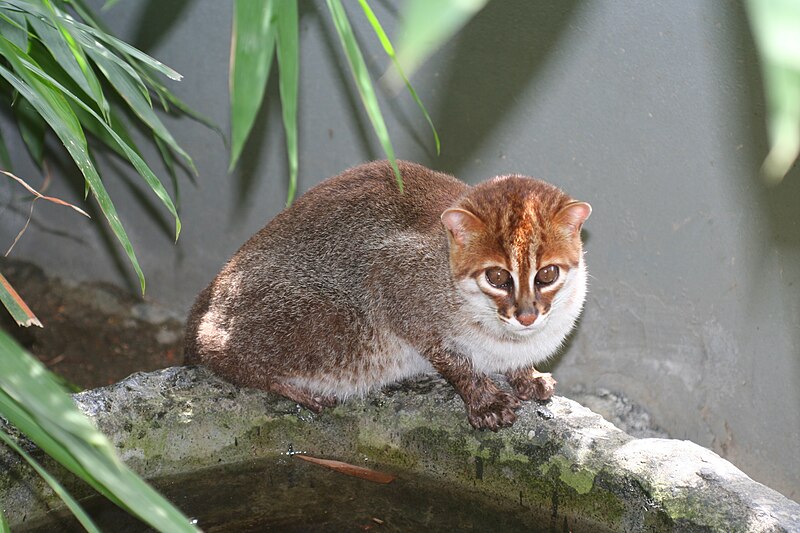
File:Flat-headed_cat_1_Jim_Sanderson.JPG · Wikimedia Commons · See Wikimedia Commons
OverviewAI-generated
The flat-headed cat, scientifically named *Prionailurus planiceps*, is a species within the genus *Prionailurus*. It is also referred to by the common names Gato Cabeciancho and Chat à tête plate. This mammal is classified as Endangered on the IUCN Red List, a status assigned in 2015. Additionally, it is listed in Appendix I of CITES.
The longest observed lifespan for this species is 14 years. The taxon has been recorded in 22 observations on iNaturalist.
Synthesized by Vinony from 18 facts across 4 sources: Wikidata, IUCN Red List, iNaturalist, Vinony graph. Generated from structured data (not the Wikipedia text) and checked against those facts — may still contain errors.
Species
EndangeredFlat-headed Cat
species
Maximum longevity: 14 years (captivity) Observations: One wild born specimen was about 14 years old when it died in captivity (Richard Weigl 2005). Maximum longevity could be slightly underestimated, though, because similar species appear to live slightly longer.
via IUCN
Wikidata facts
- Instance of
- taxon
- Parent taxon
- Prionailurus
- Image
- Prionailurus planiceps cropped.png
Show 8 more facts
- taxon rank
- species
- IUCN conservation status
- Endangered status
- Commons category
- Prionailurus planiceps
- taxon name
- Prionailurus planiceps
- taxon common name
- ploščatoglava mačka
- longest observed lifespan
- 14
- CITES Appendix
- Appendix I of CITES
- short name
- P. planiceps
Sources (2)
via Wikidata · CC0
~11 min read
Encyclopedic overview
The flat-headed cat (Prionailurus planiceps) is a small wild cat with short reddish-brown fur. Its head is elongated, and its ears are rounded. Its slender body is 41 to 50 cm (16 to 20 in) long with a tail of 13 to 15 cm (5.1 to 5.9 in), and it weighs 1.5 to 2.5 kg (3.3 to 5.5 lb).
The flat-headed cat was first described in 1827 based on a zoological specimen collected in Sumatra. It is also native to the Thai-Malay Peninsula and Borneo, and inhabits wetlands like mixed freshwater swamp forests, peat swamp forests and lowland freshwater swamps near rivers and coastal areas. It preys foremost on fish, frogs and crustaceans.
Excerpted from Wikipedia’s “Flat-headed cat” article, available under the CC BY-SA 4.0 licence.