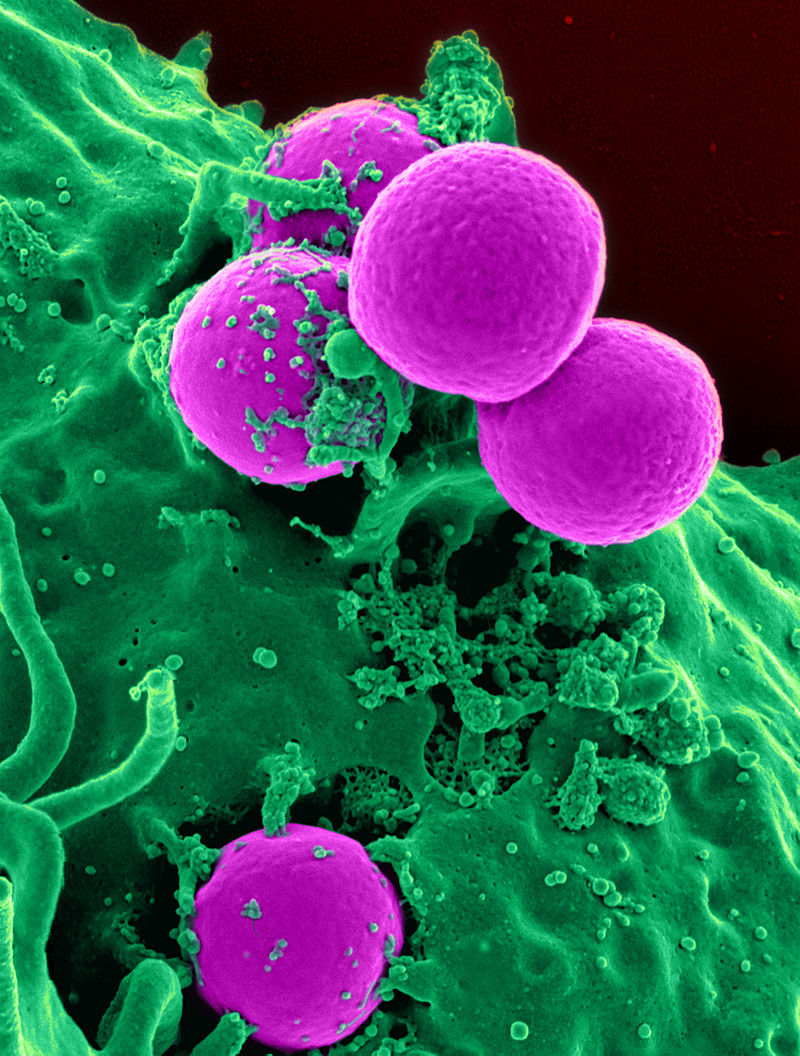
File:Human_neutrophil_ingesting_MRSA.jpg · Wikimedia Commons · See Wikimedia Commons
methicillin-resistant Staphylococcus aureus
Sign in to saveAlso known as MRSA
bacterium responsible for difficult-to-treat infections in humans
Research
47,064 papers- Methicillin-Resistant Staphylococcus aureus: Molecular Characterization, Evolution, and Epidemiology.Clinical microbiology reviews · 2018
- Methicillin-Resistant Staphylococcus aureus Infection and Treatment Options.Methods in molecular biology (Clifton, N.J.) · 2020
- Methicillin-resistant Staphylococcus aureus.Nature reviews. Disease primers · 2018
- Methicillin resistant Staphylococcus aureus: A brief review of virulence and resistance.JPMA. The Journal of the Pakistan Medical Association · 2022
- Methicillin-resistant Staphylococcus aureus in food and the prevalence in Brazil: a review.Brazilian journal of microbiology : [publication of the Brazilian Society for Microbiology] · 2020
via PubMed
Wikidata facts
- Subclass of
- Staphylococcus aureus
- Image
- MRSA7820.jpg
Show 2 more facts
- Commons category
- Methicillin-resistant Staphylococcus aureus
via Wikidata · CC0
~40 min read
Encyclopedic overview
Colorized scanning electron micrograph of a human neutrophil ingesting MRSA Methicillin-resistant Staphylococcus aureus (MRSA) is a group of Staphylococcus aureus strains that are resistant to β-lactam antibiotics. The β-lactam group is a broad-spectrum group of antibiotics that includes several widely used drugs, including methicillin, oxacillin, and cephalosporins. Therefore, MRSA is responsible for several difficult-to-treat infections in humans. It caused more than 100,000 deaths worldwide attributable to antimicrobial resistance in 2019. Strains unable to resist these antibiotics are classified as methicillin-susceptible S. aureus, or MSSA.
MRSA infection is common in hospitals, prisons, and nursing homes, where people with open wounds, invasive devices such as catheters, and weakened immune systems are at greater risk of healthcare-associated infection. MRSA began as a hospital-acquired infection but has become community-acquired, as well as livestock-acquired. The terms HA-MRSA (healthcare-associated or hospital-acquired MRSA), CA-MRSA (community-associated MRSA), and LA-MRSA (livestock-associated MRSA) reflect this.
Excerpted from Wikipedia’s “methicillin-resistant Staphylococcus aureus” article, available under the CC BY-SA 4.0 licence.