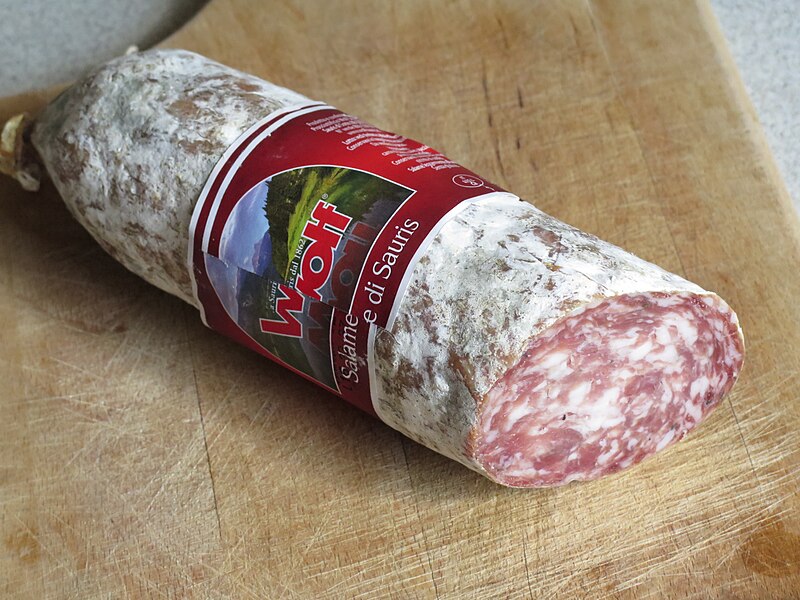
File:Salame_di_Sauris.jpg · Wikimedia Commons · See Wikimedia Commons
salami
Sign in to saveSalami ( ; : salame) is a salume consisting of fermented and air-dried meat, typically pork. Historically, salami was popular among Southern, Eastern, and Central European peasants because it could be stored at room temperature for a period of time once cut, supplementing a potentially meager or inconsistent supply of fresh meat. Countries and regions across Europe make their own traditional varieties of salami.
Salami is a type of cured meat made from fermented and air-dried pork that can be stored at room temperature after being cut. It became an important food for peasants in Southern, Eastern, and Central Europe because it provided a reliable source of protein when fresh meat was scarce or unpredictable, and today different European countries and regions have their own traditional varieties.
AI-generated from the Wikipedia summary — may contain errors.
Key facts
- Food.name
- Salami
- Food.image
- Salame di Sauris.jpg
- Food.caption
- Salame di Sauris
- Food.alternate_name
- Salame (Italian singular form)
- Food.country
- Italy
- Food.type
- Sausage
- Food.main_ingredient
- Fermented and air-dried pork
via Wikipedia infobox
Nutrition · Open Food Facts
Typical values per 100 g · averaged across 1,655 products
- Energy
- 352 kcal
- Fat
- 27.9 g
- — of which saturates
- 10.7 g
- Carbohydrates
- 2.6 g
- — of which sugars
- 1 g
- Fibre
- 0.4 g
- Protein
- 22.2 g
- Salt
- 3.79 g
via Open Food Facts · ODbL
Wikidata facts
- Subclass of
- cold cut
- Part of
- Brazilian cuisine
- Has part
- pork
- Country of origin
- Italy
- Image
- Salami aka.jpg
Show 2 more facts
- Commons category
- Salami
- native label
- Salame
Sources (3)
via Wikidata · CC0
Article · Polski
Salami – rodzaj trwałej kiełbasy suchej i wędzonej, długodojrzewającej, wyróżniającej się skórką z białym nalotem pleśni z gatunku Penicillium i Aspergillus. Oryginalny wyrób pochodzi z Włoch (Mediolan, Bolonia), pierwotnie wytwarzany z mięsa oślego (salame di asino); obecnie wykorzystuje się także mięso wieprzowe, niekiedy wołowe. Jako niezbędny dodatek stosuje się drobno pokrajaną słoninę i mocne przyprawy (kardamon, ). Jako surowiec wykorzystywane bywa również mięso drobiowe, końskie lub z mózgu osła oraz dziczyzna. Nazwa wyrobu jest pochodną od rzeczownika sale (sól) i czasownika salare (solić). Różnorodne gatunki salami produkowane są obecnie we Włoszech, na Węgrzech, w Niemczech, a nawet we Francji, Hiszpanii i niektórych innych krajach. Węgierskie salami, łagodniejsze w smaku, znane jest przede wszystkim jako produkt dwóch renomowanych firm działających od drugiej połowy XIX wieku: (1883) z Segedyna i (1888); jakością nie ustępuje wyrobom włoskim. Spośród kiełbas salami zaliczana jest do najtrwalszych, a także najdroższych wędlin. Jej cienko pokrajane plasterki podawane są w charakterze przystawki bądź jako część wykwintnych kanapek.
Abstract from DBpedia / Wikipedia · CC BY-SA
Gallery (30)
Available in 63 languages
- Español
- Français
- Deutsch
- 中文
- 日本語
- Русский
- Português
- Italiano
- العربية
- Afrikaans
- Armenian
- Bahasa Indonesia
- Basque
- Bavarian
- be_x_old
- Belarusian
- Breton
- Bulgarian
Show 44 more
- Catalan
- Corsican
- Croatian
- Czech
- Danish
- Egyptian Arabic
- eml
- Esperanto
- Estonian
- Filipino
- Finnish
- Galician
- Georgian
- Greek
- Hebrew
- Hungarian
- Irish
- Javanese
- Kazakh
- Latin
- Latvian
- Luxembourgish
- Macedonian
- Malay
- Mazanderani
- Nederlands
- Norwegian
- Norwegian Nynorsk
- Polski
- Romanian
- Serbian
- simple
- Slovak
- Svenska
- Swahili
- Tiếng Việt
- Türkçe
- Ukrainian
- Urdu
- Waray
- zh_yue
- فارسی
- ไทย
- 한국어
via Wikidata sitelinks · CC0