Category
page 1Ottoman cuisine
.%20Leiden%20University%20Library%2C%20Collection%20A.%20P.%20H.%20Hotz.jpg)
kabab
Kebab ( , ), kebap, kabob (alternative North American spelling), kebob, or kabab (Hindi and Kashmiri spelling) is a variety of roasted meat dishes that originated in the Middle East.

halva

pilaf
Pilaf (), pilav, pilau or plov () is a rice dish, or in some regions, a wheat dish, whose recipe usually involves cooking in stock or broth, adding spices, and other ingredients such as vegetables and meat, and employing some technique for achieving cooked grains that do not adhere.
.JPG)
baklava
Baklava (, or ) is a layered pastry dessert made of filo pastry, filled with chopped nuts, and sweetened with either syrup or honey.

shawarma
Shawarma (; ) is a Middle Eastern dish that originated during the Ottoman Empire, consisting of meat that is cut into thin slices, stacked in an inverted cone, and roasted on a slow-turning vertical spit. Traditionally made with lamb or mutton, it may also be made with chicken, turkey meat, beef, falafel or veal. The surface of the rotisserie meat is routinely shaved off once it cooks and is ready to be served. Shawarma is a popular street food throughout the Arab world, Israel and the Greater Middle East.

moussaka
Moussaka (, , ; ) is an aubergine (eggplant)- or potato-based dish, often including ground meat, which is common in the Balkans and the Middle East, with many local and regional variations.
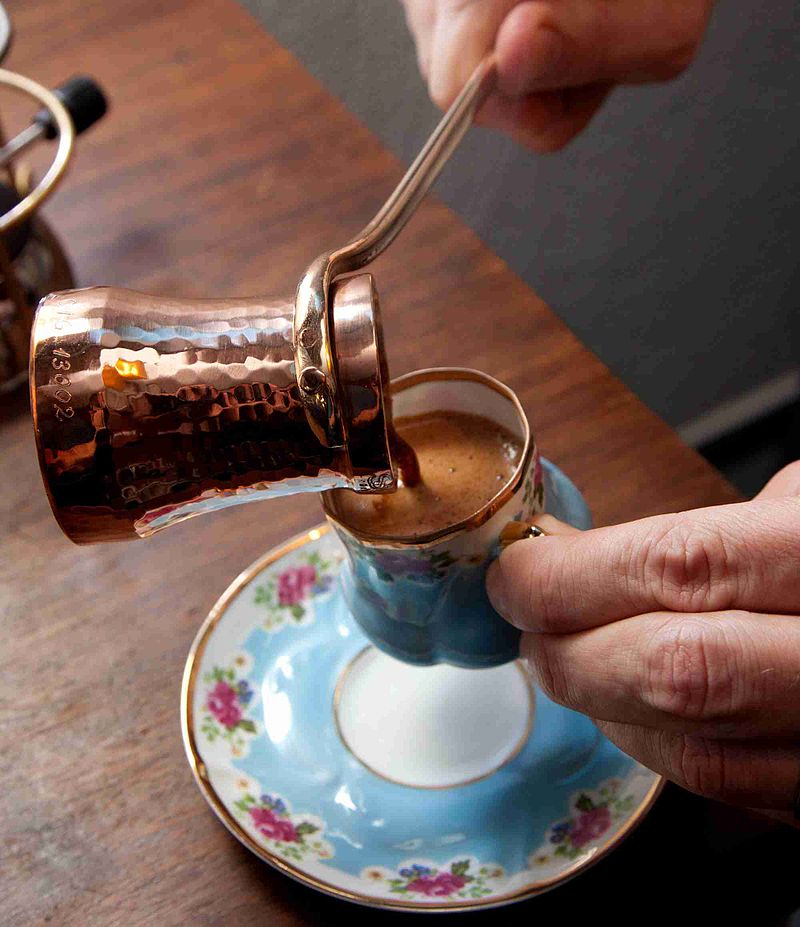
Turkish coffee
coffee brewing method originating from Turkey

dolma
Dolma is a family of stuffed dishes largely associated with Ottoman cuisine. It mainly includes vegetables and leaves, and occasionally seafood, offal, fruits, and meats, that are hollowed out or wrapped, then filled with a mixture of rice, minced meat, herbs, and spices. The leaf-wrapped type can be specifically known as sarma, but colloquially dolma is used for both.

börek
Börek (also burek or byrek) is a family of pastries or pies made in the Middle East and Southeast Europe. The pastry is made of a thin flaky dough such as filo with a variety of fillings, such as meat, cheese, spinach, or potatoes. A börek may be prepared in a large pan and cut into portions after baking, or as individual pastries. They are usually baked but some varieties can be fried. Börek is sometimes sprinkled with sesame or nigella seeds, and it can be served hot or cold.

shakshuka
thumb|Individual portion of shakshouka

boza
thumb|upright|Boza from Turkey
Boza, also bosa, is a fermented beverage originating from Central Asia and made in Turkey, Central Asia, the Caucasus, and North Africa. It is a malt drink made by fermenting various grains: millet, wheat (or bulgur) and maize (corn) in Turkey. It is one of the oldest Turkic beverages. It has a thick consistency, a low alcohol content (around 1%), and a slightly acidic sweet flavor.

sherbet
sweet drink

knafeh
Knafeh () is a traditional Arab dessert made with kadayif (spun pastry dough) layered with cheese and soaked in a sweet, sugar-based syrup called attar. Knafeh is popular throughout the Arab world, especially in Egypt, and the Levant. Knafeh is often served on special occasions, holidays and celebrating the month of Ramadan. The most common variant of knafeh in Jordan and Palestine, Knafeh Nabulseyeh, originated in the Palestinian city of Nablus.

compote
Compote or compôte (French for stewed fruit) is a dessert originating in medieval Europe, made of whole or pieces of fruit in sugar syrup. Whole fruits are cooked in water with sugar and spices. The syrup may be seasoned with vanilla, lemon or orange peel, cinnamon sticks or powder, cloves, other spices, ground almonds, grated coconut, candied fruit or raisins. The compote is served either warm or cold.

sujuk
Sujuk, sugou or sucuk (/suːˈd͡ʒʊk/) is a dry, spicy and fermented sausage which is consumed in several Anatolian, Balkan, Middle Eastern and Central Asian cuisines. Sujuk mainly consists of ground meat and animal fat usually obtained from beef or lamb, but beef is mainly used in Turkey, Egypt, Sudan, Armenia, Azerbaijan, Bosnia and Herzegovina, Albania, Georgia, Bulgaria, Kazakhstan, and Kyrgyzstan.
tulumba
Tulumba, tolomba or bamiyeh (; ) is a deep-fried dessert found in Egypt, the Levant, Greece and the regional cuisines of the former Ottoman Empire. It is a fried batter soaked in syrup, similar to jalebis or churros. It is made from unleavened choux pastry dough, usually about 3 inches long, piped with a pastry bag using an open star or similar tip. It is first deep-fried to golden colour and then sugar-sweet syrup is poured over it when still hot.
Imam Bayıldı
Turkish cold dish based on eggplants, onions and olive oil

simit
Simit is a circular bread, typically encrusted with sesame seeds or, less commonly, poppy, flax or sunflower seeds, found across the cuisines of the former Ottoman Empire and the Middle East, especially in Armenia, Turkey and the Balkans. Simit's size, crunch, chewiness, and other characteristics vary slightly by region.

pastırma
thumb|right|Pastirma

torshi
thumb|Turşu in Turkey
Torshi, tursu or turshi () are the pickled vegetables of many Middle Eastern, Caucasian, Slavic and Balkan cuisines.

basbousa
Basbousa () is a sweet, syrup-soaked semolina Arab dessert popular throughout the Arab world, Middle East and North Africa. The semolina batter is baked in a sheet pan, then sweetened with sugar syrup and typically cut into diamond (lozenge) shapes or squares.

Kokoretsi
Kokoretsi () or kokoreç is a dish of the Balkans and Anatolia (Asia Minor), consisting of lamb or goat intestines wrapped around seasoned offal, including sweetbreads, hearts, lungs, or kidneys, and typically grilled; a variant consists of chopped innards cooked on a griddle. The intestines of suckling lambs are preferred.

mehallabiyya
Muhallebi ( or ; ) is a milk pudding commonly made with rice, sugar, milk and either rice flour, starch or semolina, popular as a dessert in the Middle East. While the dessert is called muhallebi in Turkey, Iran, Iraq and Syria, in other countries in the region (Lebanon, Jordan, Egypt, Palestine, and Israel) it is called malabi, mahalabiyeh or mehalabiya.
shish kebab
skewered meat dish
keşkek
Keşkek, also known as kashkak, kashkek, or keške, is a ceremonial meat or chicken and wheat or barley stew found in Turkish, Iranian, Greek, Armenian, and Balkan cuisines.
sarma
cabbage, vine leaf, or other leaf roll
İskender kebap
Turkish meat dish (variety of "döner")
cuisine of the Ottoman Empire
cuisines of the Ottoman Empire
tavukgöğsü
Tavukgöğsü (, , 'chicken breast') is a Turkish milk pudding made with shredded chicken breast. It was served to Ottoman sultans in the Topkapı Palace, and is now a well-known dish in Turkey.
yahni
Yakhni (, , , , ), yahni (Turkish), or yahniya (, Serbian, ), jahni (Albanian), iahnie (Romanian) is a class of dishes traditionally prepared in a vast area encompassing South Asia, the Middle East and the Balkans. Generally, it is a stew of meat and vegetables.
Arnavut ciğeri
Turkish cold platter (meze) made of liver
stuffed squash
dish common in the former Ottoman Empire

hünkârbeğendi
thumb

Lakerda
thumb|250px|Lakerda steaks (center) at a store in Kapani (Agora Vlalì) Market, Thessaloniki.
rummaneyye
Rummaniyeh () is an Arab dish made from lentils and pomegranate juice. Its origins date back to at least the 10th century.
Khobz tounes
type of tunisian cake

Spoon sweets
Turkish Cypriot confectionary similar to murabba
Algerian baklawa
Balık çorbası
fish soup, Turkish style
mücver
Mücver is a Turkish fritter or pancake, made from grated zucchini (courgette). They are typically pan-fried in oil and their batter often includes a mixture of eggs, onion, dill, parsley, flour, and sometimes potatoes and cheese (beyaz peynir or kaşar). They are similar to Jewish latkes and potato pancakes from various cultures.
Tajine Lham-Lahlou
Algerian food
Circassian chicken
chicken dish from the Turkish cuisine
Dibile
Dibile or Dible () is a Turkish dessert (originating with the semi-nomadic Yörüks) from the area of İzmir, made of thin sheet-like dough. They are essentially the same as angel wings, except that they are dipped in syrup rather than served dry.
The dough is rolled into long, thin strips, fried and folded in hot oil and then dipped in a pekmez, sugar or honey syrup.
İskilip dolması
Turkish dish from İskilip, Çorum