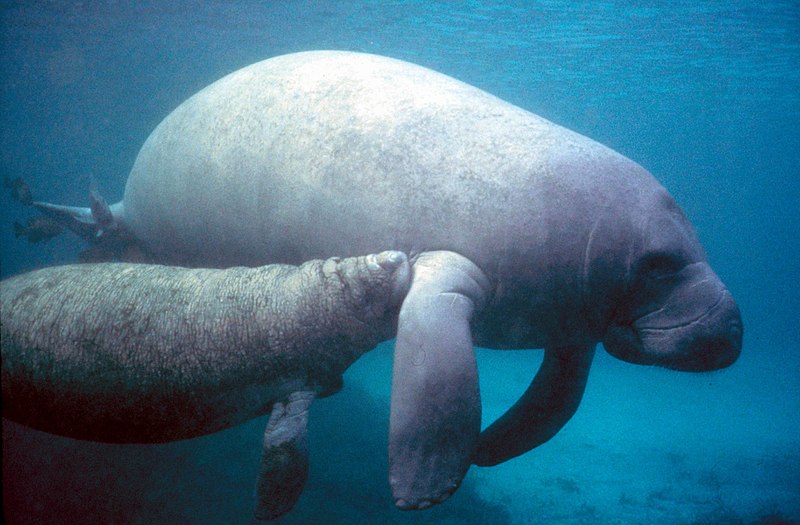
File:Manatee_with_calf.PD_-_colour_corrected.jpg · Wikimedia Commons · See Wikimedia Commons
West Indian manatee
Sign in to saveAlso known as Caribbean manatee, Trichechus manatus, Antillean manatee, manatee, American manatee
species of mammal
OverviewAI-generated
The West Indian manatee, scientifically known as *Trichechus manatus*, is a species within the family Trichechidae and order Sirenia. It belongs to the class Mammalia and phylum Chordata, with the taxon authority attributed to Linnaeus, 1758. The species is also referred to by common names such as Manati, Lamantin, and American Manatee. Its taxonomic status is accepted, and it is listed in Appendix I of CITES.
This marine mammal inhabits marine, brackish, and freshwater environments. It exhibits a cathemeral diel cycle and has a gestation period of 13. The IUCN conservation status for the West Indian manatee is Vulnerable. The taxon range is identified as Salvaterra.
Synthesized by Vinony from 27 facts across 4 sources: Wikidata, PubMed, WoRMS, Vinony graph. Generated from structured data (not the Wikipedia text) and checked against those facts — may still contain errors.
Species
West Indian manatee
Species
- PhylumChordata
- ClassMammalia
- OrderSirenia
- FamilyTrichechidae
Der Karibik- oder Nagel-Manati (Trichechus manatus) ist eine Seekuhart aus der Familie der Rundschwanzseekühe (Trichechidae). Inhaltsverzeichnis 1 Verbreitung 2 Lebensweise 3 Bestandsentwicklung 4 Einzelnachweise 5 Weblinks Verbreitung Der Karibik-Manati lebt an den Küsten des Golfs von Mexiko und der Karibik sowie an den Atlantikküsten Brasiliens und Venezuelas. Er lebt im flachen Küstenwasser und dringt oft in die Flüsse vor. In Südamerika schwamm ein Karibik-Manati 800 km ins Landesinnere. Umgekehrt wurde ein Tier einmal 15 km von der Küste entfernt auf dem Meer gefunden. Die Manatis wandern weit umher und erreichen dabei ausnahmsweise selbst die Atlantikküsten der USA – vor Virginia und Rhode Island wurden schon Karibik-Manatis gefangen und in den Golf von Mexiko zurückgebracht. Lebensweise Die Nahrungspflanzen sind vor allem Seegras im Salzwasser und Grundnesseln im Süßwasser, aber auch alle anderen Wasserpflanzen. Pro Tag frisst ein Manati etwa ein Viertel seines Körpergewichts. Manatikuh mit Kalb Karibik-Manatis sind einzelgängerische Tiere. Nur zwischen einer Kuh und ihrem Kalb herrscht eine engere Bindung. Zum Fressen oder Umherwandern tun sich manchmal mehrere Manatis zus
via
Research
330 papers- Vocalizations of wild West Indian manatee vary across subspecies and geographic location.Scientific reports · 2023
- Affinity of Staphylococcal a and Streptococcal G Proteins to West Indian Manatee ( Trichechus manatus manatus) Immunoglobulins.Journal of wildlife diseases · 2019
- Blood chemistry of the West Indian manatee (Trichechus manatus).Journal of wildlife diseases · 1982
- Metal and metalloid maternal transfer in a newborn West Indian manatee (Trichechus manatus) two years after the northeastern oil spill disaster of 2019 in Brazil.Marine pollution bulletin · 2024
- TLR4 and TLR8 variability in Amazonian and West Indian manatee species from Brazil.Genetics and molecular biology · 2021
via PubMed
Wikidata facts
- Instance of
- taxon
- Parent taxon
- Trichechus
- Image
- Manatee.jpg
Show 13 more facts
- taxon rank
- species
- IUCN conservation status
- Vulnerable
- Commons category
- Trichechus manatus
- taxon name
- Trichechus manatus
- Commons gallery
- Trichechus manatus
- taxon common name
- lamantino dei Caraibi
- gestation period
- 13
- CITES Appendix
- Appendix I of CITES
- sequenced genome URL
- www.dnazoo.org/assemblies/Trichechus_manatus
- diel cycle
- cathemeral
- short name
- T. manatus
- described by source
- New International Encyclopedia
- taxon range
- Salvaterra
via Wikidata · CC0
~29 min read
Encyclopedic overview
The West Indian manatee (Trichechus manatus), also known as the North American manatee, is a large, aquatic mammal native to warm coastal areas of the Caribbean, from the Eastern United States to northern Brazil. Living alone or in herds, it feeds on underwater plants and uses its whiskers to navigate. It is divided into two subspecies, the Florida manatee (T. m. latirostris) in the United States and the Antillean manatee (T. m. manatus) in the Caribbean, both of which are endangered and face pressure from habitat loss, pollution, and other human activity. The West Indian manatee is the largest living member of the sirenians (order Sirenia), a group of large aquatic mammals that includes the dugong, other manatees, and the extinct Steller's sea cow.
Manatees are herbivores, have developed vocal communication abilities, and are covered in highly sensitive whiskers (called vibrissae) that are used for feeding and navigation. In breeding season, several males form mating herds around an individual female; on average, one calf is born to a female manatee every two to three years.
Excerpted from Wikipedia’s “West Indian manatee” article, available under the CC BY-SA 4.0 licence.