Category
page 1Peripheral membrane proteins
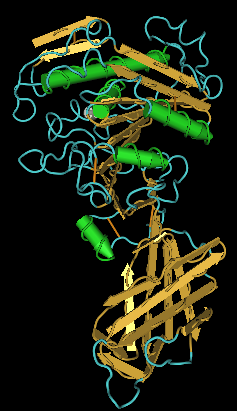
lipases
Lipase is a class of enzymes that catalyzes the hydrolysis of fats. Some lipases display broad substrate scope including esters of cholesterol, phospholipids, and of lipid-soluble vitamins and sphingomyelinases; however, these are usually treated separately from "conventional" lipases. Unlike esterases, which function in water, lipases "are activated only when adsorbed to an oil–water interface". Lipases perform essential roles in digestion, transport and processing of dietary lipids in most, if not all, organisms.

Coagulation factor II, thrombin
thumb|360px|alt=Schematic diagram of the blood coagulation and protein C pathways. In the blood coagulation pathway, thrombin acts to convert factor XI to XIa, VIII to VIIIa V to Va, fibrinogen to fibrin. In addition, thrombin promotes platelet activation and aggregation via activation of protease-activated receptors on the cell membrane of the platelet. Thrombin also cross over into the protein C pathway by converting protein C into APC. APC in turn converts factor V into Vi, and VIIIa into VIIIi. Finally APC activates PAR-1 and EPCR.|Role of thrombin in the blood coagulation cascade
G protein
type of proteins
cytochrome c, somatic
mammalian protein found in Homo sapiens

clathrin complex
Clathrin is a protein that plays a role in the formation of coated vesicles. Clathrin was first isolated by Barbara Pearse in 1976. It forms a triskelion shape composed of three clathrin heavy chains and three light chains. When the triskelia interact they form a polyhedral lattice that surrounds the vesicle. The protein's name refers to this lattice structure, deriving from Latin clathri, meaning lattice. Barbara Pearse named the protein clathrin at the suggestion of Graeme Mitchison, selecting it from three possible options. Coat-proteins, like clathrin, are used to build small vesicles in o
coagulation factor VII
mammalian protein found in Homo sapiens

(2R)-daptomycin
Daptomycin, sold under the brand name Cubicin among others, is a lipopeptide antibiotic used in the treatment of systemic and life-threatening infections caused by Gram-positive organisms.
coagulation factor IX
mammalian protein found in Homo sapiens
cholinesterase
The enzyme cholinesterase (EC 3.1.1.8, choline esterase; systematic name acylcholine acylhydrolase) catalyses the hydrolysis of choline-based esters, several of which serve as neurotransmitters.:
Protein C, inactivator of coagulation factors Va and VIIIa
mammalian protein found in Homo sapiens
nisin
Nisin is a polycyclic antibacterial peptide produced by the bacterium Lactococcus lactis that is used as a food preservative. It has 34 amino acid residues, including the uncommon amino acids lanthionine (Lan), methyllanthionine (MeLan), didehydroalanine (Dha), and didehydroaminobutyric acid (Dhb). These unusual amino acids are introduced by posttranslational modification of the precursor peptide. In these reactions a ribosomally synthesized 57-mer is converted to the final peptide. The unsaturated amino acids originate from serine and threonine, and the enzyme-catalysed addition of cysteine r
enterotoxin
An enterotoxin is a protein exotoxin released by a microorganism that targets the intestines. They can be chromosomally or plasmid encoded. They are heat labile (> 60 °C), of low molecular weight and water-soluble. Enterotoxins are frequently cytotoxic and kill cells by altering the apical membrane permeability of the mucosal (epithelial) cells of the intestinal wall. They are mostly pore-forming toxins (mostly chloride pores), secreted by bacteria, that assemble to form pores in cell membranes. This causes the cells to die.

phospholipase
thumb|right|Phospholipase cleavage sites. An enzyme that displays both PLA1 and PLA2 activities is called a phospholipase B.
antimicrobial peptide
class of peptides that have antimicrobial activity
.svg)
Synuclein alpha
Alpha-synuclein (aSyn) is a protein that in humans is encoded by the SNCA gene. It is a neuronal protein involved in the regulation of synaptic vesicle trafficking and the release of neurotransmitters.

lipoxygenases
Lipoxygenases () (LOX) are a family of (non-heme) iron-containing enzymes, more specifically oxidative enzymes, most of which catalyze the dioxygenation of polyunsaturated fatty acids in lipids containing a cis,cis-1,4-pentadiene into cell signaling agents that serve diverse roles as autocrine signals that regulate the function of their parent cells, paracrine signals that regulate the function of nearby cells, and endocrine signals that regulate the function of distant cells.

glycosyltransferases
thumb|Most glycosyltransferase enzymes form one of two folds: GT-A or GT-B
Glycosyltransferases (GTFs, Gtfs) are enzymes (EC 2.4) that establish natural glycosidic linkages. They catalyze the transfer of saccharide moieties from an activated nucleotide sugar (also known as the "glycosyl donor") to a nucleophilic glycosyl acceptor molecule, the nucleophile of which can be oxygen- carbon-, nitrogen-, or sulfur-based.

BCL2 apoptosis regulator
Bcl-2, encoded in humans by the BCL2 gene, is the founding member of the Bcl-2 family of regulator proteins. BCL2 blocks programmed cell death (apoptosis) while other BCL2 family members can either inhibit or induce it. It was the first apoptosis regulator identified in any organism.
Phosphatase and tensin homolog
tumor suppressor gene
phospholipase A2
InterPro Family
diphtheria toxin
exotoxin

prenylation
thumb|Skeletal formula of the prenyl group.Prenylation (also known as isoprenylation or lipidation) is the addition of hydrophobic molecules to a protein or a biomolecule. It is usually assumed that prenyl groups (3-methylbut-2-en-1-yl) facilitate attachment to cell membranes, similar to lipid anchors like the GPI anchor, though direct evidence of this has not been observed. Prenyl groups (also called isoprenyl groups, having one hydrogen atom more than isoprene) have been shown to be important for protein–protein binding through specialized prenyl-binding domains.
peripheral membrane protein
membrane proteins that adhere temporarily to membranes with which they are associated
Prostaglandin-endoperoxide synthase 1
Cyclooxygenase 1 (COX-1), also known as prostaglandin-endoperoxide synthase 1 (HUGO PTGS1), is an enzyme that in humans is encoded by the PTGS1 gene. In humans it is one of three cyclooxygenases. Clinically, COX-1 is notable as the target enzyme for aspirin.

Ferrochelatase
Protoporphyrin ferrochelatase (EC 4.98.1.1, formerly EC 4.99.1.1, or ferrochelatase; systematic name protoheme ferro-lyase (protoporphyrin-forming)) is an enzyme encoded by the FECH gene in humans. Ferrochelatase catalyses the eighth and terminal step in the biosynthesis of heme, converting protoporphyrin IX into heme B. It catalyses the reaction:
conotoxin
A conotoxin is one of a group of neurotoxic peptides isolated from the venom of the marine cone snail, genus Conus.

ankyrin
Ankyrins are a family of proteins that mediate the attachment of integral membrane proteins to the spectrin-actin based membrane cytoskeleton. Ankyrins have binding sites for the beta subunit of spectrin and at least 12 families of integral membrane proteins. This linkage is required to maintain the integrity of the plasma membranes and to anchor specific ion channels, ion exchangers and ion transporters in the plasma membrane. The name is derived from the Greek word ἄγκυρα (ankyra) for "anchor".
NADPH oxidase complex
enzyme complex of which the core is a heterodimer composed of a light (alpha) and heavy (beta) chain, and requires several other water-soluble proteins of cytosolic origin for activity
SH2 domain
InterPro Domain
arachidonate 5-lipoxygenase
class of enzymes
iron-sulfur protein
class of proteins in which iron is coordinated with cysteine sulfur and also with inorganic sulfur
aspartate protease
class of enzymes

Vinculin
thumb|Vinculin is a globular protein approximately 115 x 85 x 65 angstroms in linear dimension.
In mammalian cells, vinculin is a membrane-cytoskeletal protein in focal adhesion plaques that is involved in linkage of integrin adhesion molecules to the actin cytoskeleton. Vinculin is a cytoskeletal protein associated with cell-cell and cell-matrix junctions, where it is thought to function as one of several interacting proteins involved in anchoring F-actin to the membrane.

myelin basic protein
mammalian protein found in Homo sapiens
neurofibromin 2
mammalian protein found in Homo sapiens
phospholipase D
class of enzymes
heterotrimeric G protein
class of enzymes
Lipase C, hepatic type
mammalian protein found in Homo sapiens

palmitoylation
thumb|300px|right|In palmitoylation, a palmitoyl group (derived from palmitic acid, pictured above) is added.
thumb|Palmitoylation of a cysteine residue
thumb|Left Palmitoylation (red) anchors Ankyrin G to the plasma membrane. Right Close up. Palmityl residue in yellow.
thumb|Palmitoylation of Gephyrin Controls Receptor Clustering and Plasticity of GABAergic Synapses
Bruton's tyrosine kinase
mammalian protein found in Homo sapiens
colicin
A colicin is a type of bacteriocin produced by and toxic to some strains of Escherichia coli. Colicins are released into the environment to reduce competition from other bacterial strains. Colicins bind to outer membrane receptors, using them to translocate to the cytoplasm or cytoplasmic membrane, where they exert their cytotoxic effect, including depolarisation of the cytoplasmic membrane, DNase activity, RNase activity, or inhibition of murein synthesis.
annexin
Annexin is a common name for a group of cellular proteins. They are mostly found in eukaryotic organisms (animals, plants and fungi).
cytolysin
Cytolysin refers to the substance secreted by microorganisms, plants or animals that is specifically toxic to individual cells, in many cases causing their dissolution through lysis. Cytolysins that have a specific action for certain cells are named accordingly. For instance, the cytolysins responsible for the destruction of red blood cells, thereby liberating hemoglobins, are named hemolysins, and so on. Cytolysins may be involved in immunity as well as in venoms.
vitellogenins
kringle
InterPro Domain
GNAS complex locus
mammalian protein found in Homo sapiens
phospholipase A1
mammalian protein found in Homo sapiens
G-protein alpha subunit, group Q
family of heterotrimeric G protein alpha subunits
rab GTP-binding proteins
large family of GTP-binding proteins that play a role in cellular secretory and endocytic pathways
Small GTPase
class of enzymes
G-protein alpha subunit, group I
InterPro Family
AP-type membrane coat adaptor complex
Any of several heterotetrameric complexes that link clathrin (or another coat-forming molecule, as hypothesized for AP-3 and AP-4) to a membrane surface; they are found on coated pits and coated vesicles, and mediate sorting of cargo proteins into ve
arrestin
Arrestins (abbreviated Arr) are a small family of proteins important for regulating signal transduction at G protein-coupled receptors.
Arrestins were first discovered in the late '80s as a part of a conserved two-step mechanism for regulating the activity of G protein-coupled receptors (GPCRs) in the visual rhodopsin system by Hermann Kühn, Scott Hall, and Ursula Wilden and in the β-adrenergic system by Martin J. Lohse and co-workers.
cyclic peptide
peptide chains which contain a circular sequence of bonds
dihydroorotate dehydrogenase
class of enzymes
ANXA5
protein-coding gene in the species Homo sapiens
insect toxin
protein toxins produced by insect species
Braun's lipoprotein
InterPro Family
SYN2
protein-coding gene in the species Homo sapiens
retinol binding proteins
proteins binding with retinol