Category
page 1Nucleobases

adenine
Adenine (symbol A, or Ade) is a purine nucleotide base that is found in DNA, RNA, and ATP. Usually a white crystalline subtance. The shape of adenine is complementary and pairs to either thymine in DNA or uracil in RNA. In cells adenine, as an independent molecule, is rare. It is almost always covalently bound to become a part of a larger biomolecule.

cytosine
Cytosine (symbol C or Cyt) is one of the four nucleotide bases found in DNA and RNA, along with adenine, guanine, and thymine (uracil in RNA). It is a pyrimidine derivative, with a heterocyclic aromatic ring and two substituents attached (an amine group at position 4 and a keto group at position 2). The nucleoside of cytosine is cytidine. In Watson–Crick base pairing, it forms three hydrogen bonds with guanine.

guanine
Guanine () (symbol G or Gua) is one of the four main nucleotide bases found in the nucleic acids DNA and RNA, the others being adenine, cytosine, and thymine (uracil in RNA). In DNA, guanine is paired with cytosine. The guanine nucleoside is called guanosine.
.svg)
thymine
Thymine () (symbol T or Thy) is one of the four nucleotide bases in the nucleic acid of DNA that are represented by the letters G–C–A–T. The others are adenine, guanine, and cytosine. Thymine is also known as 5-methyluracil, a pyrimidine nucleobase. In RNA, thymine is replaced by the nucleobase uracil. Thymine was first isolated in 1893 by Albrecht Kossel and Albert Neumann from calf thymus glands, hence its name.

uracil
Uracil () (symbol U or Ura) is one of the four nucleotide bases in the nucleic acid RNA. The others are adenine (A), cytosine (C), and guanine (G). In RNA, uracil binds to adenine via two hydrogen bonds. In DNA, the uracil nucleobase is replaced by thymine (T). Uracil is a demethylated form of thymine.
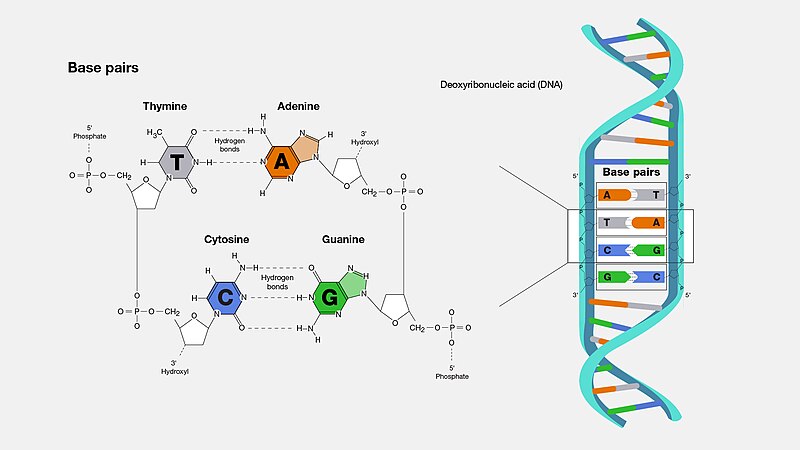
base pair
unit consisting of two nucleobases bound to each other by hydrogen bonds: either adenine–thymine or guanine–cytosine in natural DNA (additional types occur in RNA)
nucleotide base
nitrogen-containing biological compounds that form nucleosides
hypoxanthine
Hypoxanthine is a naturally occurring purine derivative. It is occasionally found as a constituent of nucleic acids, where it is present in the anticodon of tRNA in the form of its nucleoside inosine. It has a tautomer known as 6-hydroxypurine. Hypoxanthine is a necessary additive in certain cells, bacteria, and parasite cultures as a substrate and nitrogen source. For example, it is commonly a required reagent in malaria parasite cultures, since Plasmodium falciparum requires a source of hypoxanthine for nucleic acid synthesis and energy metabolism.
fluorouracil
Fluorouracil (5-FU, 5-fluorouracil), sold under the brand name Adrucil among others, is a cytotoxic chemotherapy medication used to treat cancer. By intravenous injection it is used for treatment of colorectal cancer, oesophageal cancer, stomach cancer, pancreatic cancer, breast cancer, and cervical cancer. As a cream it is used for actinic keratosis, basal cell carcinoma, and skin warts.

propylthiouracil
Propylthiouracil (PTU) is a medication used to treat hyperthyroidism. This includes hyperthyroidism due to Graves' disease and toxic multinodular goiter. In a thyrotoxic crisis it is generally more effective than methimazole. Otherwise it is typically only used when methimazole, surgery, and radioactive iodine is not possible. It is taken by mouth.
6-thioguanine
Tioguanine, also known as thioguanine or 6-thioguanine (6-TG) , sold under the brand name Tabloid among others, is a medication used to treat acute myeloid leukemia (AML), acute lymphocytic leukemia (ALL), and chronic myeloid leukemia (CML). Long-term use is not recommended. It is given by mouth.
5-fluorocytosine
Flucytosine, also known as 5-fluorocytosine (5-FC), is an antifungal medication. It is specifically used, together with amphotericin B, for serious Candida infections and cryptococcosis. It may be used by itself or with other antifungals for chromomycosis. Flucytosine is used by mouth and by injection into a vein.

5-methylcytosine
5-Methylcytosine (5mC, m5C) is a methylated form of the DNA base cytosine (C) that regulates gene transcription and takes several other biological roles. When cytosine is methylated, the DNA maintains the same sequence, but the expression of methylated genes can be altered (the study of this is part of the field of epigenetics). 5-Methylcytosine is incorporated in the nucleoside 5-methylcytidine.
5-(hydroxymethyl)cytosine
5-Hydroxymethylcytosine (5hmC) is a DNA pyrimidine nitrogen base derived from cytosine. It is potentially important in epigenetics, because the hydroxymethyl group on the cytosine can possibly switch a gene on and off. It was first seen in bacteriophages in 1952. However, in 2009 it was found to be abundant in human and mouse brains, as well as in embryonic stem cells. In mammals, it can be generated by oxidation of 5-methylcytosine, a reaction mediated by TET enzymes.
dihydrouracil
Dihydrouracil is an intermediate in the catabolism of uracil. The enzyme dihydrouracil dehydrogenase (NAD+) converts uracil to dihydrouracil:

isoguanine
Isoguanine or 2-hydroxyadenine is a purine base that is an isomer of guanine. The nucleoside form is called isoguanosine (iG).
2,6-diaminopurine
2,6-diaminopurine (2,6-DAP, also known as 2-aminoadenine, standard IUPAC symbol n2A) is a compound once used in the treatment of leukemia. It is found instead of adenine (A) in the genetic material of some bacteriophage viruses,
2-aminopurine
2-Aminopurine (2AP), a purine analog of guanine and adenine, is a fluorescent molecular marker used in nucleic acid research. It most commonly pairs with thymine as an adenine-analogue. It uses a different ketone oxygen on thymine for H-bonding and forms a stronger bond.
isocytosine
Isocytosine or 2-aminouracil is a pyrimidine base that is an isomer of cytosine. The nucleoside form is called isocytidine (iC).
dihydrothymine
Dihydrothymine is an intermediate in the metabolism of thymine. The enzyme dihydrouracil dehydrogenase (NAD+) converts thymine to dihydrothymine in the reaction:

2-Thiouracil
2-Thiouracil is a chemical derivative of uracil in which the oxygen atom in the 2-position of the ring is substituted by sulfur. It is classified as a thiourea.
bromouracil
5-Bromouracil (5-BrU, 5BrUra, or br5Ura) is a brominated derivative of uracil that acts as an antimetabolite or base analog, substituting for thymine in DNA, and can induce DNA mutation in the same way as 2-aminopurine. It is used mainly as an experimental mutagen, but its deoxyriboside derivative (5-bromo-2-deoxy-uridine) is used to treat neoplasms.
2,4-diaminopyrimidine
2,4-Diaminopyrimidine is an organic compound with the formula . It is the parent of one isomer of the diaminopyrimidines. Such compounds are structurally related to folic acid and the basis of much medicinal chemistry including the drug pyrimethamine.
6-methoxyguanine
'6-O-Methylguanine' is a derivative of the nucleobase guanine in which a methyl group is attached to the oxygen atom. It base-pairs to thymine rather than cytosine, causing a G:C to A:T transition in DNA.
queuine
Queuine () (Q) is a hypermodified nucleobase found in the first (or wobble) position of the anticodon of tRNAs specific for Asn, Asp, His, and Tyr, in most eukaryotes and prokaryotes. Because it is utilized by all eukaryotes but produced exclusively by bacteria, it is a putative vitamin.
methylthiouracil
Methylthiouracil is an organosulfur compound that is used antithyroid preparation. It is a thioamide, closely related to propylthiouracil. Methylthiouracil is not used clinically in the United States, it has a similar mechanism of action and side effect to that of propylthiouricil. The drug acts to decrease the formation of stored thyroid hormone, as thyroglobulin in the thyroid gland. The clinical effects of the drug to treat the hyperthyroid state can have a lag period of up to two weeks, depending on the stores of thyroglobulin and other factors.
benzylthiouracil
Benzylthiouracil (BTU) is an antithyroid preparation. It is a thioamide, closely related to propylthiouracil.
4-Thiouracil
4-Thiouracil is a heterocyclic organic compound having a pyrimidine skeleton. It is a derivative of the nucleobase uracil with a sulfur instead of oxygen in position 4. It is found naturally in the 4-thiouridine nucleoside.
6-amino-5-nitropyridin-2-one
6-Amino-5-nitropyridin-2-one or 6-amino-5-nitro-2(1H)-pyridinone is a pyridine base. It is used as a nucleobase of hachimoji DNA, in which it pairs with 5-aza-7-deazaguanine.
base J
chemical compound
5-hydroxycytosine
5-Hydroxycytosine is an oxidized form of cytosine that is associated with an increased frequency of C to T transition mutations, with some C to G transversions. It does not distort the DNA molecule and is readily bypassed by replicative DNA polymerases.
5-Hydroxyuracil
5-Hydroxyuracil is an oxidized form of cytosine that is produced by the oxidative deamination of cytosines by reactive oxygen species. It does not distort the DNA molecule and is bypassed by replicative DNA polymerases. It can miscode for adenine and is potentially mutagenic.
1-methylcytosine
1-Methylcytosine (1mC) is a methylated form of the DNA base cytosine. The deoxyribonucleoside it forms is called '''N1-methyl-2'-deoxy-pseudocytidine''' (m1ΨdC).