Category
page 1Purines
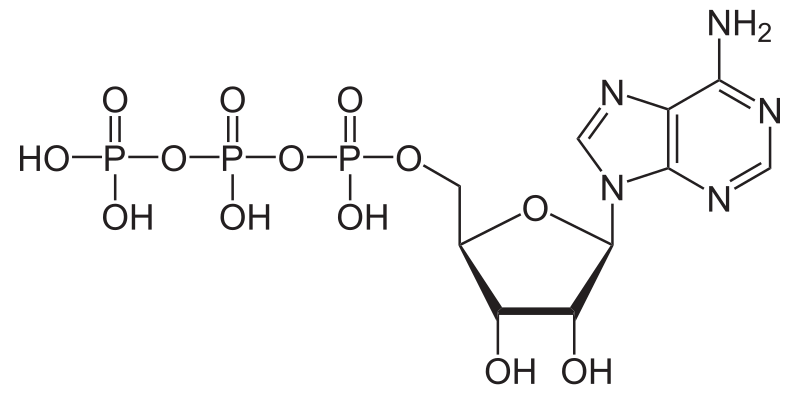
adenosine triphosphate
the energy-carrying molecule in living cells

adenine
Adenine (symbol A, or Ade) is a purine nucleotide base that is found in DNA, RNA, and ATP. Usually a white crystalline subtance. The shape of adenine is complementary and pairs to either thymine in DNA or uracil in RNA. In cells adenine, as an independent molecule, is rare. It is almost always covalently bound to become a part of a larger biomolecule.

guanine
Guanine () (symbol G or Gua) is one of the four main nucleotide bases found in the nucleic acids DNA and RNA, the others being adenine, cytosine, and thymine (uracil in RNA). In DNA, guanine is paired with cytosine. The guanine nucleoside is called guanosine.

purine
Purine is a heterocyclic aromatic organic compound that consists of two rings (pyrimidine and imidazole) fused together. It is water-soluble. Purine also gives its name to the wider class of molecules, purines, which include substituted purines and their tautomers. They are the most widely occurring nitrogen-containing heterocycles in nature.

adenosine
Adenosine (symbol A) is an organic compound that occurs widely in nature in the form of diverse derivatives. The molecule consists of an adenine attached to a ribose via a β-N9-glycosidic bond. Adenosine is one of the four nucleoside building blocks of RNA (and its derivative deoxyadenosine is a building block of DNA), which are essential for all life on Earth. Its derivatives include the energy carriers adenosine mono-, di-, and triphosphate, also known as AMP/ADP/ATP. Cyclic adenosine monophosphate (cAMP) is pervasive in signal transduction. Adenosine is used as an intravenous medication for

adenosine diphosphate
chemical compound

aciclovir

abacavir
Abacavir, sold under the brand name Ziagen among others, is a medication used to treat HIV/AIDS. Similar to other nucleoside analog reverse-transcriptase inhibitors (NRTIs), abacavir is used together with other HIV medications, and is not recommended by itself. It is taken by mouth as a tablet or solution and may be used in children over the age of three months.
guanosine triphosphate
chemical compound
adenosine monophosphate
chemical compound

guanosine
Guanosine (symbol G or Guo) is a purine nucleoside comprising guanine attached to a ribose (ribofuranose) ring via a β-N9-glycosidic bond. Guanosine can be phosphorylated to become guanosine monophosphate (GMP), cyclic guanosine monophosphate (cGMP), guanosine diphosphate (GDP), and guanosine triphosphate (GTP). These forms play important roles in various biochemical processes such as synthesis of nucleic acids and proteins, photosynthesis, muscle contraction, and intracellular signal transduction (cGMP). When guanine is attached by its N9 nitrogen to the C1 carbon of a deoxyribose ring it is
guanosine 5'-diphosphate (RRSR form)
chemical compound
hypoxanthine
Hypoxanthine is a naturally occurring purine derivative. It is occasionally found as a constituent of nucleic acids, where it is present in the anticodon of tRNA in the form of its nucleoside inosine. It has a tautomer known as 6-hydroxypurine. Hypoxanthine is a necessary additive in certain cells, bacteria, and parasite cultures as a substrate and nitrogen source. For example, it is commonly a required reagent in malaria parasite cultures, since Plasmodium falciparum requires a source of hypoxanthine for nucleic acid synthesis and energy metabolism.
tenofovir disoproxil
antiretroviral drug, used to treat or prevent HIV and hepatitis infections

azathioprine
Azathioprine, sold under the brand name Imuran, among others, is an immunosuppressive medication. It is used for the treatment of rheumatoid arthritis, granulomatosis with polyangiitis, Crohn's disease, ulcerative colitis, and systemic lupus erythematosus, and in kidney transplants to prevent rejection. It is listed by the International Agency for Research on Cancer as a group 1 human carcinogen. It is taken by mouth or injected into a vein.

inosine
Inosine is a nucleoside that is formed when hypoxanthine is attached to a ribose ring (also known as a ribofuranose) via a β-N9-glycosidic bond. It was discovered in 1965 in analysis of RNA transferase.
Inosine is commonly found in tRNAs and is essential for proper translation of the genetic code in wobble base pairs.
thumb|right|225px|Wobble base pairs for inosine and [[guanine]]
guanosine monophosphate
chemical compound
mercaptopurine
Mercaptopurine (6-MP), sold under the brand name Purinethol among others, is a medication used for cancer and autoimmune diseases. Specifically it is used to treat acute lymphocytic leukemia (ALL), acute promyelocytic leukemia (APL), Crohn's disease, and ulcerative colitis. For acute lymphocytic leukemia it is generally used with methotrexate. It is taken orally.

valacyclovir
Valaciclovir, also spelled valacyclovir, is an antiviral medication used to treat outbreaks of herpes simplex or herpes zoster (shingles). It is also used to prevent cytomegalovirus following a kidney transplant in high risk cases. It is taken by mouth.
ganciclovir
Ganciclovir, sold under the brand name Cytovene among others, is an antiviral medication used to treat cytomegalovirus (CMV) infections.
entecavir
Entecavir, sold under the brand name Baraclude, is an antiviral medication used in the treatment of hepatitis B virus infection. In those with both HIV/AIDS and hepatitis B virus antiretroviral medication should also be used. Entecavir is taken by mouth as a tablet or solution.
fludarabine phosphate
2'-deoxyadenosine
Deoxyadenosine (symbol dA or dAdo) is a deoxyribonucleoside. It is a derivative of the nucleoside adenosine, differing from the latter by the replacement of a hydroxyl group (-OH) by hydrogen (-H) at the 2′ position of its ribose sugar moiety. Deoxyadenosine is the DNA nucleoside A, which pairs with deoxythymidine (T) in double-stranded DNA.
6-thioguanine
Tioguanine, also known as thioguanine or 6-thioguanine (6-TG) , sold under the brand name Tabloid among others, is a medication used to treat acute myeloid leukemia (AML), acute lymphocytic leukemia (ALL), and chronic myeloid leukemia (CML). Long-term use is not recommended. It is given by mouth.
valganciclovir
Valganciclovir, sold under the brand name Valcyte among others, is an antiviral medication used to treat cytomegalovirus (CMV) infection in those with HIV/AIDS or following organ transplant. It is often used long term as it only suppresses rather than cures the infection. Valganciclovir is taken by mouth.
2'-deoxyguanosine
inosinic acid
chemical compound
famciclovir
Famciclovir is a guanosine analogue antiviral drug used for the treatment of various herpesvirus infections, most commonly for herpes zoster (shingles). It is a prodrug form of penciclovir with improved oral bioavailability. Famciclovir is marketed under the trade name Famvir (Novartis).
zeatin
Zeatin is a cytokinin derived from adenine, which occurs in the form of a cis- and a trans-isomer and conjugates. Zeatin was discovered in immature corn kernels from the genus Zea. It promotes growth of lateral buds and when sprayed on meristems stimulates cell division to produce bushier plants.
penciclovir
Penciclovir is a guanosine analogue antiviral medication used for the treatment of various herpesvirus infections. It is a nucleoside analogue which exhibits low toxicity and good selectivity. It is used as a topical treatment. It is sold under the brand name Denavir among others.
cladribine
Cladribine, sold under the brand name Leustatin, among others, is a medication used to treat hairy cell leukemia (formally named leukemic reticuloendotheliosis) and B-cell chronic lymphocytic leukemia. Cladribine, sold under the brand name Mavenclad, is used for the treatment of adults with highly active forms of relapsing-remitting multiple sclerosis.
didanosine
Didanosine, sold under the brand name Videx among others, is a medication used to treat HIV/AIDS. It is used in combination with other medications as part of highly active antiretroviral therapy (HAART). It is of the reverse-transcriptase inhibitor class.
pemetrexed
Pemetrexed, sold under the brand name Alimta among others, is a chemotherapy medication for the treatment of pleural mesothelioma and non-small cell lung cancer (NSCLC).
S-adenosyl-L-homocysteine
'''S-Adenosyl-L-homocysteine (SAH') is the biosynthetic precursor to homocysteine. SAH is formed by the demethylation of S''-adenosyl-L-methionine. Adenosylhomocysteinase converts SAH into homocysteine and adenosine.
nelarabine
Nelarabine, sold under the brand names Arranon (US) and Atriance (EU), is a chemotherapy medication used for the treatment of T-cell acute lymphoblastic leukemia (T-ALL) and T-cell lymphoblastic lymphoma (T-LBL).
adefovir
Adefovir is a prescription medicine used to treat (chronic) infections with hepatitis B virus. A prodrug form of adefovir was previously called bis-POM PMEA, with trade names Preveon and Hepsera. It is an orally administered nucleotide analog reverse-transcriptase inhibitor (ntRTI). It can be formulated as the pivoxil prodrug adefovir dipivoxil.

vidarabine
Vidarabine or 9-β-D-arabinofuranosyladenine (ara-A) is an antiviral drug which is active against herpes simplex and varicella zoster viruses.
deoxyguanosine diphosphate
chemical compound
dADP
chemical compound
7-methylguanosine
7-Methylguanosine (m7G) is a modified purine nucleoside. It is a methylated version of guanosine and when found in human urine, it may be a biomarker of some types of cancer. In the RNAs, 7-methylguanosine have been used to study and examine the reaction evolving methylguanosine. It also participates in the formation of 5'-cap that stabilizes mRNA and prevents its degradation by 5' exonucleases.

isoguanine
Isoguanine or 2-hydroxyadenine is a purine base that is an isomer of guanine. The nucleoside form is called isoguanosine (iG).

8-oxoguanine
8-Oxoguanine (8-hydroxyguanine, 8-oxo-Gua, or OH8Gua) is one of the most common DNA lesions resulting from reactive oxygen species modifying guanine, and can result in a mismatched pairing with adenine resulting in G to T and C to A substitutions in the genome. In humans, it is primarily repaired by DNA glycosylase OGG1. It can be caused by ionizing radiation, in connection with oxidative metabolism.
idelalisib
Idelalisib, sold under the brand name Zydelig, is a medication used to treat certain blood cancers. Idelalisib acts as a phosphoinositide 3-kinase inhibitor; more specifically, it blocks P110δ, the delta isoform of the enzyme phosphoinositide 3-kinase. It was developed by Gilead Sciences. It is taken orally (swallowed by mouth).
2-aminopurine
2-Aminopurine (2AP), a purine analog of guanine and adenine, is a fluorescent molecular marker used in nucleic acid research. It most commonly pairs with thymine as an adenine-analogue. It uses a different ketone oxygen on thymine for H-bonding and forms a stronger bond.
2,6-diaminopurine
2,6-diaminopurine (2,6-DAP, also known as 2-aminoadenine, standard IUPAC symbol n2A) is a compound once used in the treatment of leukemia. It is found instead of adenine (A) in the genetic material of some bacteriophage viruses,
8-oxo-2'-deoxyguanosine
'''8-Oxo-2'-deoxyguanosine (8-oxo-dG''') is an oxidized derivative of deoxyguanosine. 8-Oxo-dG is one of the major products of DNA oxidation. Concentrations of 8-oxo-dG within a cell are a measurement of oxidative stress.

5-hydroxyisouric acid
5-Hydroxyisourate is an organic compound that is produced by the oxidation of uric acid. The conversion is a major pathway in the antioxidant properties of urate. The conversion is catalysed by urate oxidase.
thumb|left|602px|sequence of oxidation of ureate.
5-Hydroxyisourate rearranges to allantoin.
purine nucleotide metabolic process
The chemical reactions and pathways involving purine nucleotides
kinetin
Kinetin (/'kaɪnɪtɪn/) is a cytokinin-like synthetic plant hormone that promotes cell division in plants. Kinetin was originally isolated by Carlos O. Miller and Skoog et al. as a compound from autoclaved herring sperm DNA that had cell division-promoting activity. It was given the name kinetin because of its ability to induce cell division, provided that auxin was present in the medium. Kinetin is often used in plant tissue culture to induce callus formation (in conjunction with auxin) and regenerate shoot tissues from callus (with lower auxin concentration).
clofarabine
Clofarabine is a purine nucleoside antimetabolite marketed in the United States and Canada as Clolar. In Europe and Australia/New Zealand the product is marketed under the name Evoltra. It is FDA-approved for treating relapsed or refractory acute lymphoblastic leukaemia (ALL) in children after at least two other types of treatment have failed. Some investigations of effectiveness in cases of acute myeloid leukaemia (AML) and juvenile myelomonocytic leukaemia (JMML) have been carried out. Ongoing trials are assessing its efficacy for managing other cancers.
Purine analogue
class of antymetabolites for cytostatic chemotherapy
Regadenoson
Regadenoson, sold under the brand name Lexiscan among others, is an A2A adenosine receptor agonist that is a coronary vasodilator that is commonly used in pharmacologic stress testing. It produces hyperemia quickly and maintains it for a duration that is useful for radionuclide myocardial perfusion imaging. The selective nature of the drug makes it preferable to other stress agents such as adenosine, which are less selective and therefore cause more side-effects.

thiopurine
thumb|Thioguanine
thumb|Mercaptopurine
thumb|Azathioprine
Thiopurine is an analogue of a purine wherein a C=O/C-OH group has been replaced by a C=S/C-SH group. These organosulfur compounds are bioactive in beneficial and complicating manner. They interfere with purine biosynthesis. Thiopurine drugs antimetabolites widely used in the treatment of acute lymphoblastic leukemia, autoimmune disorders (e.g., Crohn's disease, rheumatoid arthritis), and organ transplant recipients. Azathioprine is a prodrug. 6-Mercaptopurine is substrate for three enzyme]]s: thiopurine methyltransferase (to give 6-met
2,8-Dihydroxyadenine
2,8-Dihydroxyadenine is a derivative of adenine which accumulates in 2,8 dihydroxy-adenine urolithiasis. The poorly soluble purine 2,8-dihydroxyadenine is excreted in the urine because of a deficiency in the adenine salvage enzyme adenine phosphoribosyltransferase. The defect is inherited as an autosomal recessive trait; the homozygous state is associated with high urinary levels of 2,8-dihydroxyadenine and with crystalluria, calculus formation, and potential nephrotoxicity. The condition primarily presents as renal obstructive disease, but some patients have presented with advanced kidney fai
seliciclib
Seliciclib (roscovitine or CYC202) is an experimental drug candidate in the family of pharmacological cyclin-dependent kinase (CDK) inhibitors that inhibit multiple enzyme targets including CDK2, CDK7 and CDK9, which alter the growth phase or state within the cell cycle of treated cells. Seliciclib is being developed by Cyclacel.
S-adenosylmethioninamine
'''S-Adenosylmethioninamine' is a substrate that is required for the biosynthesis of polyamines including spermidine, spermine, and thermospermine. It is produced by decarboxylation of S''-adenosyl methionine.
6-methoxyguanine
'6-O-Methylguanine' is a derivative of the nucleobase guanine in which a methyl group is attached to the oxygen atom. It base-pairs to thymine rather than cytosine, causing a G:C to A:T transition in DNA.
calcium 5'-inosinate
chemical compound
cyclopentyladenosine
'''N6-Cyclopentyladenosine (CPA''') is a drug which acts as a selective adenosine A1 receptor agonist. It has mainly cardiovascular effects with only subtle alterations of behavior. CPA is widely used in scientific research into the adenosine receptors and has been used to derive a large family of derivatives.
![guanosine 5'-[beta,gamma-imido]triphosphate thumbnail](https://pixabay.com/get/g521a2e712fbab9f237082910caa6bce5997ceb0327bd359f0aeab6832eb7f3c18192feeacf54b3e8be75f6b2a9861e1afe9d10f2e35f74c58e5d940eea4a1b9b_1280.jpg)
guanosine 5'-[beta,gamma-imido]triphosphate
chemical compound