Category
page 1Transcription factors
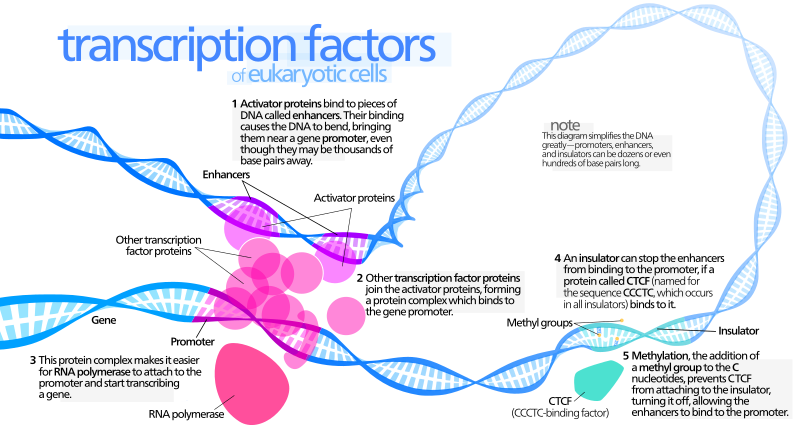
transcription factor
protein that binds to DNA and regulates gene expression by promoting or suppressing transcription
tumor protein p53
p53, also known as tumor protein p53, TP53, cellular tumor antigen p53 (UniProt name), or transformation-related protein 53 (TRP53) is a regulatory transcription factor protein that is often mutated in human cancers. The p53 proteins (originally thought to be, and often spoken of as, a single protein) are crucial in vertebrates, where they prevent cancer formation. As such, p53 has been described as "the guardian of the genome" because of its role in conserving stability by preventing genome mutation. Hence TP53 is classified as a tumor suppressor gene.
Sex determining region Y
mammalian protein found in Homo sapiens

NF-κB
450px|thumb|Mechanism of NF-κB action. The classic "canonical" NF-κB complex is a heterodimer of p50 and RelA, as shown. NF-κB waits for activation in the cytosol, complexed with the inhibitory protein IκBα. Various extracellular signals can enter the cell via membrane receptors and activate the enzyme [[IκB kinase (IKK). IKK, in turn, phosphorylates the IκBα protein, which results in ubiquitination, dissociation of IκBα from NF-κB, and eventual degradation of IκBα by the proteasome. The activated NF-κB is then translocated into the nucleus where it binds to specific sequences of DNA called re

homeobox
A homeobox is a DNA sequence, around 180 base pairs long, that regulates large-scale anatomical features in the early stages of embryonic development. Mutations in a homeobox may change large-scale anatomical features of the full-grown organism.

helix-turn-helix motif
200px|thumb|The λ repressor of bacteriophage lambda employs two helix-turn-helix motifs (left; green) to bind [[DNA (right; blue and red). The λ repressor protein in this image is a dimer.]]
RB transcriptional corepressor 1
mammalian protein found in Homo sapiens
PGR
protein-coding gene in the species Homo sapiens
activator
protein that increases transcription of a gene or set of genes
MYC proto-oncogene, bHLH transcription factor
Myc is a family of regulator genes and proto-oncogenes that code for transcription factors. The Myc family consists of three related human genes: c-myc (MYC), l-myc (MYCL), and n-myc (MYCN). c-myc (also sometimes referred to as MYC) was the first gene to be discovered in this family, due to homology with the viral gene v-myc.
hypoxia-inducible factor
family of protein complexes
JAK-STAT signaling pathway
biological signaling pathway
TBP
protein-coding gene in the species Homo sapiens
DNA-binding protein
proteins that have DNA-binding domains and thus have a specific or general affinity for single- or double-stranded DNA
PPARG
protein-coding gene in the species Homo sapiens
STAT3
Signal transducer and activator of transcription 3 (STAT3) is a transcription factor which in humans is encoded by the STAT3 gene. It is a member of the STAT protein family.
vitamin D receptor
mammalian protein found in Homo sapiens
general transcription factor
transcription factor that binds to any site or to a specific site on DNA to activate, moderate, regulate, or modulate transcription
STAT1
Signal transducer and activator of transcription 1 (STAT1) is a transcription factor which in humans is encoded by the STAT1 gene. It is a member of the STAT protein family.
Fos proto-oncogene, AP-1 transcription factor subunit
mammalian protein found in Homo sapiens

cAMP response element binding protein
alt=|thumb|200x200px|CREB (top) is a transcription factor capable of binding [[DNA (bottom) and regulating gene expression.]]
CREB-TF (CREB, cAMP response element-binding protein) is a cellular transcription factor. It binds to certain DNA sequences called cAMP response elements (CRE), thereby increasing or decreasing the transcription of the genes. CREB was first described in 1987 as a cAMP-responsive transcription factor regulating the somatostatin gene.

E2F family
E2F is a group of genes that encodes a family of transcription factors (TF) in higher eukaryotes. Three of them are activators: E2F1, 2 and E2F3a. Six others act as repressors: E2F3b, E2F4-8. All of them are involved in the cell cycle regulation and synthesis of DNA in mammalian cells. E2Fs as TFs bind to the TTTCCCGC (or slight variations of this sequence) consensus binding site in the target promoter sequence.
Autoimmune regulator
mammalian protein found in Homo sapiens
SRY-box transcription factor 2
SRY (sex determining region Y)-box 2, also known as SOX2, is a transcription factor that is essential for maintaining self-renewal, or pluripotency, of undifferentiated embryonic stem cells. Sox2 has a critical role in maintenance of embryonic and neural stem cells.
aryl hydrocarbon receptor
mammalian protein found in Homo sapiens
NR1H4
protein-coding gene in the species Homo sapiens
RARA
protein-coding gene in the species Homo sapiens
retinoic acid receptor
InterPro Family
ATF6
Activating transcription factor 6, also known as ATF6, is a protein that, in humans, is encoded by the ATF6 gene and is involved in the unfolded protein response.

transcription factor STAT
InterPro Family
SOX9
Transcription factor SOX-9 is a protein that in humans is encoded by the SOX9 gene.
RARB
protein-coding gene in the species Homo sapiens

High mobility group box 1
High mobility group box 1 protein, also known as high-mobility group protein 1 (HMG-1) and amphoterin, is a protein that in humans is encoded by the HMGB1 gene.

SMAD family member 4
SMAD4, also called SMAD family member 4, Mothers against decapentaplegic homolog 4, or DPC4 (deleted in pancreatic cancer 4) is a highly conserved protein present in all metazoans. It belongs to the SMAD family of transcription factor proteins, which act as mediators of TGF-β signal transduction. The TGFβ family of cytokines regulates critical processes during the lifecycle of metazoans, with important roles during embryo development, tissue homeostasis, regeneration, and immune regulation.
FOSB
Protein fosB, also known as FosB and G0/G1 switch regulatory protein 3 (G0S3), is a protein that in humans is encoded by the FBJ murine osteosarcoma viral oncogene homolog B (FOSB) gene.
serum response factor
mammalian protein found in Homo sapiens

Activating transcription factor 4
Activating transcription factor 4 (tax-responsive enhancer element B67), also known as ATF4, is a protein that in humans is encoded by the ATF4 gene.
ARID1A
AT-rich interactive domain-containing protein 1A is a protein that in humans is encoded by the ARID1A gene.

KMT2A
'Histone-lysine N-methyltransferase 2A, also known as acute lymphoblastic leukemia 1 (ALL-1), myeloid/lymphoid or mixed-lineage leukemia 1 (MLL1), or zinc finger protein HRX (HRX), is an enzyme that in humans is encoded by the KMT2A''''' gene.
ESR2
protein-coding gene in the species Homo sapiens
Nanog homeobox
transcriptional factor that helps embryonic stem cells maintain pluripotency by suppressing cell determination factors
Paired domain
InterPro Domain
STAT2
Signal transducer and activator of transcription 2 is a protein that in humans is encoded by the STAT2 gene. It is a member of the STAT protein family. This protein is critical to the biological response of type I interferons (IFNs). It functions as a transcription factor downstream of type I interferons. STAT2 sequence identity between mouse and human is only 68%.
retinoid X receptor
protein family

CTCF
Transcriptional repressor CTCF also known as 11-zinc finger protein or CCCTC-binding factor is a transcription factor that in humans is encoded by the CTCF gene. CTCF is involved in many cellular processes, including transcriptional regulation, insulator activity, V(D)J recombination and regulation of chromatin architecture.
AP-1 [nucleoplasm]
instance of defined set in Homo sapiens with Reactome ID (R-HSA-6806560)
MECP2
MECP2 (methyl CpG binding protein 2) is a gene that encodes the protein MECP2. MECP2 appears to be essential for the normal function of nerve cells. The protein seems to be particularly important for mature nerve cells, where it is present in high levels. The MECP2 protein is likely to be involved in turning off ("repressing" or "silencing") several other genes. This prevents the genes from making proteins when they are not needed. Recent work has shown that MECP2 can also activate other genes. The MECP2 gene is located on the long (q) arm of the X chromosome in band 28 ("Xq28"), from base pai
GATA1
GATA-binding factor 1 or GATA-1 (also termed Erythroid transcription factor) is the founding member of the GATA family of transcription factors. This protein is widely expressed throughout vertebrate species. In humans and mice, it is encoded by the GATA1 and Gata1 genes, respectively. These genes are located on the X chromosome in both species.
SPI1
Transcription factor PU.1 is a protein that in humans is encoded by the SPI1 gene.
SMAD protein
intracellular proteins
IRF5
Interferon regulatory factor 5 is a protein that in humans is encoded by the IRF5 gene. The IRF family is a group of transcription factors that are involved in signaling for virus responses in mammals along with regulation of certain cellular functions.
STAT6
Signal transducer and activator of transcription 6 (STAT6) is a transcription factor that belongs to the Signal Transducer and Activator of Transcription (STAT) family of proteins. The proteins of STAT family transmit signals from a receptor complex to the nucleus and activate gene expression. Similarly as other STAT family proteins, STAT6 is also activated by growth factors and cytokines. STAT6 is mainly activated by cytokines interleukin-4 and interleukin-13.
sterol regulatory element-binding protein
protein family
E2F1
Transcription factor E2F1 is a protein that in humans is encoded by the E2F1 gene.
SMAD7
Mothers against decapentaplegic homolog 7 or SMAD7 is a protein that in humans is encoded by the SMAD7 gene.
CEBPB
CCAAT/enhancer-binding protein beta is a protein that in humans is encoded by the CEBPB gene.
STAT4
Signal transducer and activator of transcription 4 (STAT4) is a transcription factor belonging to the STAT protein family, composed of STAT1, STAT2, STAT3, STAT4, STAT5A, STAT5B, STAT6. STAT proteins are key activators of gene transcription which bind to DNA in response to cytokine gradient. STAT proteins are a common part of Janus kinase (JAK)- signalling pathways, activated by cytokines.STAT4 is required for the development of Th1 cells from naive CD4+ T cells and IFN-γ production in response to IL-12. There are two known STAT4 transcripts, STAT4α and STAT4β, differing in the levels of inter
PPARD
protein-coding gene in the species Homo sapiens
TBXT
protein-coding gene in the species Homo sapiens
OLIG2
Oligodendrocyte transcription factor (OLIG2) is a basic helix-loop-helix (bHLH) transcription factor encoded by the OLIG2 gene. The protein is of 329 amino acids in length, 32 kDa in size and contains one basic helix-loop-helix DNA-binding domain. It is one of the three members of the bHLH family. The other two members are OLIG1 and OLIG3. The expression of OLIG2 is mostly restricted in central nervous system, where it acts as both an anti-neurigenic and a neurigenic factor at different stages of development. OLIG2 is well known for determining motor neuron and oligodendrocyte differentiation,